Showing posts with label marking. Show all posts

Move over SPaG, MATH is on the scene

I am writing this following our event Opportunities for FE English and maths #FEconnect cutt.ly/FEmathsEng. We opened the day with a discussion between Jonny Kay (https://twitter.com/jonnykayteacher) and myself guided by Lou Mycroft (https://twitter.com/LouMycroft). During the discussion I suggested a whole college marking policy for maths. Most likely colleges have one for SPaG but possibly not maths. Why not?

We spend a lot of time in FE, and we used to in schools when I was in them, trying to put English and maths front and centre. Jonny and I argued that co teaching and collaboration should happen across disciplines in colleges. If Pythagoras is being taught in the vocational area, maths staff need to share how they would teach it and a consistent approach to be taken across the college. We carefully craft policies for every eventuality and we may even have a maths marking policy and code, but what do we do in our day to day tasks to support the development of maths?

I remember maths stairs being a necessity, an equation revealed or a fact to be recalled as you ascend. Yet when the same students answers maths problems in hair and beauty there was no consistent maths marking to help build connections to the maths qualification they were studying. SPaG policies and marking codes are almost a given, common currency transferable between institutions. If you arrive at a new school or college you can guess 'SP' probably means spelling mistake in work maybe even '//' is new paragraph. This currency of whole college and school marking has become the norm for English. Some have moved away and things will always shift though.

In researching this blog post I lost hours on an image search of whole school marking policy. Lots of // and SP and P. All familiar to me. One post I read said that the marking policy must be printed in size A1 in the classroom so that all teachers adhere to it! I remember in my NQT re-marking a set of books that I had marked in the wrong shade of green and I was terrified my mentor would tell me off. They didn't; but they did point out that my students were using the wrong coloured pens for reflections. I'm not proposing maths teachers head down this route, but a more unified marking code may help bring maths out in other areas more to be celebrated.

The EEF found that there was little difference of impact of teacher using coded Vs non-coded marking, as long as students knew what the codes meant. https://educationendowmentfoundation.org.uk/evidence-summaries/evidence-reviews/written-marking/. They suggested that time can be saved for teacher in using coded marking. Maybe this is why SPaG took off, everyone has or had one, each with a nuance for their institution.

What I can't let go of though is a maths code. I know in primary I have seen some use of maths marking codes in my local area. I haven't seen it in secondary (granted not visited very secondary school around and would love to be shown successful examples). In colleges I haven't seen it either. Again if you are successfully using a maths marking code please share your experiences, I am keen to learn.

I often say we are the double glazing sales people of education as maths teachers. Everyone needs windows but they are reluctant to pay (put the effort in) for them. I know this is a generalisation, though, but I hope that you get my meaning. We are on the back foot from the beginning. We talk a lot about embedding maths in other subjects. Julia Smith (https://twitter.com/tessmaths) (on our podcast e-m-booth.site) suggests that my embedding maths we are pushing it down and squeezing it in. Julia suggests we should be enhancing out maths in other subjects. I think she is on to something.

In vocational subjects that tokenistic embedding of maths can happen. 

"When we look at graphs of data maths will be embedded in this unit of work."

Great, graphs, perfect! What I always say is, ask that next question. What does the data tell you? What would happen if the outliers were removed from the sample? What percentage of success can you assume from this data? Whenever I talk about embedding (or enhancing) maths I want staff to ask that extra question. Conversely, those not taking a tokenistic approach maybe actually teaching units that involve serious calculations. Think about the calculations needed in electrical engineering or motor vehicle or catering. These calculations will be being taught in colleges, but then we may encounter another conflict. The methods chosen might not be the methods used by the maths department. Who has checked for consistency of message? Who is looking out for the interests of the students here? Imagine being taught ratio one way by your vocational tutor (I have 4 ratio methods that my students regularly come to class with from school!) and the next day being taught it another way by your maths tutor? This could easily happen. Consistency is key.

Move over SPaG MATH is on the scene.


M - clear method used
A - accuracy in the stages of calculation
T - task met
H - Work is set out in a clear, legible manner.

Anytime there is maths being used in work, this code can be applied. In vocational subjects that have maths, in study skills sessions that cover maths, in maths lessons. There can be a consistent message. Adding in here for progression from functional skills to GCSE, consistent message is also key to supporting students in feeling settled. This MATH message suggested is also consistent to GCSE and functional skills marking codes as well.


GCSE and functional skills maths have coded marking too. M for method is common currency as is A for accuracy. The setting out of work is key skill we, as maths teachers, push. The examiner wants to award marks (trust me I examine for an awarding body) but only if they can follow the working out. High standards of the setting out of work is not only a great study skill; it is important when submitting work to be marked externally, which probably isn't just happening in students' maths subject but in their vocational subject also.


The time saved by teachers in marking using a code, as the EEF (ref above) found, is worth considering. Time saving, wherever found, should be explored. The MATH marking code, as I suggest, may save time and deliver a more consistent student experience. I would also include the movement to a coded policy could enhance the student experience further as it moves away from tick and flick. 

A tick at the end of the work doesn't tell a student what was good. Likewise a X at the end doesn't explain what or where they went wrong. I would love feedback to be given to inform students on every piece of work but we have to be mindful of teacher workload. I'm not going to stray into the difficulties in students receiving quality feedback, that might be another blog. A coded policy may be a handy bridge between tick and flick to full feedback, whilst also bringing focus on maths across all subject areas too.

[ALT lattice method multiplication for 24 x 37 with answer 888 marked using MATH code M+ A- T+ H-]


In this example, the method and answer are correct but the setting out of work is wrong. There is no 24 x 37 = 888 but task met has been awarded as we can imply that is what was meant by the student. The method chosen hasn't been accurately applied, the 24 should have been where 88 is and 888 should arrive on the left hand side. I have indicated where the high standards also applies with the formation of 2 in 28. This may seem harsh to non maths specialists but these are the margins that can cause grades to change. Exam papers are scanned into a computer system to be externally marked for GCSE. Clarity is a key skill required. Opinions on this are all valid but these are the facts and the job of the maths teacher is to prepare students for their final exam, as it stands.


This is a paint mixing example from motor vehicle. Here the method is sound but there are errors in following through with numbers so A is not awarded. It is nearly set out and so H is awarded but the task hasn't been met as the final answer is incorrect and T isn't given. I can vision student reflecting on this and seeing that they have made mistakes within their working out using this code and seeking further guidance, or a teacher initiated discussion around the errors. The code is not the end of the journey but hopefully a consistent and speedy way to promote maths and high standards across colleges.


[ALT 4(x-5)=44 answered and marked using MATH code M+ A- T- H-]

In this example the method is sound, there is accuracy throughout until the final stage which has meant the final answer is incorrect. H wasn't awarded as there is a mis-alignment of the expanded bracket and the =44. 

I think M sits well, is there a sound method being used? A, is the student accurate in their application of the chosen method? T, have they answered the question that the teacher set them correctly? H, does the work read easily?

I have tried, unsuccessfully at a college previously, to embed this marking code. The college had a whole college numeracy marking code and didn't want to change. That code wasn't used by staff, it wasn't reviewed, it wasn't on A1 printouts on the walls (maybe that's where it fell down?) And it was a full page long. It had numeracy, processing, shape all included. For example, of drawing shapes must be done with a ruler. That awarded the [] mark on the code. 0 indicated correct order of digits. You get the idea. It was lengthy and not shared regularly, most importantly it wasn't led from the front. Was it a policy to grab if OfSTED asked if they had one maybe?

What I'm suggesting here is a brief whole college marking code. Wherever calculations are used they are marked the same way. Consistency of message aligned to GCSE and functional skills maths marking codes. But it must be led, it can't be assumed others will follow it, maths needs pushing to the top of the agenda! If college resit results are to improve, something has to change. If you have a SPaG marking code do you have a maths one too? I would love to know more, is it commonly used, is it equally used as much as SPaG?

And if you don't maybe you might consider applying my MATH example?

Context whole links included to be more accessible rather than hyperlinked behind a word of text. I am a consultant to colleges on their teaching and learning, EdTech and embedding of maths; whilst still teaching GCSE maths in an FE college.

M 0 method, A accuracy, T task met, H high standards


Angles in parallel lines


I have to admit that this is not a topic I am personally brilliant at. Every time as a department we did a mock paper there would always be a heightened anxiety I had if there was an angles in parallel lines question on the paper. I am not great at spotting F and Z angles. I struggled with it at school. I was taught it as F and Z angles and they’re no longer allowed as descriptions! It’s just not my kind of topic, I have a brain that means I have to work harder with shape space and measure topics! I have some great lessons to demonstrate alternate and corresponding angles and I heavily rely on these to be clear in my demonstrations. I have to admit in my early years of teaching I had my fingers crossed that all the students would get on board with it and there wouldn’t be many questions! As the years have gone on I am more confident to field the questions that learners have on the topic but I can’t help but empathise with those learners that just don’t get it!

Have you ever sat in a training session thinking, nope no idea where this is going, what time is lunch? You can see that look on learners' faces sometimes and I see it more often than not in angles on parallel lines. One year I had a learner who was in a bridging provision, not quite an alternative provision but not a mainstream school placement, she just couldn’t grasp angles in parallel lines. I went back to teaching angles on a straight line and recapped that. She turned and looked at me and said “yeah what’s that got to do with this stuff though?” and I thought, oh yeah she’s right! It made me think. What is the best way to sequence angles on parallel lines? I wasn’t sure I had it right? I went back to the exam boards scheme of work. I then checked another exam boards scheme of work and both indicated angles in polygons and angle facts on lines were the building blocks to angles in parallel lines. So yes, what did it have to do with this new topic of angles in parallel lines?

I questioned myself. I know it is 2 sets of lines and angles facts but why do I teach it as an abstract standalone topic? Was it because of my previous lack of knowledge in the topic? Was I projecting my fears onto my learners? So being brave and taking the risk with my next group of learners I taught angle facts on straight lines and around a point then in the lesson on angles in parallel lines I left it as a challenge for them to calculate missing angle values in parallel lines. Unsurprisingly with their existing knowledge they were able to answer the problems. Obviously their reasons weren’t alternate and corresponding angles but their numerical value answers were correct. I then taught my usual lessons edited a bit so that we covered the reasons for parallel lines in the following lesson.

Now I teach GCSE resit to 16+ learners. I teach 16-18 and 19+ learners and as you can imagine both groups require different approaches. I find that 19+ often crave the knowledge for perfect answers and will tackle angles in parallel lines with greater ease than 16-18 learners. 16-18 learners have sat the exam already, if not more than once. They have seen angles in parallel lines in many forms already, they’ve learnt F and Z to help them remember but then had that crutch taken away and ‘should’ know how to calculate missing angles in parallel lines with reasons. However they haven’t achieved a grade 4 and have to sit the exam again and what if they still ‘can’t’ calculate angles in parallel lines? So I now teach it as 2 sets of angles on a straight line problem and that the angles repeat. For example:

When you look at the mark scheme, the majority of the marks are for the numerical values, 

This is taken from Edexcel Foundation Paper 2 2018. ¾ marks are for numerical calculations. This example had an isosceles triangle included as well as parallel lines. I have now, almost, enjoyed teaching angles in parallel lines this way. I find that if their angle fact knowledge is secure I can introduce the labels on top for alternate and corresponding angles easier. 

You may not have the difficulties I had with angles on parallel lines, you may not even teach maths! My point is had I not been challenged with “but what does that have to do with this stuff though?” I would never have looked at my sequencing on the topic. Perhaps you have a topic that often falls flat in class? It may be worth re-evaluating your sequencing up to that point, does it make sense, almost ask yourself, yeah so what? Why am I teaching it this way? I don’t need to remind you if you are in education of the need for impact impact, IMPACT! If you taught it this way what would be the intended impact and if you taught it that way what would be the intended impact? What is the actual impact? Can you trial both ways? 

We must, as educators evaluate where we have been on the learning journey in order to guide our learners to their intended destination. We don’t often have the time or prioritise the time to undertake such evaluations but hopefully this post inspired you to take a moment and think? 

Circles, pi and Slido! The best lesson ever?

I'm not sure I should write this blog post but anyway! I taught for 3.5 hours 10 adults GCSE Foundation Maths where we looked at shape, space and measure topics. I had planned to do this lesson last week but due to a family emergency I was absent. As my class are adults I was nervous today that I may get a rough ride for the inconvenience of skipping out on them last week. Not true, they were wonderful. One lady said, "never apologise for putting your kids first". I thought, wow that's really powerful. I'm hoping to hold onto that when I am saying no to the million CPD lates I'm asked to do but I realistically can never deliver.


So I have to admit there was a very free and easy approach to my planning, I had a tonne of activities photocopied for a variety of SSM topics as I was out of sync with my scheme of work. I took a look and thought we will start with circles and see where we end up. We had just finished statistics and graphs as a topic a couple of weeks before so I quickly rustled up a retrieval grid on that, set that out as they arrived whilst I checked over my Google Slides presentation on circles. Just at that moment in walked 2 colleagues to do a peer observation. I have an open door policy. As an experienced teacher I feel it is my duty to offer an open door policy. Generally staff ask ahead of time out of courtesy if they can come in. I always reply with "come anytime, I won't be doing anything special" today's lesson couldn't have been more true! 


Off we go then with circles in Google Slides. I have my learning intentions displayed and I write them on my board with my keywords to remain for the whole lesson. I also write the date in words. I'm a bit of a stickler on this one as good habits help make better teachers I think. I was once taught by a head of department that if you write the date in words you are showing learners that there is a quick way to write the date but have pride and high standards and wrote it fully. I quite like writing it in words and it upsets me when it is missing from classroom boards and when it is written as 1/2/20 I always flash back to my old head of department. 


In the slides presentation I have inserted slido. Now Slido is a great polling tool that pops in really easily. It is an add-on to Google Slides (I am a Google Certified Trainer so most things I do are in GSuite) I have used Pear Deck before but due to connectivity issues at the remote campus I find Slido works better. I break down the learning intentions by grade, a grade 3 student should be able to do this and a grade 5 student can do this. I give my class my same old speech: "if we teach to a 4 and we fall short we will get a 3 so no apologies I teach to a grade 5 to give you the best chance of achieving a 4." This is high expectations in its simplest form. The Slido then appears and the learners rate themselves out of 5 stars where they are against the grade 5 broken down intention. We get a split of ratings, and some questions about what a sector is. (The grade 5 intention was about calculating area of sectors!)


I begin with labelling parts of a circle. Reminding them of correct spelling. English isn't the first language for many learners, for some it's not even their second or third language. This takes some time and is dull. I am worried I am losing them. I planned to do a mini quiz on the parts of the circle and a card sort but the mood in the room is, we have notes, you will out this on Google Classroom so we have your notes too, what time is break? Picking up the pace I jump in with the circle song! You can watch the one I use here. I know there are others but this is my favourite and I encourage them to sing it to themselves in their exam!


Back to the lesson... I can then see joy at the song but confusion at pi. No surprise, who actually knows what pi is? I quickly grab the elastic bands from my photocopying and ask them to measure the diameter whilst a partner holds the band in a circle shape. I then cut the bands and ask them to measure the length of the chopped band. They then tell me that they are measuring the circumference and that is. We record the 2 measurements from each pair on the board and discover that the circumference is about 3 times bigger than the diameter. We then look at where pi is on our calculators. There is the inevitable conversation of borrowing calculators, we can debate high standards and correct equipment vs financial situation vs local demographic vs adult learners another time.


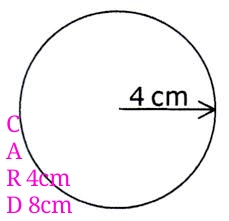
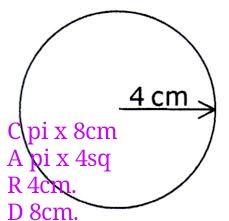
I then come away from the presentation and project some circles onto my board with varying measurements of radius and diameter. I then give the learners the option to go through area first and then circumference. I highlight that in my experience the thing people get wrong in this topic is doing the wrong one in the wrong question. Calculating area when they needed circumference. Or I give the learners the option of my default every time way. They choose my way. Everyone I see a circle I write CARD. We look at this example where we are asked to find the circumference of this circle:


The question gives us 4cm as a radius. We can write into CARD that R is 4cm and D is 8cm. Quickly singing pi r squared sounds like area to me… we can write in that the circumference would be pi x 8 and area would be pi x 4 squared. We then look back to the question and see what it asked us to calculate. In this case it was circumference so we circle that one and work it out. I like this method as it build solid repetition of the skill of recalling and applying the formulae. I also like it as it encourages the learner to reflect and choose is it area or circumference before diving in. 


In my class today the lower level group struggled to start but once CARD had been repeatedly applied they had rapid progression through the tasks. My top end learner decided his way was better and off he went. I always say, I don't care how you get here, just get here if you can. Meaning here is the correct answer! All the learners have access to the answers of all the tasks, they are marking as they go along. Suddenly my top end learner becomes frustrated. He has got most of the work wrong. I take a look and he has done the classic mistake of circumference when it wants area and vice versa. I remind him of CARD he gives it another go and signals to me 5 minutes later that he is being more successful now!


Whilst the learners are working I take 3 of them out one by one for a mini tutorial. They are my 3 at risk learners. I let them know I am putting in interventions for them and say that I believe with hard work they can improve. I am then taken aback realising my peer observers are with me in my final mini tutorial. I am mortified I left my class unattended with peer observers in the room. I apologise and my peers are great and they say, no we think it's brilliant you have taught them well enough to leave them for 5 minutes and these mini tutorials are equally important. I check on the class and they have all done a nice mix of area/circumference including semi circles and compound shapes. I give verbal feedback (should have written more down!) It's almost time for a break but not quite and I am just about to move on when one of the learners makes a safeguarding disclosure to me out of the class so I call a break for 10 minutes while I make notes and report it to my safeguarding lead. I bid farewell to my peers.


I grab 2 minutes to think about what we can do next. I had planned to do angles in parallel lines but I'm concerned that the secure circle knowledge is at risk if I go to angles. My other option is loci or bearings. I decide to go loci. I don't know why I don't teach loci particularly well. Actually it probably ranks as one of my worst lessons. I don't enjoy it and I struggle to visualise the boundaries of areas in the complex questions. Decision has been made now though, I am writing my new learning intentions up on the board before I remember how badly I teach loci!


We do a quick Slido to check our rating now on circles. Everyone has improved. We review the grade 3 and grade 5 learning intentions on loci and constructions and do another Slido, the class has no idea about the language of the topic. No one rates themselves higher than a 1. With a feeling of dread that this has been a poor decision we begin by drawing line and angle bisectors on blank pieces of paper. I demo them in my Slides presentation. (Someone years ago shared a nice demo where the compass moves and the arc appears, I would never have the time to make such a beautiful presentation so I am very grateful to still have it!) Cue difficulties with expanding compass widths in between arcs. Some are unable to keep their pencil in the compass. Some can't use the compass. I get round everyone improving their techniques I see no harm in spinning the paper rather than the compass if the learner struggles. We then take a look at some exam questions. They progress into not explicitly stating it is a line or an angle bisectors but a more worded question. All can do the explicit ones, most can do the more challenging ones. Progress is through skill repetition practise here.


I then put an x on the board (I have been rummaging in my bag for post it notes whilst they were working) and I ask each of them to put a post it note 20cm away from my x. They chat amongst themselves. Some want to do a line, someone twigs it would be a circle, then there's a competition on who can be accurate and exactly 20cm away. I am observing this active learning loving the conversation. I then demo a dog tied to a post would have a circle locus. Then a dog tied to a bar would have a running track shaped locus. (Handily there's a bar outside my window to help visualise) all are keen to get going and for some unknown reason I then decide to demo one of the complex garden planning questions. I draw a rectangle ABCD and ask them where I could put my path that is an equal distance from AB and CD. I start to get clammy I am about to jump in and answer my own question when one of the weaker learners contributes "would it be a line dissector?" We will skip over the incorrect language for now. I check the room and all are thinking the same. Another learner says "yeah this is fine but more than 5m away from the tree for the fountain that isn't any bisect or anything so what do we do there?" I am over joyed. The long phase about the path was because they had twigged that it was a line bisector and were struggling with the next part of the question. I demo an arc 5m from the tree and all are itching to get going. We do a quick Slido and no one rates themselves below a 4!


I circulate the room giving feedback. All have the answers so can tick and flick. I see little merit in me ticking and flicking their work. My role is to shape their learning journey and I do this through feedback not ticks and flicks. I can't believe it, everyone can do it! The lower level ones have some beautiful running track shaped around lines and even a running track around an L shape. The higher level ones are shading the correct regions in the town planning questions. One learner even attempts a create a shipping path question involving 5 elements. I look at the clock and 3.5 hours has gone! I pull them back for a final Slido, it stays the same. I recap our learning intentions and ask them to reflect in their fake iMessage sheets. See my blog post on feedback for these. They all thank me for a brilliant lesson.


I grab a cuppa and sit down to respond to their feedback iMessage sheets. Here are some of the responses:


"Why has no one shown me CARD before? Changed it all now"


"I will forget loci but I won't forget the lesson"


"Thank you it was epic, I learnt more than the last 4 years of studying for my GCSE"


I honestly think this was my best lesson ever. Yes I had pre planned presentations and my photocopying was ready but I made responsive decisions throughout and reflected on learner points. I don't think I did anything special, I certainly would never do anything special for a peer obs, and it all came good in the end. The peer observer emailed me a few weeks later and said she was trying Slido and some other bits she had seen me do, that is why I have an open door policy!


Google Forms

In my quest to be better at giving feedback I am willing to give anything a try! I make no apologies I am a Google Certified Trainer so Google is my thing. You can recreate this in Microsoft Forms I am sure but Google is what I know. I wanted my learners to go over what they had done wrong in an exam independently. I had a class of 30 with 3 papers to go through and a variety of questions answered incorrectly across the board. I decided to go down the route of Google Forms to get feedback and next steps all done in one lesson. 


I chose 3 key questions from each paper, 9 in total. I marked the papers at home, entered them into my analysis grid and chose my 9 questions that were fairly red on the analysis grid. I had in my mind a choose your own ending scenario, like the Goosebumps books from my childhood! The form starts with instructions, assumptions are the enemy of a teacher. The instructions ask the learner to have the 3 papers, some paper to make notes, headphones etc. Question 1 asks “Did you achieve 5 marks for question 14 on paper 1?” The options are yes or no. The question was 5 marks for drawing a pie chart and a comparison between a pie chart and a bar chart. If the student answers no on the Google Form it takes them to a video on You Tube (Corbett maths) covering drawing pie charts. This is achieved with the After This Section Move to (‘After section’) part of Google Forms. If a student did get 5 marks on the question the form would take them to another section with a video on interpreting pie charts. After those videos the learner is given a question on what they have watched on the video, the question self marks as it is written as a multiple choice. The learners are then reunited on the Google Form and it asks again about another of my 9 questions, again with a yes or a no route. 


There are a few things I learnt through this process. First 9 questions was too much and too long. The next time I used a Google Form for feedback I only chose 3 questions and it ran smoother. Second thing that I learnt was that learners will sit quite happily watching videos about the topics. I wanted a way to harness this and assess them more robustly during their peak engagement with the videos. I discovered EdPuzzle, you can read more about it my experiences with EdPuzzle in my next blog. Third thing that I learnt is learners enjoyed the experience and that they could go back over things at their own pace.


I am never a fan of doing something for the sake of it. At the time of writing this Esports is everywhere and I am yet to see the benefit to my learners so I am not on board, for now! A while back QR codes were everywhere, Every worksheet, poster, display and staircase, yes staircase! I was a little late to the QR code game, it took me a while to find a place that was meaningful for me and my learners! A really nice way I found was to use it in a feedback sheet. I took the idea that students liked watching videos and were willing to work at their own pace via this medium. I created a table with the 9 questions and added 2 QR codes. One linking the learner to the video drawing pie charts and the other QR code linking learners to the video on interpreting pie charts. The point of Google Forms and the QR code sheet is to engage the learner with taking next steps or guiding them to recover topics they need to look back over. Both ways were successful in this aim. Successful in students making progress?, I have no clear answer but we try these things and build on them, I am still building!


Another use of Google Forms I have used in maths is as mini assessments. I was tasked with reducing the marking workload of the maths teachers for a LARGE number maths learners. The team wanted a 30 minute assessment on the topics covered to far that was robust and akin to GCSE. I cut and paste images from Exam Wizard and Exam Pro (both exam boards were used so I ended up making 2 assessments!) I would then make 4 choices on a multiple choice question. I was fascinated by Mr Barton’s Diagnostic Questions and the idea that you can diagnose a misconception. An example would be an averages question asking for the median of a data set. Option 1 would be correct, option 2 would be the mode, option 3 would be the mean, option 4 would be the median but using unordered data. The aim being that if the learner chose the mode or the mean you can assume the learner doesn’t know the difference between the 4 types of averages. The learner who chooses option 4 knows the median is the middle value but forgot to order the data. They need teaching differently to the learner who can calculate averages correctly. One needs practise on the language of the question, the other needs to practise median. This is a very crude example but I hope I make my point.


In my 30 minute assessment using Google Forms I made all the questions multiple choice. I enjoyed finding misconceptions. Using the incorrect trigonometry ratio, listing a highest common factor when we were looking for a lowest common multiple, it was great fun! Once the responses are in the Google Form you can direct them to a Google Sheets. From here we can mark them correct or incorrect using IF formulas. We can then RAG rate the student’s work. Staff appreciated the reduced marking, but challenged the use of multiple choices. Ideally free text would have been better but I couldn’t see a way to mark it automatically this way. If the answer was vertically opposite angles are equal learners could have made spelling mistakes that would have been marked correct if the spelling was logical. In a later blog I will talk about Equatio, a potential solution to this.


The advantages of using Google Forms in this way was that we could batch upload student results to our student data system. When it came to assessment time again 6 weeks later we could see progress within the areas assessed. Problems arose when staff got ahead or fell behind the scheme of work. Students felt under prepared. Nothing will ever be perfect but we are making strides in the right direction. If this has peaked your interest and you want to know more about my use of Google Forms, please get in touch. My plan is to write an ebook at some point about them in great detail...


EdPuzzle

I moved into an Ed tech role 2 years ago. I am not an expert in ed tech and actually a lot of my maths lessons are dull and very non techy, I think that’s what makes my colleagues willing to listen to me when I come and show them some new glittery tech. I am acutely aware that time is precious. I am proud that I will only show staff a tech idea if I see a real benefit. It has been very unsuccessful when we have been asked to ‘push’ tech out to staff! I was reflecting on the Google Forms for Feedback using videos and thought, I need to assess them part way through these videos, otherwise we may end up with more misconceptions. I stumbled upon EdPuzzle.


EdPuzzle is fantastic, I am not ‘pushing’ it to you merely telling you the benefits it has given my learners and other staff’s groups. EdPuzzle allows you to insert questions into a video that you can either set as free text or multiple choice. In maths I use it inside Corbett maths videos. When Mr Corbett uses a GCSE question for a second example I will pause the video and insert a question using EdPuzzle. My learners enjoy it. They say it keeps them watching. It reminds them to make notes! I have tried it will my 16-18 learners who enjoy the speediness of it, they like that they have to do something rather than just watching the video. My adult learners, 19+ enjoy it because it gives them time to take in what has happened so far in the video. Here is a quote from a student who is in his late 60’s:

“It is hard to get the video to play but I like that it pauses it, I can think about what has gone before. I can watch some more and enjoy the explanation”


I take the point, it turned out that EdPuzzle when on an Apple iOs device needs the EdPuzzle app downloading rather than watching it in a browser. That part is hard to explain to students (and staff) that some need an app and others don’t. The power of the tool regardless of this initial barrier to accessing the tool makes it worthwhile. Once the learners have watched the video you can get a RAG rated sheet of their marks, timings etc. Evidence of progress over time as they work through tasks. You can lock videos down so that the learners can’t skip until they answer the question. Sometimes I enable this and sometimes I don’t depending on my group.


I knew the power of the tool and was slowly working my way into embedding it naturally in my lessons when I decided to share it with another department. I took it to the English as a second language, ESOL department. I demonstrated it to the staff, my hope was that the staff would see the benefit to them that their learners could listen to the English spoken language and then answer questions based on what they had heard. I was right, they loved it. One teacher took it to heart, it instantly became her go to method for assessing topics. She insisted on using her own videos rather than inserting questions into existing You Tube videos as I had been doing. The level of effort she put into this cannot be underestimated. 


What transpired was a brilliant display of dedication and commitment by this teacher to her ESOL learners. They could watch a video on their phone as they're were waiting for a bus and practise the language that they needed for the journey. The teacher had evidence of progress over time using the tracking produced by EdPuzzle. She could show starting points, hours spent learning and improvement in the quiz scores. In my lessons my learners felt that it brought Corbett maths to life. As brilliant as Hegarty maths is, the students appreciated a different voice and a different method of assessment. As I set it to multiple choice in the Corbettmaths videos, I didn't need to mark the work. I used misconceptions for my incorrect answers. See my post on misconceptions in my Google Forms blog. Then the video progressed and Mr Corbett answered the question in much more detail than I ever would so if the learners had misunderstood or made a mistake they could identify where they had gone wrong. Finally to end I would I sent another multiple choice question with an image of a GCSE exam question to see if there had been any progress. It looks a little like this: 


The video pauses before the second example by Mr Corbett. I have used the incorrect angle fact of angles on a straight line add up to 180o to give the incorrect options of 85 and 100 degrees. I have also listed 45o as an incorrect option to diagnose the misconception of opposite angles being equal applying here. The video then resumes after the learners answer the question and Mr Corbett goes through in great detail how and why the correct answer is 140o. I really like this as an independent learning assessment tool. I am all for something that gives learners independence, stretches them, reduces my workload and evidences progress, I think EdPuzzle is a great tool that hits this brief!


Equatio and Read & Write

I have sat for years listening to CPD that was absolutely brilliant with a voice in my head going "not possible in a maths classroom though. " I have tried to fight it, shushing my inner voice, willing things to be possible. But we have to hold our hands up and say maths is a different subject, we can't ask students to expand or share an opinion on someone else's correct answer. 

Imagine sitting in a CPD session on Read and Write from Texthelp. Read and Write can read aloud text to learners, look up words in a picture dictionary and allow learners to speak in and it types for them. (it does a LOT more but I'm trying not to waffle!) it's brilliant, what a powerful tool for our learners. Amazing. Now how do you embed that into a maths lesson? Possible, thankfully, but not a perfect fit. Can it read complex formulae or calculations? Does it have pictures in its dictionary for density? No? Boo! I was gutted when I first came across it. I thought, argh it's so close but it's still not for me. 

A short while later I was sat down again to be talked at, sorry I mean, I was sat down in a CPD session, and this time it was on Equatio. Which is a pain to blog about because Google thinks I mean Equation, so if Google auto corrects and I miss it I apologise, I am talking about Equatio! Hold on to your seats if you've not heard of Equatio before and if you are a maths or science teacher this will blow your mind!

Equatio is a toolbar that allows you to speak in maths work. You say 2x bracket x add 4 bracket and it will write 2x(x+4) with curly xs. Equatio will let you type in fractions and curly xs and all the other niggly things we battle with typing as maths teachers with ease. If you have a touchscreen device you can freehand your maths and it will type it up for you. Hurrah, at last we have something amazing for maths, whoop! I was so excited and got straight on it, fractions were now a breeze to write, my work sped up when I was writing questions and making resources. You can even put it in Google Forms and make quizzes! I mean come on, this is the dream folks!

Loving my new Equatio life I ingested their website. I watched video after video, became certified in Read and Write (Texthelp make both products, I am not paid by them for this post, this is not an ad, I'm not paid by anyone to blog, wish I was!) importantly I signed up to updates from Texthelp and their monthly webinar list. Some time later I was introduced to the mobile features of Equatio. Students can handwrite their working out, photograph it into Equatio and it will make it editable typed maths for them... Take a moment... Take that in. Happy dance!!!!!!! Equatio has and does a lot more but I might do another blog on the other bits later. 

Students prefer pen and paper for maths in my experience. Maybe it's because I teach resit and they have experienced that paper linear exam, I don't know. I know that I prefer paper when I am work things out, I always have a pen in my pony tail ready to go in class! Students like to show their working out, sometimes! I like those conversations where they have spent ages anwering a question incorrectly and you go through their working out together to spot where it went wrong. I dislike those conversations where they have spent ages working something out incorrectly and their working out cannot be followed and they cannot articulate what they were trying to do. Those conversations are the hardest, where you desperately want to help but you can't. I have always wanted a way to make students stop and check their work or at least check they are on the right track. I have tried setting timers to get them to practise pausing mid answer but generally they just lose their flow. I have tried building in check your answer time but mainly they stare into space. Anyway back to Equatio... 

It's become my new way of working, especially since lock down. Students snap their work and sent it to me all typed up. Yes they could just snap their work but sometimes I struggle with the shadows of their photos, or the clarity of their working out. This way Equatio does the quality check for me. If it can't read what the students have put (and its very good at reading, trust me I have tried all sorts of maths working out to try to catch it out!) then an examiner wouldn't be able to read what they have put. Equatio helps me promote high standards. Equatio saves me time and it saves me marking on paper, although that's not happening in the world anyway at the minute.

Since lock down I have wanted to stay connected with my learners. I have found that the Read and Write tools that I have ignored in my maths lessons have really become invaluable. It has a feature where you can make a 1 minute voice note. I have been able to give verbal feedback to my learners. I don't mind that it's 1 minute because if I'm talking for more than 1 minute to each learner I'm not being clear enough in my feedback. My learners have said they feel little difference in terms of marking and being in the classroom, they can still hear my voice. 

I am so overjoyed that finally I have something that is invaluable and it is maths specific and maths focused. I feel like we can truly support learners remotely now, which is more important than ever. We have accessibility and maths speak all under one roof. Learners like it too. Sure they get frustrated when it doesn't correctly type up their written work and they have to edit it. But what's the harm in that, they are checking their work! A battle I long since thought that i would never win! 

Feedback and Marking

This is a hard post to write as I feel that this is one of the weakest areas of my teaching. I have to be honest, I struggle! I am well read on types of feedback and marking but I often find it a challenge to apply to maths when the answer is either right or wrong and it is SO natural to tick and flick. I hate ticking and flicking I also hate writing “great” or “well done” I despair when I see it in other books when I am observing. But what is the answer? I’m not sure I have one!


We did a lot of work around growth mindset, Carol Dweck being the expert. One of the things that came out of it was providing learners with a help zone. The idea of the help zone is that at any point in the lesson learners could go and seek further information to help them overcome what they are stuck on. This was universal to all subjects and it is something I really ran with. I always have a help zone, I have a travel pack for when I am in between rooms! It contains:

  • Chromebook - learners can look online for answers

  • Revision Guide - learners can research the topic

  • Templates/grids - prompts that learners may need, e.g. lattice method grids pre-printed

  • Equipment - if tracing paper will help with a rotation or loci question, why not use it?

  • Dictionary - English one to help with definitions, overseas language to English if I have a few learners from the same country in class too

  • Answers - to all the questions/worksheets/tasks of the class


Why do some teachers make the answers a secret, it was the same when I was at school. I vividly remember by teacher telling me that she would give me the answers after I had done the first exercises. Interestingly she recently interviewed me for a post, I didn’t recognise her, it’s funny how the mind builds up images of people over time! If the students have the answers they can mark their work and move on to an appropriate task when they are ready. Sometimes it is easier to unpick where you have gone wrong when you see the answer. I am a firm believer that as hard as understanding is to teach if you can articulate how, where any why an answer exists incorrect or correct you are on your way to developing understanding. 


If you are sat in my class and you can’t go forward because you haven’t got a clue how to tackle the first question. I would like to think I would spot you and be able to help. However with adults they can be very good and acting like a swan and mis-lead the teacher into being OK when they aren’t (this happens weekly with a student of mine who rattled through work happily but all of it incorrect!) If you are stuck and you don’t want to ask for help, how do you get help? Yes students should be comfortable asking for help, that is the purpose of staff being there! But sometimes it is a lot more than that, take my student with severe anxiety in public. For her to turn up is an achievement. Yet when she is stuck, how does she alert me, how do I know? I actually keep a close eye on her but what she likes best is that she has the answers and she can work out where she went wrong once she sees the answer and then move on. Take my confident student who likes to regularly tell me I have written something wrong on the board. She wants to know that she has got everything right and get to the harder work before I have even typed it out! She needs the answers so she can pick and choose a few of the easier ones to do, check she has got it and move on. Take my student who is a doctor in her home country. She needs the answers because she knows the maths but is unfamiliar with the language of the GCSE exam. She wants to read a few questions and answers before moving on to the harder work. 


If my learners have the answers, what am I doing I hear you ask? I have my trusty coloured pen in my hair. It can be red, green, purple or rainbow coloured depending on the department I am working in. I wander around the room giving feedback and asking students, why did you put that? Can you tell me how you got that answer? What would happen if we did this? I am helping those who are really struggling, offering alternative explanations. I am having conversations with my learners about their homework, or lack of it. I am asking them to move up a level in the tasks they are completing. I am spending time with them. I think that is a better use of my time than me standing at the front reading the answers out so that they can tick and flick.


So how do I record feedback? This is another challenge. They have got everything right, they have answered a more challenging set of work. We are collectively at the end of the topic now, where do I take them? How do I feedback? Like I said I am not an expert but I take this opportunity to ask them to find my error in some incorrect work that I have done or for them to write a cheat sheet of their workings out, I challenge them! See my post on Challenge for all


To record feedback is hard, most of it is verbal, or notes over corrections. I have tried the old, “verbal feedback given” stamp and they have to copy down what you said. I like this idea, it allows them time to reflect on what you said and by writing it down it may stick a little more than if they just heard it. However it takes time, it slows them down, pace is crucial in maths. I also have the challenge of adults who don’t really want to talk things through with me or admit that they are struggling freely, I mean who does! So I hit upon a fake imessage idea. It is a printed template, it has a blank fake messaging conversation


that looks like this,


We use this during the lesson to capture verbal feedback. I am the green, they are the white. Sometimes I will write in the green myself for speed. The white is what is important to them, their misconception. I then developed it to include a progress line on the top as well. This then meant that learners naturally wrote in the white part how they felt in my progress checks in my lesson. Say we were mid way through translations and we were just finishing translations with words before we looked at column vectors the lesson naturally has a progress check in, learners will record their thoughts in the white message bubbles at that point. “This is easy” “ I need to remember that I pick a corner first” and so on. 


When I think about my aim when providing feedback, it isn’t to say “great”. It is to develop the learner, that is why I am there. They can watch videos on you tube and learn translations without me. They can also find exam questions on translations and mark schemes and tick and flick them without me. The purpose of me being there is to help them overcome misconceptions. I am there to guide them on next steps. I am there to provide alternative explanations. I am there to praise them. I am there to support them. All of this needs an active dialogue between me and my learners. I need a one to one with them during class, after class, mid week when they tackle their homework and before they come into class to check on their actions from the last one to one. This isn’t possible! But if we have an active dialogue we can achieve many of these things. This messaging print out allows me to do this. Remember the old red card on the desk to alert you that a student was struggling. These do the same thing, they can write down they are unsure and you can see it as you go round the room. I take them in at the end of the lesson, provide detailed summary feedback from my point of view after the lesson. I set next steps or challenge work and we have 5 minutes reflection on what i have written at the start of next lesson. 


Now I know what I do isn’t perfect, nor is it ground breaking but it works for me and I may provide someone with a structure that may help them, so if you are struggling to avoid writing “great” it may be worth a try?


Why do we count in 4s?

 Why do we count in 4s in England? As a former maths teacher who chose to work in #FEmaths I think we may need to look at assessment at age ...