Distance learning and the 4C's
Padlet and notice boards
One of the things I am often asked for is an online noticeboard. Staff want to use them to inform learners, assess learners and display student work. The natural choice is Padlet. See my previous post on challenge for all. This is an example of my challenge for all Padlet. When we were ready to enter the challenge for all zone I would display my Padlet and learners would choose a challenge to apply their knowledge from the lesson to.
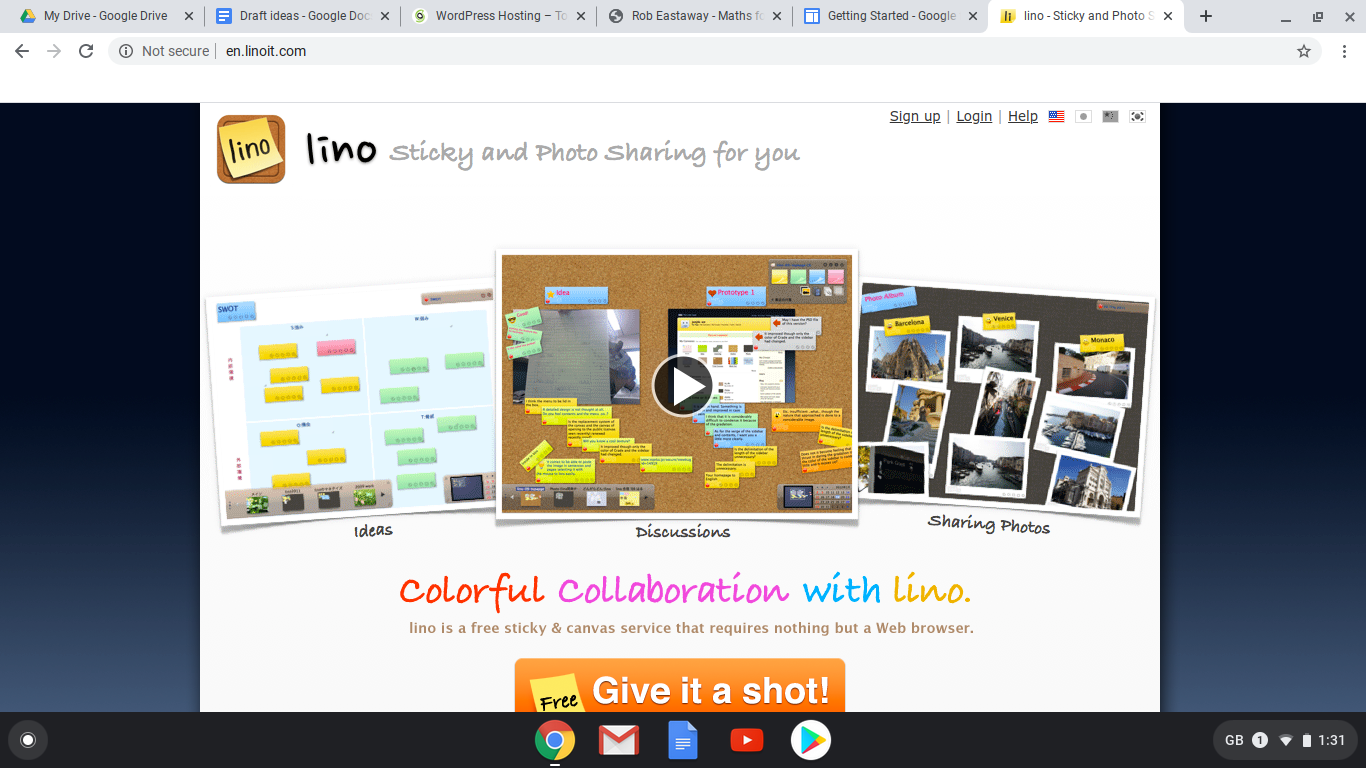
I hit a problem when Padlet became popular at work. We were limited to the free accounts only and this meant I now had MASSIVE messy padlets. No longer was a nice collection of things, it was now a repository for everything shiny. We trialled a few others, Linoit was my personal favourite.
Linoit allows you to get learners to collaborate together on a large noticeboard. I liked the ease of it. I disliked the basic feel of it. We were then introduced to Jamboards. I must always point out I am a Google Certified Trainer and I do use Google a lot! Jamboard replaced Linoit for me as it was very similar. The real power of Jamboard is the app that can be used on any device and everyone can collaborate live. This is seen best with an actual Jamboard in the classroom. I take the point that it is another type of board and it is unaffordable for many. I am not totally convinced on any type of board to be honest. Some of my lessons are in a room that has a projector onto a whiteboard and I annotate around my slide deck in whiteboard pen. I am very happy with this arrangement! Like I said before, I am not a fan of tech just for the sake of it and an interactive board is not always necessary in my lessons.
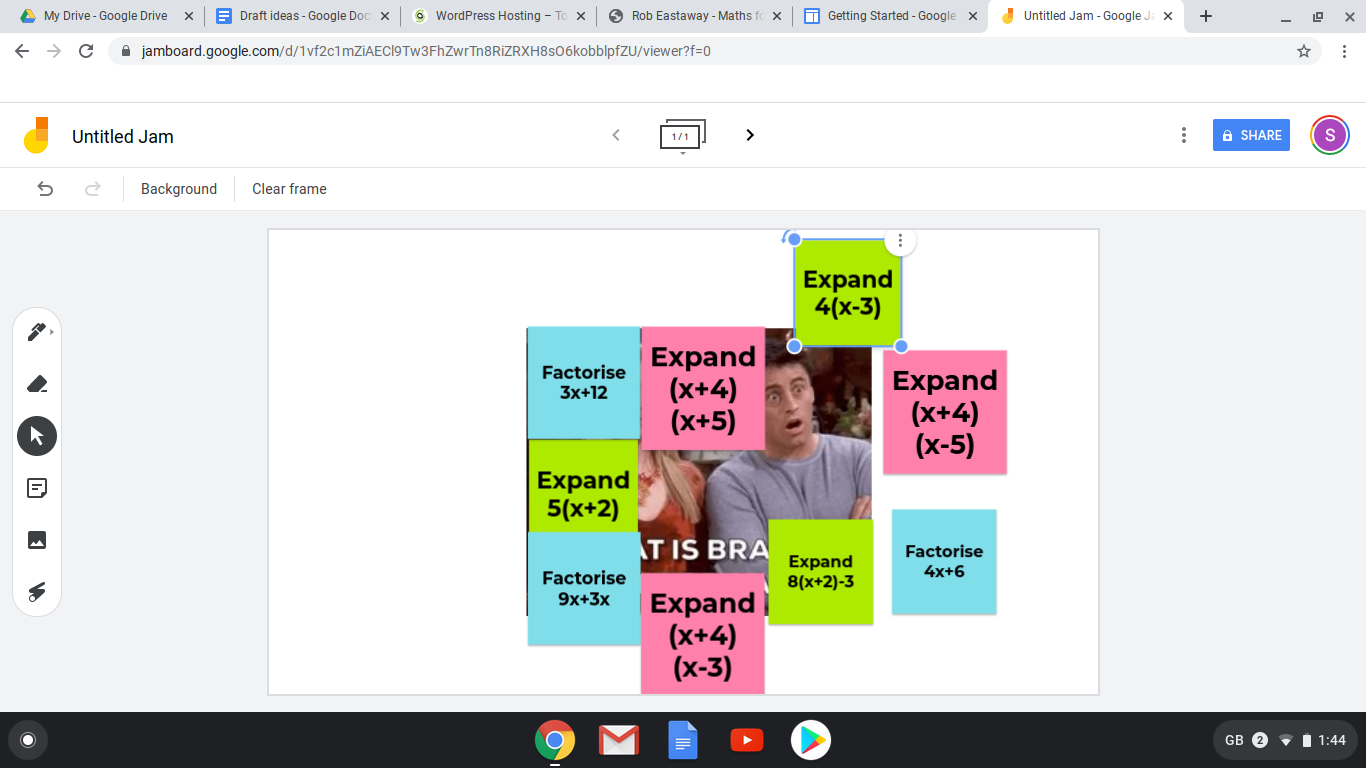
Anyway Jamboard...I like the collaborative nature, I like the name, join a jam, I like the colours and ease of it. I dislike the feature limitations and that it doesn’t recognise maths notation (quite a large problem!)(I m hopeful Equatio will be built in soon!) However I work with teachers of all different subjects and it has transformed some lessons. This is a simple maths jam that I use. It’s a drag and drop to reveal a hidden picture. Very similar idea to the amazing Catchphrase activities that the brilliant Laura Rees Hughes made in the early years of my teaching career that were very handy to have.
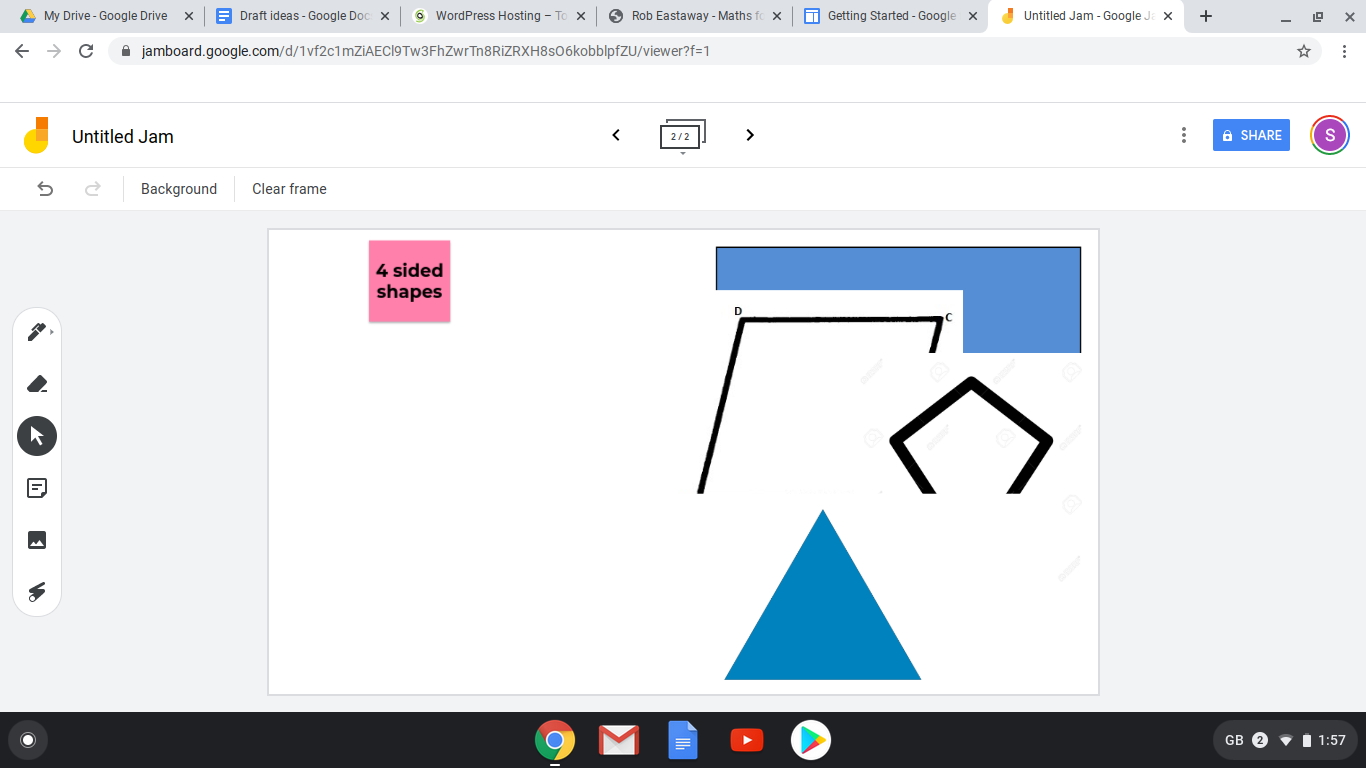
I work with provisions with learners with additional needs and some learners with profound learning needs. I hoped the power of Jamboard would be useful to the teaching staff in these areas. I was right. The learners enjoyed the kinaesthetic nature of dragging and dropping to reveal a picture. I then expanded this to reveal giphs. One learner loved buttons, so I used buttons instead of the sticky notes and it revealed a giph of underwater creatures bubbling away. We then used the Jamboard to practise mark making. I inserted mark making worksheets as backgrounds that learners wrote over. Finally we looked at traditional categorising card sort activities and replacing them with the Jamboard. We used the Jamboard to categorise shapes that had 4 sides on. I simply inserted lots of shapes, using the Google image search feature on Jamboard. It layers them nicely on top so you have a stack of them to move about. I then added a sticky of the category.
We then built on this to parts of the body, we did an activity on vowels and consonants. We also did an ordering activity where I inserted the images of washing your hands and the learners had to put them in the right order. It has been hugely successful with our learners with additional needs. My maths learners like the maths sticky activities too. So from a tool where we collected ideas on Padlet we have now moved to Jamboard for assessing and categorising. This meant I still had a need for a tool for displaying ideas and resources. I was introduced to Wakelet.
You can add anything to Wakelet, your own material, material from the web, videos, bookmarks the list goes on. The aim of Wakelet is to curate your collection. The very problem I was having with Padlet ending up all messy is resolved with Wakelet as it is about picking your best, and being selective. My learners like Wakelet as a reference board. For example I would make one on multiplication, starting with lattice method. Then multiplying decimals. Supported with some videos and some practise on the methods. I am by no means a Wakelet expert, others I work with are! But I see the benefit and I like to set them up after a staff CPD session just displaying the tools or theory I raised in the session.
Hegarty Maths and active dialogue
I have to admit when I was told that we were getting Hegarty Maths and we all had to do it, I was a little resistant. Initial thoughts were, not another thing I have to do! I already do so much! I will also fight tooth and nail to protect my learners from additional work too. I was not on board with this new Hegarty Maths! After speaking to Mr Hegarty himself, I began to see the benefit for the learner and for me. This blog post is about Hegarty but it can be about any platform that marks student work, you will see!
When I started teaching we set all student homework on My Maths. It was great they did a little online worksheet, it told me who got the highest so that I could give them a good comment on SIMS, and who didn’t do it on time so that I could give them a bad comment on SIMS, and those that didn’t do very well on it. These learners would either have taken less than 2 mintues to complete or they were genuinely struggling and you could pick this up with them in class. It was great, no books to mark on the weekend at home! Perfect!
Hegarty Maths can be used in a similar way. Learners log in, see the tasks that I have set them, watch a video to explain the topic to them and attempt a quiz on the topic. It gives them a mark, I can view the class as a whole, see who has done it, who hasn’t, how long they spent doing it and so on. I still don’t have any books to mark at home! Perfect!
Yet as I have progressed through my career I have realised that these platforms have the opportunity to provide so much more! The benefit for the learner is that instant gratification from getting it correct. The opportunity for them to further research the topic by going to the video before or after to either re-cover the basics or extend their knowledge. A bank of videos for all topics so if they want to pre-teach themselves something they think they may struggle with is a great tool as well.
The benefit to me is that I don’t have lots of marking, but I do have lots of opportunities for feedback! For me, my purpose is to have an active dialogue with my learners, to engage and enthuse them. See my post on feedback. Hegarty Maths is great for promoting an active dialogue. Learners can leave me comments as they progress through tasks. One student left me 57 comments one week. I read every single one. I will give you a small flavour of what she wrote:
“Don’t get this”
“I tried to put 5 but it wouldn’t let me”
“I see I should have times it first”
“Think I know where I went wrong”
“Nope not getting it”
I like this as an example because as a teacher I can see what she went on during the task. She had to overcome that initial frustration at the task, then she followed some of it, still getting it wrong. Then she lost it again. I can respond to each of these comments individually or as an overall feedback. Ultimately what I want to say to her is well done for getting stuck in, it must have been hard. I want to say well done for keeping going even though she was getting it wrong. I want to spend some time with her going over it again to show her where she went wrong. I want to set her the previous topic as a refresher before she comes back in and we go over this task again together in class. This was my reply:
“Wow! What a journey you went on, well done for sticking with it! I think we need to take another look at this together to make sure we have it solidly in our memory bank. Can you take a look at task 87 (I have set it for you now) then bring your notes in for this and task 87 and we can go back over it together. Thank you for giving 100% to this”
Yes it is brilliant that Hegarty Maths and other online platforms take away the tick and flick element for me but time saving they are not. Nor should they be, it is our job to educate and converse with learners and help shape their learning together through an active dialogue.
Google Forms
In my quest to be better at giving feedback I am willing to give anything a try! I make no apologies I am a Google Certified Trainer so Google is my thing. You can recreate this in Microsoft Forms I am sure but Google is what I know. I wanted my learners to go over what they had done wrong in an exam independently. I had a class of 30 with 3 papers to go through and a variety of questions answered incorrectly across the board. I decided to go down the route of Google Forms to get feedback and next steps all done in one lesson.
I chose 3 key questions from each paper, 9 in total. I marked the papers at home, entered them into my analysis grid and chose my 9 questions that were fairly red on the analysis grid. I had in my mind a choose your own ending scenario, like the Goosebumps books from my childhood! The form starts with instructions, assumptions are the enemy of a teacher. The instructions ask the learner to have the 3 papers, some paper to make notes, headphones etc. Question 1 asks “Did you achieve 5 marks for question 14 on paper 1?” The options are yes or no. The question was 5 marks for drawing a pie chart and a comparison between a pie chart and a bar chart. If the student answers no on the Google Form it takes them to a video on You Tube (Corbett maths) covering drawing pie charts. This is achieved with the After This Section Move to (‘After section’) part of Google Forms. If a student did get 5 marks on the question the form would take them to another section with a video on interpreting pie charts. After those videos the learner is given a question on what they have watched on the video, the question self marks as it is written as a multiple choice. The learners are then reunited on the Google Form and it asks again about another of my 9 questions, again with a yes or a no route.
There are a few things I learnt through this process. First 9 questions was too much and too long. The next time I used a Google Form for feedback I only chose 3 questions and it ran smoother. Second thing that I learnt was that learners will sit quite happily watching videos about the topics. I wanted a way to harness this and assess them more robustly during their peak engagement with the videos. I discovered EdPuzzle, you can read more about it my experiences with EdPuzzle in my next blog. Third thing that I learnt is learners enjoyed the experience and that they could go back over things at their own pace.
I am never a fan of doing something for the sake of it. At the time of writing this Esports is everywhere and I am yet to see the benefit to my learners so I am not on board, for now! A while back QR codes were everywhere, Every worksheet, poster, display and staircase, yes staircase! I was a little late to the QR code game, it took me a while to find a place that was meaningful for me and my learners! A really nice way I found was to use it in a feedback sheet. I took the idea that students liked watching videos and were willing to work at their own pace via this medium. I created a table with the 9 questions and added 2 QR codes. One linking the learner to the video drawing pie charts and the other QR code linking learners to the video on interpreting pie charts. The point of Google Forms and the QR code sheet is to engage the learner with taking next steps or guiding them to recover topics they need to look back over. Both ways were successful in this aim. Successful in students making progress?, I have no clear answer but we try these things and build on them, I am still building!
Another use of Google Forms I have used in maths is as mini assessments. I was tasked with reducing the marking workload of the maths teachers for a LARGE number maths learners. The team wanted a 30 minute assessment on the topics covered to far that was robust and akin to GCSE. I cut and paste images from Exam Wizard and Exam Pro (both exam boards were used so I ended up making 2 assessments!) I would then make 4 choices on a multiple choice question. I was fascinated by Mr Barton’s Diagnostic Questions and the idea that you can diagnose a misconception. An example would be an averages question asking for the median of a data set. Option 1 would be correct, option 2 would be the mode, option 3 would be the mean, option 4 would be the median but using unordered data. The aim being that if the learner chose the mode or the mean you can assume the learner doesn’t know the difference between the 4 types of averages. The learner who chooses option 4 knows the median is the middle value but forgot to order the data. They need teaching differently to the learner who can calculate averages correctly. One needs practise on the language of the question, the other needs to practise median. This is a very crude example but I hope I make my point.
In my 30 minute assessment using Google Forms I made all the questions multiple choice. I enjoyed finding misconceptions. Using the incorrect trigonometry ratio, listing a highest common factor when we were looking for a lowest common multiple, it was great fun! Once the responses are in the Google Form you can direct them to a Google Sheets. From here we can mark them correct or incorrect using IF formulas. We can then RAG rate the student’s work. Staff appreciated the reduced marking, but challenged the use of multiple choices. Ideally free text would have been better but I couldn’t see a way to mark it automatically this way. If the answer was vertically opposite angles are equal learners could have made spelling mistakes that would have been marked correct if the spelling was logical. In a later blog I will talk about Equatio, a potential solution to this.
The advantages of using Google Forms in this way was that we could batch upload student results to our student data system. When it came to assessment time again 6 weeks later we could see progress within the areas assessed. Problems arose when staff got ahead or fell behind the scheme of work. Students felt under prepared. Nothing will ever be perfect but we are making strides in the right direction. If this has peaked your interest and you want to know more about my use of Google Forms, please get in touch. My plan is to write an ebook at some point about them in great detail...
Analysis Grids
I make no apologies I LOVE an analysis grid! I love it per question, I love it per topic, I love it conditional formatted. Love it RAG rated. I love it all.
This is a snapshot of a number assessment for one of my groups. I can instantly see I need to go over dividing fractions for a few of them and maybe adding fractions as a starter as well. We have been using these in departments since I began teaching. The revelation of Google Sheets and that everyone can be on the same document together avoiding the need for you to wait for Miss Haans to input her results before she sends the Excel sheet to you has been transformational. I encourage all of my student teachers to use an analysis grid regularly, it easily informs your teaching at a glance. If you are looking for a start activity, check out your most recent analysis grid and it will tell you an amber topic for most that may need recovering. Likewise if someone comes to see you teach, and they ask how do you know what they need to cover the analysis grid shows them.
Great, we as teachers have a lovely coloured sheet that informs our teaching. Sorted! What about our learners? Is it just for us? Is it a secret? I give my learners their analysis grids too! They can quickly see where they need to put their revision efforts. Obviously I don’t share the whole class grid with individuals. I will add in some QR codes to Corbett maths videos as well so that learners can watch a video on a topic that they need to work on. Learners can see their grid, see their amber areas and search the topic on Hegarty Maths and give it a go.
One of the biggest challenges I face around revision time is helping learners understand what the topic is called. They see it as a tiling the wall problem whereas we know it as a percentage discount and area with money problem. Do we expect them to know that? Do we tell them that is what they would look up if they wanted to revise it? The analysis grid does. Especially the ones made by the exam board. It gives them the complicated long name that we are very used to as staff. It gets learners used to seeing what we are looking for in their answers.
An analysis grid is not the only opportunity for this. I like to (like is a bit strong, I do it because I believe it benefits my learners, I don’t like doing it!) cut and paste the title of the topic from the analysis grid into a text box in the exam paper so that as the learner completes the exam paper they can see what the topic is that they are being assessed on and research it if necessary. This takes a long time, especially with a question with parts a,b,c,d,e and f! But I think it genuinely benefits learners by allowing them to be a bit more independent in their revision and think about what topics they want to learn more about.
Feedback and Marking
This is a hard post to write as I feel that this is one of the weakest areas of my teaching. I have to be honest, I struggle! I am well read on types of feedback and marking but I often find it a challenge to apply to maths when the answer is either right or wrong and it is SO natural to tick and flick. I hate ticking and flicking I also hate writing “great” or “well done” I despair when I see it in other books when I am observing. But what is the answer? I’m not sure I have one!
We did a lot of work around growth mindset, Carol Dweck being the expert. One of the things that came out of it was providing learners with a help zone. The idea of the help zone is that at any point in the lesson learners could go and seek further information to help them overcome what they are stuck on. This was universal to all subjects and it is something I really ran with. I always have a help zone, I have a travel pack for when I am in between rooms! It contains:
Chromebook - learners can look online for answers
Revision Guide - learners can research the topic
Templates/grids - prompts that learners may need, e.g. lattice method grids pre-printed
Equipment - if tracing paper will help with a rotation or loci question, why not use it?
Dictionary - English one to help with definitions, overseas language to English if I have a few learners from the same country in class too
Answers - to all the questions/worksheets/tasks of the class
Why do some teachers make the answers a secret, it was the same when I was at school. I vividly remember by teacher telling me that she would give me the answers after I had done the first exercises. Interestingly she recently interviewed me for a post, I didn’t recognise her, it’s funny how the mind builds up images of people over time! If the students have the answers they can mark their work and move on to an appropriate task when they are ready. Sometimes it is easier to unpick where you have gone wrong when you see the answer. I am a firm believer that as hard as understanding is to teach if you can articulate how, where any why an answer exists incorrect or correct you are on your way to developing understanding.
If you are sat in my class and you can’t go forward because you haven’t got a clue how to tackle the first question. I would like to think I would spot you and be able to help. However with adults they can be very good and acting like a swan and mis-lead the teacher into being OK when they aren’t (this happens weekly with a student of mine who rattled through work happily but all of it incorrect!) If you are stuck and you don’t want to ask for help, how do you get help? Yes students should be comfortable asking for help, that is the purpose of staff being there! But sometimes it is a lot more than that, take my student with severe anxiety in public. For her to turn up is an achievement. Yet when she is stuck, how does she alert me, how do I know? I actually keep a close eye on her but what she likes best is that she has the answers and she can work out where she went wrong once she sees the answer and then move on. Take my confident student who likes to regularly tell me I have written something wrong on the board. She wants to know that she has got everything right and get to the harder work before I have even typed it out! She needs the answers so she can pick and choose a few of the easier ones to do, check she has got it and move on. Take my student who is a doctor in her home country. She needs the answers because she knows the maths but is unfamiliar with the language of the GCSE exam. She wants to read a few questions and answers before moving on to the harder work.
If my learners have the answers, what am I doing I hear you ask? I have my trusty coloured pen in my hair. It can be red, green, purple or rainbow coloured depending on the department I am working in. I wander around the room giving feedback and asking students, why did you put that? Can you tell me how you got that answer? What would happen if we did this? I am helping those who are really struggling, offering alternative explanations. I am having conversations with my learners about their homework, or lack of it. I am asking them to move up a level in the tasks they are completing. I am spending time with them. I think that is a better use of my time than me standing at the front reading the answers out so that they can tick and flick.
So how do I record feedback? This is another challenge. They have got everything right, they have answered a more challenging set of work. We are collectively at the end of the topic now, where do I take them? How do I feedback? Like I said I am not an expert but I take this opportunity to ask them to find my error in some incorrect work that I have done or for them to write a cheat sheet of their workings out, I challenge them! See my post on Challenge for all
To record feedback is hard, most of it is verbal, or notes over corrections. I have tried the old, “verbal feedback given” stamp and they have to copy down what you said. I like this idea, it allows them time to reflect on what you said and by writing it down it may stick a little more than if they just heard it. However it takes time, it slows them down, pace is crucial in maths. I also have the challenge of adults who don’t really want to talk things through with me or admit that they are struggling freely, I mean who does! So I hit upon a fake imessage idea. It is a printed template, it has a blank fake messaging conversation
that looks like this,
We use this during the lesson to capture verbal feedback. I am the green, they are the white. Sometimes I will write in the green myself for speed. The white is what is important to them, their misconception. I then developed it to include a progress line on the top as well. This then meant that learners naturally wrote in the white part how they felt in my progress checks in my lesson. Say we were mid way through translations and we were just finishing translations with words before we looked at column vectors the lesson naturally has a progress check in, learners will record their thoughts in the white message bubbles at that point. “This is easy” “ I need to remember that I pick a corner first” and so on.
When I think about my aim when providing feedback, it isn’t to say “great”. It is to develop the learner, that is why I am there. They can watch videos on you tube and learn translations without me. They can also find exam questions on translations and mark schemes and tick and flick them without me. The purpose of me being there is to help them overcome misconceptions. I am there to guide them on next steps. I am there to provide alternative explanations. I am there to praise them. I am there to support them. All of this needs an active dialogue between me and my learners. I need a one to one with them during class, after class, mid week when they tackle their homework and before they come into class to check on their actions from the last one to one. This isn’t possible! But if we have an active dialogue we can achieve many of these things. This messaging print out allows me to do this. Remember the old red card on the desk to alert you that a student was struggling. These do the same thing, they can write down they are unsure and you can see it as you go round the room. I take them in at the end of the lesson, provide detailed summary feedback from my point of view after the lesson. I set next steps or challenge work and we have 5 minutes reflection on what i have written at the start of next lesson.
Now I know what I do isn’t perfect, nor is it ground breaking but it works for me and I may provide someone with a structure that may help them, so if you are struggling to avoid writing “great” it may be worth a try?
Exam Top Tips
The pressure of the exam can cause so much distress that learners automatically forget how brilliant they are. I am a huge fan of doing everything possible to settle and calm nerves before exams. I remember in the opening year of a small school I was in buying pan au chocolat, cereal bars and hot chocolate for the 12 year 11 learners on the day of their exams. It is always something I have done, maybe it is the areas I work in but breakfast seems to be a meal we, as education providers, often supply. No more so on exam day.
I began thinking about ways to embed the exam throughout the year in an effort to reduce some of the stress of the actual event. Every lesson includes and exam question, printed from the exam so it looks and feels like the real thing. After a couple of years of this I asked one of my repeat repeaters what was happening when he got into the exam and he said there’s just so much stuff to remember he kept making mistakes on the easy parts.
I then began building a bank of hints and tips that I could embed into my lessons that I called save the space. The idea is to give learners more space to remember the stuff that they find hard. Here are a few examples:
Number line
I am a big fan of a -10 to +10 number line somewhere on the exam booklet. Once it’s down it can be referred to and the learner can jump from one to another hopefully doing addition and subtraction of negative numbers a little easier. Even if the numbers are more sophisticated the number line may remind them of the concept of whether a number gets larger or smaller.
Get out of jail 2,3,5,7,11
I teach prime factor decomposition with the first 5 primes written all over the place. I call them the get out of jail free numbers and say one branch on the decomposition must be one of the top 5 primes! I then use the first 5 primes again in simplifying fractions. It is essentially divisibility checks but in my experience if you mention the word division panic sets in for many learners so giving them the divisibility checks as a helpful hint overcomes that panic.
360o protractors.
Every year around February I will ask the head of department I am in what equipment they have for the exam. I understand in the outside world if you turn up to your job without the correct equipment it is your responsibility and no one will help you out. Maybe it is the area I work in or my empathy for the learners going through the exam again not for the first time. Whatever the reason I always provide equipment. I always encourage the department to buy 360o protractors. Again it just helps ease learners stress in the exam when working with bearings
Faces Edges and Vertices
There is so much for students to remember in exams. In my private tutoring work I always say my job is to get you ready for your exam, your teacher is teaching you. When I am the teacher in front of a group of resitters it is both my job to get them ready for the exam and teach them! So a little thing I like to do is to teach faces, edges and vertices using your hand, forearm and elbow. Put your hand in front of your face, this is a face! Your forearm is the edge and your elbow is the vertex. The hope is that students will re-enact this in the exam on the low grade 3D shape property questions and save some valuable brain space for the more challenging topics. Plus it provides the invigilator some entertainment in the exam!
British Values in maths
I must admit, when British Values came on the scene, I let out a little sigh! Purely for the fact that I saw it as something else I had to do. I held onto this mindset for some time. I attended training on it, held in-house in my FE College, and my opinion changed. Once it was clarified that it was essentially a code of conduct for lessons I was off and running. I began using a stock template, here is a bit of an example.
Tolerance and mutual respect when discussing ideas. Promoting inclusion through targeted questioning.
I thought I had it cracked! My observers thought I was hitting it and I was never really asked to look at it again. Reflecting after, a half term, I let out a little sigh again. This time I was sighing at the fact I was including the same thing on my next set of planning. It was boring. But my mind got distracted and I never re-did it. Fast forward to the next half term and I was joined by a new PGCE student. Instantly I knew she would be brilliant, I wasn’t wrong! She blew me away in many areas but especially in British Values. She looked for democracy examples in Parliament that would bring her lessons to life, like when she taught fractions the number of elected MP’s vs non-elected Lords and their positions in the law-making process. It was a pleasure to mentor her. Unsurprisingly we employed her once she qualified and together we co-planned the following year. It was a joy! My British Values were on point and I enjoyed the challenge of planning for them. It gave my planning purpose rather than being an added extra.
Let me give you an example of how planning would work. Take compound area and perimeter. Queue screams of excitement at a lesson on compound area! Remember my students are re-sitters and have probably been taught how to calculate compound area and perimeter, they need it bringing to life!
I assemble a series of T and L shapes of desks. Room size dependant!
We then, as a class, put chairs around the shapes, counting how many places are around the outside of the shape.
Then we imagine (or actually do if it is appropriate) putting the chairs on top of the desks and seeing how many chairs could fit inside the shapes.
Then we have a discussion about what we have done, hopefully concluding a difference between area and perimeter. (I always sing “round the outside round the outside” to remind them!)
Then I ask them to tell me if they think the area is large enough for a bedroom and how would they position the furniture if it were their bedroom.
Generally the students struggle to fit everything they want in their bedroom in, so I ask them to make a larger area using the desks so that they can accommodate their design.
I then bring up the “technical housing standards” from the government, 2015. Then we look at the government bedroom standards from the 2018 tenancies document. The minimum size is 6.51 m2. One of the L shapes I set up before class generates an area of 6.5m2.
I then ask the learners to imagine two 15 year old girls sharing the 6.5m2 room.
I then explain the bedroom tax and that any room 6.51m2 is classed as a bedroom and children of the same sex inder 16 are to share. I give a scenario of a double bedroom, and two single bedrooms of 6.51m2. A family of 2 parents and 2 daughters aged 15 live in the house. They receive housing benefit and have had a 14% reduction in their benefit as the girls are expected to share and therefore they have a spare room. We then explore the rule of law, democracy and mutual respect and tolerance.
My re-sitters sometimes share their own personal experience with this scenario and it requires delicate handling. I have felt uncomfortable in these conversations but I am comfortable with the experience I am giving the learners. British values and understanding the world we live in are of equal importance to me. Anything I can do to prepare my learners for the world outside the classroom holds as much value as course content as it develops them as young people and hopefully I encourage them to become active members of society.
This is just one example of where I integrate British values into my lesson, I have more but the joy of finding the opportunities yourself is really powerful and I encourage you to look again at your planning.
Why do we count in 4s?
Why do we count in 4s in England? As a former maths teacher who chose to work in #FEmaths I think we may need to look at assessment at age ...
-
I have just published my blog on what I plan for September and I wanted to follow it up with how I will do it. Cast your mind back to a les...
-
I have sat for years listening to CPD that was absolutely brilliant with a voice in my head going "not possible in a maths classroom th...
-
This post is inspired by a thread from Twitter here started by Jude Mortimer (She is well worth the follow too :) We were discussing the ...