Showing posts with label retrieval practice. Show all posts

Circles, pi and Slido! The best lesson ever?

I'm not sure I should write this blog post but anyway! I taught for 3.5 hours 10 adults GCSE Foundation Maths where we looked at shape, space and measure topics. I had planned to do this lesson last week but due to a family emergency I was absent. As my class are adults I was nervous today that I may get a rough ride for the inconvenience of skipping out on them last week. Not true, they were wonderful. One lady said, "never apologise for putting your kids first". I thought, wow that's really powerful. I'm hoping to hold onto that when I am saying no to the million CPD lates I'm asked to do but I realistically can never deliver.


So I have to admit there was a very free and easy approach to my planning, I had a tonne of activities photocopied for a variety of SSM topics as I was out of sync with my scheme of work. I took a look and thought we will start with circles and see where we end up. We had just finished statistics and graphs as a topic a couple of weeks before so I quickly rustled up a retrieval grid on that, set that out as they arrived whilst I checked over my Google Slides presentation on circles. Just at that moment in walked 2 colleagues to do a peer observation. I have an open door policy. As an experienced teacher I feel it is my duty to offer an open door policy. Generally staff ask ahead of time out of courtesy if they can come in. I always reply with "come anytime, I won't be doing anything special" today's lesson couldn't have been more true! 


Off we go then with circles in Google Slides. I have my learning intentions displayed and I write them on my board with my keywords to remain for the whole lesson. I also write the date in words. I'm a bit of a stickler on this one as good habits help make better teachers I think. I was once taught by a head of department that if you write the date in words you are showing learners that there is a quick way to write the date but have pride and high standards and wrote it fully. I quite like writing it in words and it upsets me when it is missing from classroom boards and when it is written as 1/2/20 I always flash back to my old head of department. 


In the slides presentation I have inserted slido. Now Slido is a great polling tool that pops in really easily. It is an add-on to Google Slides (I am a Google Certified Trainer so most things I do are in GSuite) I have used Pear Deck before but due to connectivity issues at the remote campus I find Slido works better. I break down the learning intentions by grade, a grade 3 student should be able to do this and a grade 5 student can do this. I give my class my same old speech: "if we teach to a 4 and we fall short we will get a 3 so no apologies I teach to a grade 5 to give you the best chance of achieving a 4." This is high expectations in its simplest form. The Slido then appears and the learners rate themselves out of 5 stars where they are against the grade 5 broken down intention. We get a split of ratings, and some questions about what a sector is. (The grade 5 intention was about calculating area of sectors!)


I begin with labelling parts of a circle. Reminding them of correct spelling. English isn't the first language for many learners, for some it's not even their second or third language. This takes some time and is dull. I am worried I am losing them. I planned to do a mini quiz on the parts of the circle and a card sort but the mood in the room is, we have notes, you will out this on Google Classroom so we have your notes too, what time is break? Picking up the pace I jump in with the circle song! You can watch the one I use here. I know there are others but this is my favourite and I encourage them to sing it to themselves in their exam!


Back to the lesson... I can then see joy at the song but confusion at pi. No surprise, who actually knows what pi is? I quickly grab the elastic bands from my photocopying and ask them to measure the diameter whilst a partner holds the band in a circle shape. I then cut the bands and ask them to measure the length of the chopped band. They then tell me that they are measuring the circumference and that is. We record the 2 measurements from each pair on the board and discover that the circumference is about 3 times bigger than the diameter. We then look at where pi is on our calculators. There is the inevitable conversation of borrowing calculators, we can debate high standards and correct equipment vs financial situation vs local demographic vs adult learners another time.


I then come away from the presentation and project some circles onto my board with varying measurements of radius and diameter. I then give the learners the option to go through area first and then circumference. I highlight that in my experience the thing people get wrong in this topic is doing the wrong one in the wrong question. Calculating area when they needed circumference. Or I give the learners the option of my default every time way. They choose my way. Everyone I see a circle I write CARD. We look at this example where we are asked to find the circumference of this circle:

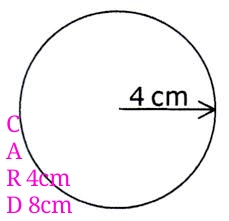
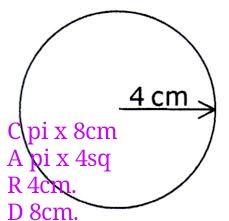
The question gives us 4cm as a radius. We can write into CARD that R is 4cm and D is 8cm. Quickly singing pi r squared sounds like area to me… we can write in that the circumference would be pi x 8 and area would be pi x 4 squared. We then look back to the question and see what it asked us to calculate. In this case it was circumference so we circle that one and work it out. I like this method as it build solid repetition of the skill of recalling and applying the formulae. I also like it as it encourages the learner to reflect and choose is it area or circumference before diving in. 


In my class today the lower level group struggled to start but once CARD had been repeatedly applied they had rapid progression through the tasks. My top end learner decided his way was better and off he went. I always say, I don't care how you get here, just get here if you can. Meaning here is the correct answer! All the learners have access to the answers of all the tasks, they are marking as they go along. Suddenly my top end learner becomes frustrated. He has got most of the work wrong. I take a look and he has done the classic mistake of circumference when it wants area and vice versa. I remind him of CARD he gives it another go and signals to me 5 minutes later that he is being more successful now!


Whilst the learners are working I take 3 of them out one by one for a mini tutorial. They are my 3 at risk learners. I let them know I am putting in interventions for them and say that I believe with hard work they can improve. I am then taken aback realising my peer observers are with me in my final mini tutorial. I am mortified I left my class unattended with peer observers in the room. I apologise and my peers are great and they say, no we think it's brilliant you have taught them well enough to leave them for 5 minutes and these mini tutorials are equally important. I check on the class and they have all done a nice mix of area/circumference including semi circles and compound shapes. I give verbal feedback (should have written more down!) It's almost time for a break but not quite and I am just about to move on when one of the learners makes a safeguarding disclosure to me out of the class so I call a break for 10 minutes while I make notes and report it to my safeguarding lead. I bid farewell to my peers.


I grab 2 minutes to think about what we can do next. I had planned to do angles in parallel lines but I'm concerned that the secure circle knowledge is at risk if I go to angles. My other option is loci or bearings. I decide to go loci. I don't know why I don't teach loci particularly well. Actually it probably ranks as one of my worst lessons. I don't enjoy it and I struggle to visualise the boundaries of areas in the complex questions. Decision has been made now though, I am writing my new learning intentions up on the board before I remember how badly I teach loci!


We do a quick Slido to check our rating now on circles. Everyone has improved. We review the grade 3 and grade 5 learning intentions on loci and constructions and do another Slido, the class has no idea about the language of the topic. No one rates themselves higher than a 1. With a feeling of dread that this has been a poor decision we begin by drawing line and angle bisectors on blank pieces of paper. I demo them in my Slides presentation. (Someone years ago shared a nice demo where the compass moves and the arc appears, I would never have the time to make such a beautiful presentation so I am very grateful to still have it!) Cue difficulties with expanding compass widths in between arcs. Some are unable to keep their pencil in the compass. Some can't use the compass. I get round everyone improving their techniques I see no harm in spinning the paper rather than the compass if the learner struggles. We then take a look at some exam questions. They progress into not explicitly stating it is a line or an angle bisectors but a more worded question. All can do the explicit ones, most can do the more challenging ones. Progress is through skill repetition practise here.


I then put an x on the board (I have been rummaging in my bag for post it notes whilst they were working) and I ask each of them to put a post it note 20cm away from my x. They chat amongst themselves. Some want to do a line, someone twigs it would be a circle, then there's a competition on who can be accurate and exactly 20cm away. I am observing this active learning loving the conversation. I then demo a dog tied to a post would have a circle locus. Then a dog tied to a bar would have a running track shaped locus. (Handily there's a bar outside my window to help visualise) all are keen to get going and for some unknown reason I then decide to demo one of the complex garden planning questions. I draw a rectangle ABCD and ask them where I could put my path that is an equal distance from AB and CD. I start to get clammy I am about to jump in and answer my own question when one of the weaker learners contributes "would it be a line dissector?" We will skip over the incorrect language for now. I check the room and all are thinking the same. Another learner says "yeah this is fine but more than 5m away from the tree for the fountain that isn't any bisect or anything so what do we do there?" I am over joyed. The long phase about the path was because they had twigged that it was a line bisector and were struggling with the next part of the question. I demo an arc 5m from the tree and all are itching to get going. We do a quick Slido and no one rates themselves below a 4!


I circulate the room giving feedback. All have the answers so can tick and flick. I see little merit in me ticking and flicking their work. My role is to shape their learning journey and I do this through feedback not ticks and flicks. I can't believe it, everyone can do it! The lower level ones have some beautiful running track shaped around lines and even a running track around an L shape. The higher level ones are shading the correct regions in the town planning questions. One learner even attempts a create a shipping path question involving 5 elements. I look at the clock and 3.5 hours has gone! I pull them back for a final Slido, it stays the same. I recap our learning intentions and ask them to reflect in their fake iMessage sheets. See my blog post on feedback for these. They all thank me for a brilliant lesson.


I grab a cuppa and sit down to respond to their feedback iMessage sheets. Here are some of the responses:


"Why has no one shown me CARD before? Changed it all now"


"I will forget loci but I won't forget the lesson"


"Thank you it was epic, I learnt more than the last 4 years of studying for my GCSE"


I honestly think this was my best lesson ever. Yes I had pre planned presentations and my photocopying was ready but I made responsive decisions throughout and reflected on learner points. I don't think I did anything special, I certainly would never do anything special for a peer obs, and it all came good in the end. The peer observer emailed me a few weeks later and said she was trying Slido and some other bits she had seen me do, that is why I have an open door policy!


Challenge for all

You know the feeling when you return in September, feeling prepared, lessons ready, imagining your groups, beautiful 5 minute lesson plans for the first 12 weeks that took an hour each all ready….smug! Then day 1 you are hit with...right so today we thought we could spend some time planning the first few weeks of term given our new lesson plan and scheme of work structure….Argh!!!! It’s all changed! Into the bin goes your summer work and rapidly you pray to get through at least the first 4 weeks worth of work in a day. No idea what I am on about, then you are very fortunate as this happens to me every year! Thankfully every year’s change or tweak to the lesson plans or schemes of work are positive and eventually I am pleased they have changed but those first few weeks are gruelling!


A few years ago I was introduced to the 'challenge for all'. (Cue images of Tower of Terror ride at Disneyland and the Twilight zone music!) As part of the team responsible for coaching and mentoring staff to meet standards it was quite complex to get across to staff what the 'challenge for all' is. I can take no credit it was all the work of my amazing teaching and learning colleagues but I am more than happy to share it!


To be clear, this is not stretch and challenge in the sense that you plan for the HATs (oldie but a goodie term!) top end of the group some extension activities. There is an element of that but it is actually about challenging all learners no matter where they sit in your group. What often comes up as good ideas for challenging all are, design a tweet, create a mnemonic, promote a discussion with deeper probing questions. Some of these techniques are useful and appropriate to maths lessons but often they are not. Discussions and opinions about who is right and wrong are very limited in their applicability in maths in my opinion. 


Imagine we are teaching expanding brackets, something like 2(x+5). 

Traditionally to stretch and challenge the high attainers we might ask them to move onto expanding double brackets, for example (x+5) (x+3). This stretches their skills to a new level. However it can be argued that they are actually learning a new skill in moving on to double brackets. In my experience of doing this, more teacher input is required meaning that the learner isn’t being stretched but that the teacher is guiding them to the next activity. Yes you can set them off with scaffolded worksheets to relieve this but I always have Dylan Wiliam ringing in my ears at this point. Wiliam (on the amazing Mr Barton Maths Blog) talks about a hysteria of a few years ago which came from observations where teachers, observers and OFSTED all wanted to see more activities to evidence the learning. Thankfully this is less so now, we recognise it’s not the busyness of the learner it’s the engagement that tells us if learning is taking place. This is why I like the 'challenge for all' element. It’s not about keeping them busy with the next thing, it’s not about more teacher input, it’s about deepening the learners understanding of the topic covered in that lesson.


So let’s return to our expanding brackets of 2(x+5). We could ask learners to create a tweet, a diagram of the stages or a cheat sheet (see next blog). However, if we could apply their knowledge to new concept we could evidence a deeper understanding. Asking them to move onto double brackets wouldn’t necessarily achieve this. We could take expanding brackets to solving a worded problem, an AO3 style question.  We could ask the learners how old Millie is if Billie is 5 years older than Ellie and Millie is twice as old as Billie.  For the lower attainers we could form the expressions as Billie is (x+5) and Millie then is 2(x+5). For the middle attainers we could give them the problem without the expressions. For the high attainers we could ask them how old Millie is if Billie is 12 and they could solve the expressions. We could ask all of them the age difference between the oldest and youngest and see if they can work this out algebraically rather than by solving. This got me thinking, would this work with any AO3 style question? Could we give a 'challenge for all' opportunity for all just by looking at the AO3 style problems. 


I am a big fan of doing something well once and it will save you time in the long run. I created a lucky dip box and cut up AO3 questions and put them in the box. The 'challenge for all' then became about learners applying their knowledge to an AO3 style question. It started off as random and they could pick a number AO3 question out and we had been learning data but it worked as a nice retrieval element as well. Reflecting on this,  I created an algebra AO3 lucky dip, a shape AO3, a number one, data and finally the really tricky crossover problems box lucky dip. Depending on the topic would depend on which lucky dip box we used. The beauty of this was high attainers could pull their own AO3 out. Mid and low attainers we could work on as groups and collaboratively solve. 


As with anything once it becomes routine it is expected. Learners would race through activities to get to the lucky dip. There was a leader board of who answered which question quickest. We would discuss if one question was harder than the other, and if so why. Given that we think one is harder than the other, should they be worth the same amount of points for the leaderboard. This then got learners thinking about the design on the question. One healthcare student said “the maths isn’t any harder in that one it’s just spotting what it’s asking” I think if we are aiming for learners to deepen their knowledge that quote sums it up beautifully. If learners know why they are doing something and can explain what the aim of the task is they have begun to understand the topic. We will cover understanding another time….


Retrieval Practice

I love to read, and I read widely around education, teaching. Maths, anything that interests me. However, no matter how much I love to read the amount of time I am able to spend reading is significantly less than I would like it to be. Prior to my current position, unfortunately the only real time I devoted to reading was when there was an urgent need. I was preparing for interview for my previous position I was trying to find some research that was relevant to what I was discussing in my presentation. 


I know this is the wrong way round to do things the research should have informed what I was doing beforehand but we were where we were and the interview was in 2 days. I am pleased that I now allocate myself coffee and reading time once a week to keep up with the latest blogs and developments. I love my coffee and reading time and it is sacred, I need it to be so. That doesn’t mean that if work is busy and I don’t get time to read at work I will make time to sit at home with a coffee and read, point is I read weekly! Whilst preparing for my  interview I came across retrieval practice. Retrieval practice had nothing to do with what I was presenting in interview but it instantly sparked my interest. 


I ended up spending all my interview talking about retrieval practice and openly admitted that I haven't used it yet because I just found it but since I got the job and have begun using retrieval practice. I am not an expert but am happy to signpost you to the experts here: https://www.retrievalpractice.org/

Retrieval practice works on the basis that if you regularly retrieve small bits of information you will deepen your understanding. It was really nice to finally find something that was current, relevant to my teaching and unusually appropriate to a maths lesson. Too many times as a maths teacher I have felt left behind. Whilst other subjects make huge strides in questioning and feedback I find myself trying my hardest to make it work in maths but most of the time answers are right or wrong. The guys at https://www.retrievalpractice.org/ shared a retrieval practice grid where the topics that have been covered previously were colour-coded by how far in the past they had been. This was easily replicated into my lessons and it looks a little bit like this. 


Share £60 in the ratio 7:5

Find the nth term of this sequence:

32, 26, 20, 14, 8

Simplify:

f + f -f +2f -2f + e

Multiply:


5.4 x 3.2

What is the 100th term of the sequence 5n-6?

Tickets cost £3.50, we need 18 tickets in total. 

Calculate the total cost.

Share £125 in the ratio 18:7

Simplify:

d x d x d

Simplify:

2k - 3g + 5g + 4k

The next term in a sequence is 15. The start number is 9. What is the nth term rule?

Multiply: 

2.5 x 1.2

Aliaa and Steve share £45 in the ratio 5:4. How much do they each get?

Multiply:

4.4 x 3.2

Gray and Teag share some money in the ratio 2:3. Teag gets £45. How much was the total amount shared?

Simplify:

e x j x j x e x e

Is the term 54 in the sequence 6n-6?


Red is 4 lessons ago, orange is 3 lessons ago, green is 2 lessons ago and blue is last lesson. This replaced my bellwork. Students arrive and these are on their desks already they sit down and begin working through the grid. Every lesson I would change the questions and colours. It really wasn’t an onerous task. The aim of it being a little reminder a little refresher and in total would take less than 5 minutes to go through the board. So I would give the learner's 5 minutes to come in and do it and then 5 minutes to run through at the board I felt that it was worth the sacrifice in my lesson time but I appreciate not everyone has 90 minute lessons like we have. (We only have 1 90 minute lesson a week though!)


My adult resit learners would sit and discuss the questions. You would overhear questions about when to use ADAM or DINO. I would spend the 5 minutes catching up with any absentees from the previous week or any messages that I needed to pass on to my learners. The next time when I would look up the powerful maths discussions that were taking place were jaw dropping. The collaboration and cooperation of learners in reminding and refreshing each other with how to answer the questions was lovely to see. Age gaps disappeared and mature adult learners were working at the same pace and stage collaboratively with teenage adult learners. Over time our little routine expanded into each table being responsible for sharing the answers rather than me standing at the board. My application of the grids also evolved in that the red section became a place for poorly answered topics to be repeated and recovered. For example nth term would be in the red section for one class for a few weeks whereas for another class it was factorising. Using these grids I was able to personalise the retrieval practice that each group needed.


Having taught resit groups for a number of years the impact in my results was significant. The topics that have been regularly and consistently answered correctly on my retrieval practice grids were regularly and consistently answered correctly in my mock exam papers. It was evident that those 5 minutes made all the difference in keeping topics ticking over. When we came to the actual exam one learner asked me for a copy of all the previous retrieval practice grids to revise from. This was a Eureka moment. Thanks to Google Docs I had a bank of sheets that I could print off and issue meaning we had instant revision packs ready to go! Google docs is brilliant for this because it has version history allowing you to revert to previous versions. If you would like to know more about Google docs I will talk about this at a later date. 


Not only did retrieval practice improve my in class testing, it helped create an empowering collaborative working environment which was an outcome I wasn’t expecting. It also enabled me to have a class specific time relevant revision pack for learners appropriate to their stage and ability. I am a big fan of curating revision collections for my learners based on the topics and how well they have done in them. Retrieval practice did this for me! 


Why do we count in 4s?

 Why do we count in 4s in England? As a former maths teacher who chose to work in #FEmaths I think we may need to look at assessment at age ...