Showing posts with label feedback. Show all posts

Why do we count in 4s?

 Why do we count in 4s in England?


As a former maths teacher who chose to work in #FEmaths I think we may need to look at assessment at age 16.


I give the analogy of a pilot in my book.


A pilot proves knowledge has been acquired and retained on key aspects of flying in an exam. But to fly a plane commercially they accrue hours of competency. They evidence, over time, how they apply this acquired knowledge. They progress in their roles held in a hierarchical structure with flying hours a key part.


When I think about assessment in England, we assess at 16 a whole course approach and those who don't achieve the desired grade 4 are immediately affected for the rest of their lives. 


Imagine a student who achieved a grade 3 in maths but 7s in all other subjects. They gain 4 A levels (not in maths). Go to university and achieve a BA. They do an MA and then decide to get a job.


The first qualification that is often required is a grade 4 in English and maths. The rest of this students brilliant study doesn't get taken into account unless that grade 4 is there.


The 4 is what counts.


Sure the student can re-sit alongside other study but the point is, we place all our emphasis on this assessment designed for students aged 16.


What were you like at 16?


We don't take into account experience, skills, evidence of learning over time. 


We count in 4s.


I say this having taught an adult who worked as a healthcare assistant in a hospital, during covid, who wanted to be a nurse. They re-sat maths 6 times. They earnt a healthcare assistant wage for the 6 years of re-sits they took. They gained vast care and medical experience in that time. The year of covid they passed maths and immediately began a nursing qualification. Upon completion all the years experience were recognised and they entered nursing at a higher band salary than would be usual.


The experience counted but only after we counted in 4s.


So I come back to the pilot example, yes a skills test of the basics. Then a process of evidencing learning over time, applying the subject to real life, showing what you know in a variety of non exam ways. Sounds like a good maths course for 16-19 years olds, no?


These are not our decisions to make but we can raise our voices and show how we think change would deliver better for our students.


We need to stop counting in 4s.


This analogy and other arguments for disruption are in my book which is raising funds for charity. It is also available as an audio listen along version as well. Info at www.whatthetrig.co.uk 

Student Feedback Worth it?

 This post is inspired by a thread from Twitter here started by Jude Mortimer (She is well worth the follow too :)


We were discussing the pros and cons and time saving tips on giving FE maths students, particularly adults, written feedback and target setting. Let me tackle target setting first off. I set my students targets at the start of the year. This is personal to them. I know it should be grade or qualification related, and sometimes it is. But sometimes it is to develop my English understanding of maths to support my son in high school. Once it has been, to be able to help my foster kids with their maths when they start high school. Most often it is, to get a grade 4 so I can apply to be a nurse/teacher/lawyer/paramedic/and so so many more careers that require it. My students are engaged with their target, we refer back to them regularly. I write them in all our student documentation on our systems. Minimum target grades are always entered and one grade above prior qualifications or an agreed minimum grade between me and the student if no prior qualifications are held. I will often refer to student targets in their one to ones with me. Rightly or wrongly I still do one to ones at least once a term. I set revision work for my students in my classroom and call them all one to one to a separate room and chat about their progress. I find it really useful to have quality time together and away from others to avoid awkwardness. I am by no means prefect in my lesson style but I am sharing truthfully what I do.

Work scrutiny was the next part of the thread. My department has booklets we have made and these are to be ready to be called upon when needed for work scrutiny as well as 3 times a year in formal work scrutiny periods. My student's work is never readily available. Not sorry. Why do I want to keep their work? Why does it need to be kept in a drawer in the office? Radically I let my students take their work booklets home. I let them reflect on their notes and revise from them all the time. I actively encourage them to do it! I call the booklets in ahead of work scrutiny week but I won't see them in between times. And that's OK. My feedback is given in another format as well. These booklets are covered in student marked work and my verbal feedback that they capture or highlighted notes to remind them to refer back to a specific example they copied form my modelled board work.

This has led to department discussions. I am a huge fan of everyone in the department try to do the same things at the same time for consistency so it doesn't sit well with me that I do something different. But I genuinely don't get why I need to keep their booklets? They make notes in them, they write in them, they reflect on them, they belong to them not me. It is their learning journey.

The thread then asked for tips on what should go into department booklets. I have to admit I don't think we have ever nailed this, in all the incarnations. But I do insist on QR codes being added to each page. The QR code links to a video from YouTube related to the topic. Giving students support that when they are revising from their booklet they can see some modelled work to help them address some misconceptions. Or if they are absent they can see an overview and seek out more work. One of my biggest challenges is getting the titles we call topics over to students. I am often asked, what do you call this question? I want to do more of them. So in the booklets is an exam question on the topic and the title. Like forming expressions for isosceles algebra questions or ratio for the 10p 5p question, if you know you know!

So then I was asked how do I give feedback, and how much written feedback to my students? I have found a process that works for me, it may not work for you and I am not saying it is brilliant. It is actually pretty basic but, like I say it works for me. In our college we need to have summative assessment that is defined in the lesson. We also need to give students next steps. I don't have an issue with this and have included it in my feedback template. So here it is:


I have used this with 16-19 and adults alike and it has iterated over the years and this is it's current version. Well it has been like this for 2 years now! 

Checkpoints - from sharing the learning intentions all the way through my lesson I ask students to reflect as to where they are on the progress line. The aim is to visually see progress over the lesson and them celebrate that. If they don't make progress, which happens!, it can also promote messages form students as to what has gone on. At each episode in the lesson I do a mini assessment, usually an exam question, and then I ask them to reflect on their progress line.

Assessment - the defined assessment in the lesson will be flagged as such by me. Here I ask them how did it go? This can be a score from the student of their opinion on how the assessment went.

Follow up - this is where I respond and provide next steps. These and my retrieval grids are on the tables at the start of the lesson. I collect them in at the end, read and respond to them, scan them in so I have a record and return them to students the following lesson. 

Text messages - Here students chat with me. They capture my verbal feedback. We discuss private issues that they don't want to share in class time. We identify barriers to learning that they may be experiencing. Or simply students ask questions they are too scared to ask in class. I have read it all in these messages! The foster mum alerting me to a new child on placement and her being unable to do any homework the coming week. Through to the 16 year old starting a new job and needing to move back in with his dad and wanting to chat about how that was making him feel. I find that this space gives my students space to share their voice.

Here are some examples:


You can see my green pen scribbles replying and responding, and in these examples there aren't many next steps other than referring to let me know how you get on after attempting the homework. I love to see the progress marks growing as the lesson goes on. I love to hear my students voices, those conversations we struggle to have in large classes, so it is great we can do this privately too.

Obviously this is all in the face to face classroom. When online teaching my students have made use of the private chat in Google Chat and we still have these conversations. I ask them to enter their progress in a Google Form during the lesson. The same form over and over again. It is 1 question, rate where you are against the learning intentions. The beauty of Google Forms is that the responses are time stamped so I can see the journey in the Google Sheet after the lesson.

Like I said this isn't perfect but this is what works for me, if it has sparked an idea for you to use, please let me know!


Teaching Maths Online Issue 5

 Synchronous vs Asynchronous

On our journey to become asynchronous we had another lockdown. Full on big style lockdown, the time pressure of this was now more real than before, we kind of knew we weren't physically going into the building but now it was definite. Although colleges remain open in the lockdown initially, my adults and I were an honest bunch and we all recognised we had seen the last of each other for a while. I was very grateful to have had them in for their mock previously. We needed to get this online learning working better and quicker.

Gathering all the feedback from my learners whilst balancing my own workload I began looking at tools we could use. (My workload for info, I am contracted to teach the class for 3.25 hours and the class is 3.25 hours so there is no planning time, marking time covered in the contracted hours, this is common in FE unfortunately.) I like Transum, Maths Kitchen, Study Maths, Mathsbot, YouTube videos, PearDeck, Nearpod, Edpuzzle, the list goes on. My learners particularly liked Transum, Maths Kitchen and Study Maths. Transum has levelled progression and the learners were capable and confident to drop down a level or jump up a level depending on how the task was going. They particularly like the check it button that self marks part way through the task. Maths Kitchen gives levelled progression and videos if you get stuck. Study Maths has quick 10 questions that change all the time and are instantly marked.

The hyperdoc concept had worked but to create a hyperdoc of all the videos, tasks for the vast amount of content that we cover in class it would be a booklet of hyperdocs in no time at all, defeating the object of it being a one stop shop hyperdoc. I wanted to give them choice over the tasks to complete, if they preferred Transum they could do that, or if they wanted a Maths Kitchen, I wanted to give them a choice. Likewise I wanted to give them a choice over which videos they watched, there would be one of me explaining the topic with my nuances but I wanted to give them another option, I didn't want them to get stuck at any point. I decided on Google Forms, the same theory applies to Microsoft Forms too. I used branching logic, or go to section based on answer to create a path for my learners through their asynchronous work. Much like my favourite choose your won ending books of my childhood the principles applied nicely here to Forms.

I began with writing the learning intentions and giving them the video of my explanation. I did this by pasting a link into the form text, in Google Forms unless it is a YouTube video it cannot be inserted. I didn't want my learners heading to YouTube and becoming more lost, they were staying with me on this form! 


If they were ready to practise, they would be taken to a choice of tasks to complete, if they wanted another video it took them to a YouTube video explaining the same topic. No matter what their route they all ended up at a final exam style question in the form and a self reflection score.

We trialled it synchronously first. We had 3 different topics to cover in our 3 hours. I inserted each of the Forms into one hyperdoc and wrote the timings on for each section. I ran one to ones with learners in those self study times. At the end I was exhausted, there was no difference for me, I still talked for 3 hours constantly be it in a group chat or a one to one. I gave them 45 minutes on each topic and we came back together for what was planned to be 15 minutes cover misconceptions chat but ended up just being a chat. The chat was fun. In the Form I also included a file upload question. Here the learners could upload a screenshot of their work on the task. This was less successful as many couldn't do screenshots so took photos on their phone and then sent them via our Hangouts messaging chat instead. Either way I still got evidence of how many correct they go in the task. So the chat time in the lesson became more about the technical features of the file upload section and by the third round of forms I had an almost 100% success rate of file uploads coming in.

At the end we chatted about how the lesson had gone, I am honest enough to say I am trying new things to help them and I need their feedback to decide on the next steps. Overwhelmingly this was their favourite lesson so far. We decided to make the switch to asynchronous from next lesson. (I best get some videos and forms made quickly!) The main feedback was they felt less pressure not being on a large call with all of us. They like the peer support but they all felt pressure. In the one to ones that I held this was expressed too, they didn't want to be the one with tab issues slowing people down. So that's it we are now trying asynchronous learning. 

3 forms with go to section based on answer enabled (branching logic in Microsoft forms) choice on video, choice on task, upload evidence of work, answer exam style question to assess, and give self evaluation score too. All pulling in to one Spreadsheet for me to analyse.

Easy done, never need to speak to them on a call again right? No! I have long been aware that the value of the teacher is in the explanations and tackling misconceptions not in delivering content. So in our 3 hour timed slot I will be available for one to ones for 45 minutes. Followed by 3 workshops all 45 minutes long. Where I will tackle misconceptions address errors, recap key points, the mini teaching we used to do in small groups in class. Sometimes I will invite learners specifically to come along. All have an opportunity to speak to me on a one to one basis, at present it is first booked first served. I would like this to be a rotation basis so that they all get time regularly. I am excited by this. I am excited by spending more quality time with my learners, at this moment I have no idea if it will work at all! Hope you're online teaching is going well.


Angles in parallel lines


I have to admit that this is not a topic I am personally brilliant at. Every time as a department we did a mock paper there would always be a heightened anxiety I had if there was an angles in parallel lines question on the paper. I am not great at spotting F and Z angles. I struggled with it at school. I was taught it as F and Z angles and they’re no longer allowed as descriptions! It’s just not my kind of topic, I have a brain that means I have to work harder with shape space and measure topics! I have some great lessons to demonstrate alternate and corresponding angles and I heavily rely on these to be clear in my demonstrations. I have to admit in my early years of teaching I had my fingers crossed that all the students would get on board with it and there wouldn’t be many questions! As the years have gone on I am more confident to field the questions that learners have on the topic but I can’t help but empathise with those learners that just don’t get it!

Have you ever sat in a training session thinking, nope no idea where this is going, what time is lunch? You can see that look on learners' faces sometimes and I see it more often than not in angles on parallel lines. One year I had a learner who was in a bridging provision, not quite an alternative provision but not a mainstream school placement, she just couldn’t grasp angles in parallel lines. I went back to teaching angles on a straight line and recapped that. She turned and looked at me and said “yeah what’s that got to do with this stuff though?” and I thought, oh yeah she’s right! It made me think. What is the best way to sequence angles on parallel lines? I wasn’t sure I had it right? I went back to the exam boards scheme of work. I then checked another exam boards scheme of work and both indicated angles in polygons and angle facts on lines were the building blocks to angles in parallel lines. So yes, what did it have to do with this new topic of angles in parallel lines?

I questioned myself. I know it is 2 sets of lines and angles facts but why do I teach it as an abstract standalone topic? Was it because of my previous lack of knowledge in the topic? Was I projecting my fears onto my learners? So being brave and taking the risk with my next group of learners I taught angle facts on straight lines and around a point then in the lesson on angles in parallel lines I left it as a challenge for them to calculate missing angle values in parallel lines. Unsurprisingly with their existing knowledge they were able to answer the problems. Obviously their reasons weren’t alternate and corresponding angles but their numerical value answers were correct. I then taught my usual lessons edited a bit so that we covered the reasons for parallel lines in the following lesson.

Now I teach GCSE resit to 16+ learners. I teach 16-18 and 19+ learners and as you can imagine both groups require different approaches. I find that 19+ often crave the knowledge for perfect answers and will tackle angles in parallel lines with greater ease than 16-18 learners. 16-18 learners have sat the exam already, if not more than once. They have seen angles in parallel lines in many forms already, they’ve learnt F and Z to help them remember but then had that crutch taken away and ‘should’ know how to calculate missing angles in parallel lines with reasons. However they haven’t achieved a grade 4 and have to sit the exam again and what if they still ‘can’t’ calculate angles in parallel lines? So I now teach it as 2 sets of angles on a straight line problem and that the angles repeat. For example:

When you look at the mark scheme, the majority of the marks are for the numerical values, 

This is taken from Edexcel Foundation Paper 2 2018. ¾ marks are for numerical calculations. This example had an isosceles triangle included as well as parallel lines. I have now, almost, enjoyed teaching angles in parallel lines this way. I find that if their angle fact knowledge is secure I can introduce the labels on top for alternate and corresponding angles easier. 

You may not have the difficulties I had with angles on parallel lines, you may not even teach maths! My point is had I not been challenged with “but what does that have to do with this stuff though?” I would never have looked at my sequencing on the topic. Perhaps you have a topic that often falls flat in class? It may be worth re-evaluating your sequencing up to that point, does it make sense, almost ask yourself, yeah so what? Why am I teaching it this way? I don’t need to remind you if you are in education of the need for impact impact, IMPACT! If you taught it this way what would be the intended impact and if you taught it that way what would be the intended impact? What is the actual impact? Can you trial both ways? 

We must, as educators evaluate where we have been on the learning journey in order to guide our learners to their intended destination. We don’t often have the time or prioritise the time to undertake such evaluations but hopefully this post inspired you to take a moment and think? 

Screencastify

I moved into Ed tech a couple of years ago and one of the first things I was asked to do was to pass my master caster course. Nope, me either! An embarrassed Google later and I discovered Screencastify. It's a great recording tool in Google Chrome that allows you to record your screen with or without your webcam included or just record your webcam. The beauty of working on a chrome book is that you always have a webcam and microphone ready to go. Screencastify is not paying me for this post. No one pays me for my posts. There are alternatives to Screencastify; Loom, Screencastomatic, Awesome Screenshot, Nimbus, Hippo Video and We Video to name a few. All have their merits and a place in my heart and much of what I'm about to talk about can be achieved on all these tools. But none with the ease that I have found with Screencastify. 

I have openly admitted that I struggle with questioning in my lessons. I can ask for the answer, I can ask for someone to explain the answer but I can't pick pose pause pounce bounce or any other iterations. Questioning is not my strength. Likewise feedback. I can do right or wrong, I can do corrections needed. I can do next steps or go back over this, but, I can't do Star or any other iterations. I'm not sure if it's me or if its subject specific but I am not the best at either. I am especially poor at giving feedback on mock papers. I have built Google forms to help (and blogged about these previously, read about them here) but when I am marking I am going through a process and because I have three papers for each of my 22 learners per group, I don't have the time or the inclination to handwrite this process down. This is where Screencastify changed the game. 

I was sat marking a paper and I wanted to give the student full marks, the page was full of working out! The final answer was incorrect but not a million miles away. Yet I had to score the answer zero. Imagine being that learner and seeing that effort not being rewarded with a single mark. Previously I would have written, "you've gone on the wrong track, let's have a chat". That was the best I could do in the time allocated to mark that question. Not insightful for the learner, and requiring them to ask me for more information. The change is now I sit with my chrome book open as I mark and when I come to a question like this, I flick on Screencastify with my webcam only and chat as I mark. (the chrome book isn't fully open as to see what I'm writing the camera needs to be angled so the chrome book is partially open which often results in my colleagues entering my room to check today isn't the day I finally lose it as they think I'm talking to myself! I need a sign for my door to say recording in process!!!) 

I can orate to the learner how I am marking their answer. I can explain that if you used an incorrect method that arrived at this answer it is automatically a zero mark answer. I can explain that if you had carried on with this piece of working out here part way down the page you would have got 2 marks but because it was replaced with this working out it is a zero. This is powerful because the learner can hear my voice. They can hear my empathy, they can hear the effort I have put in to marking their work. I can flash them the mark scheme and show them what it says, this informs the learner and helps them decide on what they will do next. The learner doesn't have to come to me for feedback. I can post this just to them on Google classroom and they can privately reflect. They can reply with video too if they want to have another attempt. Or they can reply with their thoughts and feelings on my marking. This powerful because they can see their mistakes and the impact these had in a 1 minute video and they don't have to leave their house! They don't need to be in class to hear this, they don't need to ask a peer "what did you get for Q8 I got nothing but I wrote loads?". Screencastify is helping create a clarity in what we need to do next to improve. 

Once I have marked a batch of papers, much like a chief examiner, I can pick out things that went well as a theme and not so well. I can use my analysis grid (I have blogged about these before read about my love of them here!) I can see as a group what we did well on and what we can improve on. I can record this as a video with Screencastify. Very quickly I can explain an overall class picture, I can hide the names on my analysis grid and include my webcam as I talk over the whole class results. Including my webcam is not something I enjoy but I recognise the power of my learners feeling connected and seeing my expressions as I explain. I can explain that because we all did well on this we won't be coming back to it in class so it's something the learner needs to keep ticking over at home. I can explain that because we didn't do well on this as a class that we are going to need to spend a bit of time on it next lesson and what I need the learners to do to prepare. Screencastify is helping create a clarity in what our next steps are. 

If there is a particular question that many have done poorly on, I can model answers. I can quickly open Screencastify, webcam only, tilt my chrome book and model my working out on certain questions. I can show my learners what we were looking for. I can explain it in the way that we learnt it in class, using the examples we looked at linking to the event of the lesson, triggering memories in my learners. I can explain my frustrations at poor exam etiquette and illegible handwriting. My learners can reflect on this exam without leaving their home, just by picking up their phone they can see my Google classroom video on whole class feedback. Screencastify is helping create a clarity with that feedback. 

This was all before COVID and before things changed. Screencastify has now come more to the forefront as we look at blended learning becoming the normal. I can now talk over my slides like I would have done in class. I can share my screen and flick between resources. I can embed my webcam so my learners can see my face and feel connected to me. Screencastify allows me to plan as normal (ish) I can record my content that allows those outside the classroom to learn at their own pace. It allows them to go back over things they are unclear on. It helps them personalise their own learning in developing their understanding of the content. 

I also love to use Screencastify to orate my curation of resources. I have been using it to talk over my lesson plan and record why I chose that approach and that tool or that website for colleagues to help them begin planning for blended learning. But this is also powerful for my learners. I am now giving them choice boards of much wider choices as I am no longer constrained  by device limits or photocopying limits. In this choice though I want to explain why I have chosen what I have chosen as a resource and at what point in the learning journey a learner might want to access that resource. I can explain that "this website is great for this but I think it would sequence better if you practised with this task before you give the website activity a go". I can give my learners choice but explain why I have curated in this way. I can also orate my expectations of the tasks and how I will be giving feedback. Screencastify is helping me create clarity in why and what we are doing. 

The incredible ease of using Screencastify in a GSuite environment is that it automatically saves to My Drive. You can change the sharing settings to all within the domain in one click. In one click you can share your video to Google classroom. In one click you can export as an Mp4. In one click you can open the editor and begin easily editing and inserting more clips. It launches from chrome on 1 click too. It is an easy to use tool. I appreciate I have a premium account, and lack of editing and video length are an issue for free accounts, but I don't think premium is prohibitively expensive. Yes, I accept premium is significantly better than a free account. But all the one click sharing tools that I just described are available on the free account. And let's be honest if you're talking for more than 5 minutes about 1 thing to your learners they may have stopped listening anyway so a free account may help you keep it concise! 


Planning for blended learning

As I write this, we don't know what September will bring. We assume September is coming as expected but local lockdowns and bubble collapsing appear to be the normal. I have been fortunate to have 5 minutes to think about what do I want my classroom to look like in September. I am fairly certain I don't want to teach live lessons virtually. I am fairly certain for a few reasons: 

1) How will I check progress?
2) How will I adapt if they're not getting it?
3) How will I give feedback
4) It sounds exhausting

In terms of checking progress, my usual go to tool would be Pear Deck or Slido. Both allow me to collate feedback, confidence checks and contributions whilst presenting. In the section of my lesson where I chalk and talk. In the new virtual world. This should be entirely still possible. However I have been delivering staff CPD virtually for a few months and in the majority of cases staff's internet hasn't been capable of hosting a virtual meeting and another tab in the browser. I have tried guiding staff through joining both Pear Deck and Slido via their phones as well as the Google Meet on their browser. This was a clunky experience for all involved. I'm not sure I want to pursue this. 

Adapting my content, sure, this is a skill I have in my locker but is it a skill I have when running a virtual meeting? When I will be in present mode and not see my students? I am able to join the Google Meet on another device so I can see the participants on one screen and present on another but the focus and attention that takes means I am not focusing on what matters, the learning experience.

Giving feedback. The awkward delay waiting for a response when you throw a question out there, then they talk when you talk. No thank you. If I have an important message to give I want to give it my full attention in my delivery and the recipient to be ready to receive it also. All of this sounds exhausting.

I have blogged before on the Driving Digital New Normal blog about planning. As I have gained more experience in the virtual teaching world I am more convinced than ever that we need to deliver in a team teach approach. In a traditional classroom we plan 15 minute episodes. Ideally staff could take it in turns to deliver 15 minute episodes. Whilst one is delivering the other is running the chat, offering feedback. This seems sensible to me. So far it doesn't seem to be catching on as a concept.

So we are back to square 1, how will I deliver content virtually. Alice Keeler and Jo Boaler have often said, stop pretending that Google exists. Now more than ever we need to embrace the tools and material that already exist. I think the skill of teacher is in the relationship and feedback the teacher builds with the learner. The learner has to trust the teacher and in that trust be willing to take risks, that's when transformative learning experiences can take place. 

My plan currently is, and this is subject to change, record my chalk and talk section. Post this to Google Classroom with the resources of the lesson, then hold a live virtual meeting to discuss how the work has gone and give valuable feedback and build those relationships. Followed by a class virtual meet where we quiz or assess our skills at the end of the topic. I could run a quiz or a bingo in a Slides presentation like in class, where they draw a 3 x 3 grid, and that seems like a nice experience for students.

Hyperdocs are going to be key. Everything all in once place. Self marking quizzes to help check progress. Existing videos that explain my point. You know for that moment when no matter how you say it some students just don't follow? Now we can include an alternative video on the same topic so if they need to hear it from another voice to help it sink in, we can! There are opportunities to be had, we need to seek them out a bit.

Distance learning and the 4C's


Education is a rare profession where if you are absent you have to supply the work for the day. Imagine working in a GP practice and you had to supply the diagnoses for all the patients that were going to visit that day, it doesn’t make sense. That’s why cover work often falls down in achieving positive outcomes. Learners don’t always learn the way we expect them to learn. How often in a lesson do we have to change and shift the route we are on based on what we are seeing and feeling from the learners? That is why we are the experts, the professionals in our field.

I remember feeling an enormous guilt with all the time off I was having for my maternity appointments with my first child. I would miss at least half a day every other week for a variety of appointments. I would dutifully leave work for learners to complete but all too often I would return to it either not being done as cover didn’t arrive or it being done incorrectly because the learners had struggled. With all the stresses of my job in a normal capacity along with my personal stresses of being pregnant for the first time it became an arduous doomed task. So what is the solution? I can’t easily identify one. Sure a quality cover teacher with resources and knowledge of how to re-shape the learning if needed is the solution but in FE this is unlikely to happen. Since returning from maternity leave I have heavily stepped into distance and blended learning. A very unnatural fit for a maths teacher but I have thoroughly enjoyed it. Let’s make it clear, I am not saying setting distance learning in staff absence is the  solution. It may be an alternative but there is a lot of leg work to do beforehand. THIS BLOG WAS DRAFTED BEFORE COVID 19.

My first attempt at setting online/distance learning for my GCSE maths class was a disaster. It wasn’t completed correctly, nor was the button hand in clicked in many cases. Although the work had been done it had remained owned by the learner and I was unable to access it! I then tried an online activity in class on transformation. I reviewed the number of submissions after my first class and was shocked that I only had a third or so returned. I knew they had been working on it, I saw them do it! Again the hand in button hadn’t been pressed. This button is a large blue button on our system (Google Classroom is what we use, I am a Google Certified Trainer in the interests of transparency) and yet it had gone unnoticed. With the second group I ensured they pressed the blue button, by telling them to press it! And as the words fell from my mouth I realised I hadn’t included the explicit instruction on the task sheet to hand in the task! I had made an assumption that learners would know what to do. I wouldn’t do this in class with a normal task. I would never assume that they knew to do task b after task a I would always check on their progress and guide them to the next task. Something in my brain had said leave all your teaching knowledge at the door and let them fly, they’re online, they’re not your concern now.

Although I am disappointed that I did this, I am glad that I have had the opportunity to learn and reflect on the experience. I don’t think I am alone in this thought process either. There are lots of examples online of people experiencing the same thing and in handbooks on online teaching it is quite clear that student instructions need to be explicit. (Handbook of Research on Learner-Centered Pedagogy in Teacher Education and Professional Development) (http://bit.ly/2Tr8l1B) I have also seen it in my own organisation. As part of my role I get to mentor and support staff to include more digital and technology elements in their lessons. All too often I see learners sitting looking at a screen bewildered at the task having written 100 words not knowing what to do next. 

This week I was sat listening to learners completing a Google Slides presentation on the issues surrounding mental health in the workplace. The learners were discussing that identifying as BAME increased your risk to some mental health conditions according to the research they were reading here (http://bit.ly/2VKIcxB) the learners were shocked at how your ethnicity is something that you cannot control but plays such a significant part in your mental health. I was impressed at their articulation and debate. The teacher then came to check on their work and they had cut and paste 2 images into a Slides presentation and inserted the link to their source. I was shocked, they had discussed everything that needed to be in that presentation but not put any of it down. I sat and worked through with them creating their presentations again, we learnt how to insert videos, they added comments underneath as to why they felt the video was important, it ended up being a good piece of work. Afterwards I asked the learners why they hadn’t done this to start with, they said 

“You get stuff like this to do all the time and you just cut and paste stuff in and the teacher says it’s a pass”

“I didn’t know she wanted us to write all the stuff you wanted us to write, she didn’t say, she just said make a presentation and we did that”

“I didn’t know how to put videos in and that. I didn’t know you had to say why you wanted to put that video on as well”

I looked back over my colleagues task; she had asked them to create a presentation on the issues of mental health in the workplace. That was it. She had made an assumption that they knew what she was looking for in the task. I am not blaming my colleague for this, as I have made a similar mistake before as I have said. But there is a habit that staff have that if a learner is working online they know what they are doing and will return a brilliant piece of work with the scantest of task instructions.

Some of my colleagues deliver entirely online content and I wanted to see how that looks and feels for the learners, and the staff to ensure the quality is there. I visited one educator who gave me this narrative:

“Don’t get me wrong those first few weeks are hard. Logging in, showing them where stuff is, giving examples, I like to bring them in for a few sessions as well if I can so they can see the clicks and stuff.”

I thought this was interesting that even with entirely online content they still like students to come in to experience how to submit work online. My colleague later informed me that some students take until the end of term 1 to grasp how to complete work online, be it the physical submission process or the level of content required. There are two issues here then that I have identified when setting online work; how do students know what good looks like? And how do students know how to technically use the software?

Educators in the US are way ahead of us in the UK on this and one strand I have identified is the development of the 4C’s. I joke with my boss that now the 4C’s are 6C’s soon we will have 27C’s. For ease I will stick with 4 for the purposes of this. These are taken from the NEA in America: Communication, Collaboration, Critical Thinking and Creativity. (http://bit.ly/39cNGF7)These are the 4 most important skills the future workforce will need. I don’t think anyone will find it hard to disagree with them as key skills learners need. Whether this is the latest buzz in education or becomes embedded in our teaching practise I cannot see anything other than learners benefitting from educators focussing on these key skills. Encouraging learners to explore these 4C;s in distance learning has become common in the USA through a variety of tools.

Take a moment to google hyperdocs and hyperbooks as methods of instruction or choice boards and you will be overwhelmed with the content that is out there for staff to use. I must express my concern at staff delving too far into this without pausing and reflecting on the impact on  their individual learners, one size doesn’t fit all, yet to be informed of what is out there is important. You can read about my experiences with hyperdocs in a previous blog post. Handily there is a guide to hyperdocs here: http://bit.ly/2Ie5GTr Hyperdocs allow students to create unique work, collaborate on shared documents, critically think about the content they are adding and communicate their ideas. There are many other vehicles that do this but hyperdocs is a nice one to start with. The level of detail in a hyperdoc template exhausts me just looking at it. Videos, links, task sheets, all beautifully crafted. Now I realise why my first forays into online activities failed. I didn’t give the task the thought it deserved.

Whilst setting a distance learning activity is a solution for staff absence it is also a new way to deliver curriculum when students are physically at a distance (AGAIN THIS WAS DRAFTED BEFORE COVID). Creating independent learning resources is a new skill that I have had to learn. It is not OK just to label the task, you have to think about every aspect of the content. I created an entire GCSE maths curriculum in online lessons over one summer all with original images and questions, no cut and pasting. It took a whole day to write one lesson, and that is at my peak after I had found my flow with it! I must say though the beauty of it now is that I have carefully constructed content that I can dip in and out of within lessons which has eased my planning longer term! By no means are my lessons the most creative, nor do they embed many of the 4C’s but they guide learners through a topic from start to finish. 

Here is the outline of a lesson on angles in parallel lines:

Angles on a straight line,
Vertically opposite angles,
Angles around a point,
BREAK
Angles around a point in a set of parallel lines bisected by the same line,
Alternate angles,
Corresponding angles.

There are some topics on angles that I would normally cover in class when I look at angles, reading angles using a protractor, types of angles, acute obtuse etc. I have purposefully not included them here as I decided that those two topics were a skill all on their own. Due to the complexities of layering images and animations in Google Slides and my experiences of the physical difficulties learners have with using protractors I did them as a stand alone lesson. My teaching experience of how learners engage with specific topics informed the structure of my online lessons. If I wouldn’t expect them to complete all the tasks in one lesson why would I expect them to do so online? Likewise in my angles in parallel lines topic I have inserted a break. I would have made it two separate lessons but in my experience, although the correct language is often wrong, learners easily recall angles on a straight line, opposite angles and angles around a point. Where learners struggle is which is an alternate and which is a corresponding angle. I always teach it that you calculate the 2 sets of angles around a point first for the correct values then label them alternate and corresponding. You can read more about why I do this in my next blog post. 

Through my experience creating the GCSE curriculum online, I have a better understanding of the content of an online activity. There is still the barrier of students having the skills to undertake the activity. You know the feeling when you have a beautifully planned lesson and they just don’t get it! Imagine that but you find out a week later when you mark it! 

I was asked to complete a tracking document at work on a new system and I was given a series of screenshots to help me fumble my way through. However the screenshots were of every third of fourth stage in the process and I really struggled to complete my tracking. I mean I really struggled, I felt stupid, I tried every way I could to figure it out and in the end I admitted defeat and asked for help only to be told that the first stage of turning on the tracking document to make it live was missing from the instructions so all my efforts were in vain! I was deflated, furious and instantly didn’t want to complete any work for this department ever again! I now had an understanding of how our learners must feel.

I made a vow to myself to never make anyone feel stupid through lack of instructions on my part. I am now queen of screenshot guides. Someone has labelled them idiots guides, I’m not a fan of the term but it’s a common enough phrase that everyone understands it. I screenshot everything. Every click, every button, I insert rings around where to click, something like this:


Each of these images would be a separate page in a Slides or PDF document. I often make a video using screencastify to accompany the guides too. I have been following this approach for a year or so now and so far no one has said they failed to do something using one of my guides. I am mainly working with staff who are new to the technology I am showing them. One colleague made a mistake and asked me to visit her to rectify it. I printed off the guide that I knew would help and sat with her as we went through it step by step and she managed to rectify her own mistake. But how often do we as educators make this level of detailed guides for our learners to complete tasks? When my colleague asked her class to discuss mental health issues in the workplace did she give them a step by step screenshot guide of where to click? No, was that part of the problem, yes along with poor content instructions.

I fear when staff offer distance learning as the solution to staff absence or student attendance. It is one solution. But for it to be a solution it needs to have two carefully crafted components. One is of clear content instructions, what should the end product look like, is there an example or a template? And the other is clear technical instructions of where and when to click to complete the task. Only when both these elements are in place will better quality distance learning take place.

Circles, pi and Slido! The best lesson ever?

I'm not sure I should write this blog post but anyway! I taught for 3.5 hours 10 adults GCSE Foundation Maths where we looked at shape, space and measure topics. I had planned to do this lesson last week but due to a family emergency I was absent. As my class are adults I was nervous today that I may get a rough ride for the inconvenience of skipping out on them last week. Not true, they were wonderful. One lady said, "never apologise for putting your kids first". I thought, wow that's really powerful. I'm hoping to hold onto that when I am saying no to the million CPD lates I'm asked to do but I realistically can never deliver.


So I have to admit there was a very free and easy approach to my planning, I had a tonne of activities photocopied for a variety of SSM topics as I was out of sync with my scheme of work. I took a look and thought we will start with circles and see where we end up. We had just finished statistics and graphs as a topic a couple of weeks before so I quickly rustled up a retrieval grid on that, set that out as they arrived whilst I checked over my Google Slides presentation on circles. Just at that moment in walked 2 colleagues to do a peer observation. I have an open door policy. As an experienced teacher I feel it is my duty to offer an open door policy. Generally staff ask ahead of time out of courtesy if they can come in. I always reply with "come anytime, I won't be doing anything special" today's lesson couldn't have been more true! 


Off we go then with circles in Google Slides. I have my learning intentions displayed and I write them on my board with my keywords to remain for the whole lesson. I also write the date in words. I'm a bit of a stickler on this one as good habits help make better teachers I think. I was once taught by a head of department that if you write the date in words you are showing learners that there is a quick way to write the date but have pride and high standards and wrote it fully. I quite like writing it in words and it upsets me when it is missing from classroom boards and when it is written as 1/2/20 I always flash back to my old head of department. 


In the slides presentation I have inserted slido. Now Slido is a great polling tool that pops in really easily. It is an add-on to Google Slides (I am a Google Certified Trainer so most things I do are in GSuite) I have used Pear Deck before but due to connectivity issues at the remote campus I find Slido works better. I break down the learning intentions by grade, a grade 3 student should be able to do this and a grade 5 student can do this. I give my class my same old speech: "if we teach to a 4 and we fall short we will get a 3 so no apologies I teach to a grade 5 to give you the best chance of achieving a 4." This is high expectations in its simplest form. The Slido then appears and the learners rate themselves out of 5 stars where they are against the grade 5 broken down intention. We get a split of ratings, and some questions about what a sector is. (The grade 5 intention was about calculating area of sectors!)


I begin with labelling parts of a circle. Reminding them of correct spelling. English isn't the first language for many learners, for some it's not even their second or third language. This takes some time and is dull. I am worried I am losing them. I planned to do a mini quiz on the parts of the circle and a card sort but the mood in the room is, we have notes, you will out this on Google Classroom so we have your notes too, what time is break? Picking up the pace I jump in with the circle song! You can watch the one I use here. I know there are others but this is my favourite and I encourage them to sing it to themselves in their exam!


Back to the lesson... I can then see joy at the song but confusion at pi. No surprise, who actually knows what pi is? I quickly grab the elastic bands from my photocopying and ask them to measure the diameter whilst a partner holds the band in a circle shape. I then cut the bands and ask them to measure the length of the chopped band. They then tell me that they are measuring the circumference and that is. We record the 2 measurements from each pair on the board and discover that the circumference is about 3 times bigger than the diameter. We then look at where pi is on our calculators. There is the inevitable conversation of borrowing calculators, we can debate high standards and correct equipment vs financial situation vs local demographic vs adult learners another time.


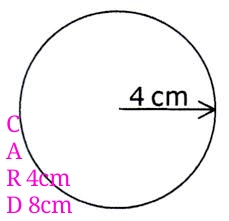
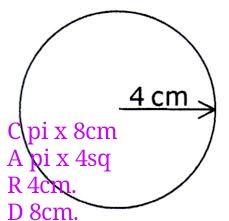
I then come away from the presentation and project some circles onto my board with varying measurements of radius and diameter. I then give the learners the option to go through area first and then circumference. I highlight that in my experience the thing people get wrong in this topic is doing the wrong one in the wrong question. Calculating area when they needed circumference. Or I give the learners the option of my default every time way. They choose my way. Everyone I see a circle I write CARD. We look at this example where we are asked to find the circumference of this circle:


The question gives us 4cm as a radius. We can write into CARD that R is 4cm and D is 8cm. Quickly singing pi r squared sounds like area to me… we can write in that the circumference would be pi x 8 and area would be pi x 4 squared. We then look back to the question and see what it asked us to calculate. In this case it was circumference so we circle that one and work it out. I like this method as it build solid repetition of the skill of recalling and applying the formulae. I also like it as it encourages the learner to reflect and choose is it area or circumference before diving in. 


In my class today the lower level group struggled to start but once CARD had been repeatedly applied they had rapid progression through the tasks. My top end learner decided his way was better and off he went. I always say, I don't care how you get here, just get here if you can. Meaning here is the correct answer! All the learners have access to the answers of all the tasks, they are marking as they go along. Suddenly my top end learner becomes frustrated. He has got most of the work wrong. I take a look and he has done the classic mistake of circumference when it wants area and vice versa. I remind him of CARD he gives it another go and signals to me 5 minutes later that he is being more successful now!


Whilst the learners are working I take 3 of them out one by one for a mini tutorial. They are my 3 at risk learners. I let them know I am putting in interventions for them and say that I believe with hard work they can improve. I am then taken aback realising my peer observers are with me in my final mini tutorial. I am mortified I left my class unattended with peer observers in the room. I apologise and my peers are great and they say, no we think it's brilliant you have taught them well enough to leave them for 5 minutes and these mini tutorials are equally important. I check on the class and they have all done a nice mix of area/circumference including semi circles and compound shapes. I give verbal feedback (should have written more down!) It's almost time for a break but not quite and I am just about to move on when one of the learners makes a safeguarding disclosure to me out of the class so I call a break for 10 minutes while I make notes and report it to my safeguarding lead. I bid farewell to my peers.


I grab 2 minutes to think about what we can do next. I had planned to do angles in parallel lines but I'm concerned that the secure circle knowledge is at risk if I go to angles. My other option is loci or bearings. I decide to go loci. I don't know why I don't teach loci particularly well. Actually it probably ranks as one of my worst lessons. I don't enjoy it and I struggle to visualise the boundaries of areas in the complex questions. Decision has been made now though, I am writing my new learning intentions up on the board before I remember how badly I teach loci!


We do a quick Slido to check our rating now on circles. Everyone has improved. We review the grade 3 and grade 5 learning intentions on loci and constructions and do another Slido, the class has no idea about the language of the topic. No one rates themselves higher than a 1. With a feeling of dread that this has been a poor decision we begin by drawing line and angle bisectors on blank pieces of paper. I demo them in my Slides presentation. (Someone years ago shared a nice demo where the compass moves and the arc appears, I would never have the time to make such a beautiful presentation so I am very grateful to still have it!) Cue difficulties with expanding compass widths in between arcs. Some are unable to keep their pencil in the compass. Some can't use the compass. I get round everyone improving their techniques I see no harm in spinning the paper rather than the compass if the learner struggles. We then take a look at some exam questions. They progress into not explicitly stating it is a line or an angle bisectors but a more worded question. All can do the explicit ones, most can do the more challenging ones. Progress is through skill repetition practise here.


I then put an x on the board (I have been rummaging in my bag for post it notes whilst they were working) and I ask each of them to put a post it note 20cm away from my x. They chat amongst themselves. Some want to do a line, someone twigs it would be a circle, then there's a competition on who can be accurate and exactly 20cm away. I am observing this active learning loving the conversation. I then demo a dog tied to a post would have a circle locus. Then a dog tied to a bar would have a running track shaped locus. (Handily there's a bar outside my window to help visualise) all are keen to get going and for some unknown reason I then decide to demo one of the complex garden planning questions. I draw a rectangle ABCD and ask them where I could put my path that is an equal distance from AB and CD. I start to get clammy I am about to jump in and answer my own question when one of the weaker learners contributes "would it be a line dissector?" We will skip over the incorrect language for now. I check the room and all are thinking the same. Another learner says "yeah this is fine but more than 5m away from the tree for the fountain that isn't any bisect or anything so what do we do there?" I am over joyed. The long phase about the path was because they had twigged that it was a line bisector and were struggling with the next part of the question. I demo an arc 5m from the tree and all are itching to get going. We do a quick Slido and no one rates themselves below a 4!


I circulate the room giving feedback. All have the answers so can tick and flick. I see little merit in me ticking and flicking their work. My role is to shape their learning journey and I do this through feedback not ticks and flicks. I can't believe it, everyone can do it! The lower level ones have some beautiful running track shaped around lines and even a running track around an L shape. The higher level ones are shading the correct regions in the town planning questions. One learner even attempts a create a shipping path question involving 5 elements. I look at the clock and 3.5 hours has gone! I pull them back for a final Slido, it stays the same. I recap our learning intentions and ask them to reflect in their fake iMessage sheets. See my blog post on feedback for these. They all thank me for a brilliant lesson.


I grab a cuppa and sit down to respond to their feedback iMessage sheets. Here are some of the responses:


"Why has no one shown me CARD before? Changed it all now"


"I will forget loci but I won't forget the lesson"


"Thank you it was epic, I learnt more than the last 4 years of studying for my GCSE"


I honestly think this was my best lesson ever. Yes I had pre planned presentations and my photocopying was ready but I made responsive decisions throughout and reflected on learner points. I don't think I did anything special, I certainly would never do anything special for a peer obs, and it all came good in the end. The peer observer emailed me a few weeks later and said she was trying Slido and some other bits she had seen me do, that is why I have an open door policy!


Why do we count in 4s?

 Why do we count in 4s in England? As a former maths teacher who chose to work in #FEmaths I think we may need to look at assessment at age ...