Showing posts with label stretch. Show all posts

Distance learning and the 4C's


Education is a rare profession where if you are absent you have to supply the work for the day. Imagine working in a GP practice and you had to supply the diagnoses for all the patients that were going to visit that day, it doesn’t make sense. That’s why cover work often falls down in achieving positive outcomes. Learners don’t always learn the way we expect them to learn. How often in a lesson do we have to change and shift the route we are on based on what we are seeing and feeling from the learners? That is why we are the experts, the professionals in our field.

I remember feeling an enormous guilt with all the time off I was having for my maternity appointments with my first child. I would miss at least half a day every other week for a variety of appointments. I would dutifully leave work for learners to complete but all too often I would return to it either not being done as cover didn’t arrive or it being done incorrectly because the learners had struggled. With all the stresses of my job in a normal capacity along with my personal stresses of being pregnant for the first time it became an arduous doomed task. So what is the solution? I can’t easily identify one. Sure a quality cover teacher with resources and knowledge of how to re-shape the learning if needed is the solution but in FE this is unlikely to happen. Since returning from maternity leave I have heavily stepped into distance and blended learning. A very unnatural fit for a maths teacher but I have thoroughly enjoyed it. Let’s make it clear, I am not saying setting distance learning in staff absence is the  solution. It may be an alternative but there is a lot of leg work to do beforehand. THIS BLOG WAS DRAFTED BEFORE COVID 19.

My first attempt at setting online/distance learning for my GCSE maths class was a disaster. It wasn’t completed correctly, nor was the button hand in clicked in many cases. Although the work had been done it had remained owned by the learner and I was unable to access it! I then tried an online activity in class on transformation. I reviewed the number of submissions after my first class and was shocked that I only had a third or so returned. I knew they had been working on it, I saw them do it! Again the hand in button hadn’t been pressed. This button is a large blue button on our system (Google Classroom is what we use, I am a Google Certified Trainer in the interests of transparency) and yet it had gone unnoticed. With the second group I ensured they pressed the blue button, by telling them to press it! And as the words fell from my mouth I realised I hadn’t included the explicit instruction on the task sheet to hand in the task! I had made an assumption that learners would know what to do. I wouldn’t do this in class with a normal task. I would never assume that they knew to do task b after task a I would always check on their progress and guide them to the next task. Something in my brain had said leave all your teaching knowledge at the door and let them fly, they’re online, they’re not your concern now.

Although I am disappointed that I did this, I am glad that I have had the opportunity to learn and reflect on the experience. I don’t think I am alone in this thought process either. There are lots of examples online of people experiencing the same thing and in handbooks on online teaching it is quite clear that student instructions need to be explicit. (Handbook of Research on Learner-Centered Pedagogy in Teacher Education and Professional Development) (http://bit.ly/2Tr8l1B) I have also seen it in my own organisation. As part of my role I get to mentor and support staff to include more digital and technology elements in their lessons. All too often I see learners sitting looking at a screen bewildered at the task having written 100 words not knowing what to do next. 

This week I was sat listening to learners completing a Google Slides presentation on the issues surrounding mental health in the workplace. The learners were discussing that identifying as BAME increased your risk to some mental health conditions according to the research they were reading here (http://bit.ly/2VKIcxB) the learners were shocked at how your ethnicity is something that you cannot control but plays such a significant part in your mental health. I was impressed at their articulation and debate. The teacher then came to check on their work and they had cut and paste 2 images into a Slides presentation and inserted the link to their source. I was shocked, they had discussed everything that needed to be in that presentation but not put any of it down. I sat and worked through with them creating their presentations again, we learnt how to insert videos, they added comments underneath as to why they felt the video was important, it ended up being a good piece of work. Afterwards I asked the learners why they hadn’t done this to start with, they said 

“You get stuff like this to do all the time and you just cut and paste stuff in and the teacher says it’s a pass”

“I didn’t know she wanted us to write all the stuff you wanted us to write, she didn’t say, she just said make a presentation and we did that”

“I didn’t know how to put videos in and that. I didn’t know you had to say why you wanted to put that video on as well”

I looked back over my colleagues task; she had asked them to create a presentation on the issues of mental health in the workplace. That was it. She had made an assumption that they knew what she was looking for in the task. I am not blaming my colleague for this, as I have made a similar mistake before as I have said. But there is a habit that staff have that if a learner is working online they know what they are doing and will return a brilliant piece of work with the scantest of task instructions.

Some of my colleagues deliver entirely online content and I wanted to see how that looks and feels for the learners, and the staff to ensure the quality is there. I visited one educator who gave me this narrative:

“Don’t get me wrong those first few weeks are hard. Logging in, showing them where stuff is, giving examples, I like to bring them in for a few sessions as well if I can so they can see the clicks and stuff.”

I thought this was interesting that even with entirely online content they still like students to come in to experience how to submit work online. My colleague later informed me that some students take until the end of term 1 to grasp how to complete work online, be it the physical submission process or the level of content required. There are two issues here then that I have identified when setting online work; how do students know what good looks like? And how do students know how to technically use the software?

Educators in the US are way ahead of us in the UK on this and one strand I have identified is the development of the 4C’s. I joke with my boss that now the 4C’s are 6C’s soon we will have 27C’s. For ease I will stick with 4 for the purposes of this. These are taken from the NEA in America: Communication, Collaboration, Critical Thinking and Creativity. (http://bit.ly/39cNGF7)These are the 4 most important skills the future workforce will need. I don’t think anyone will find it hard to disagree with them as key skills learners need. Whether this is the latest buzz in education or becomes embedded in our teaching practise I cannot see anything other than learners benefitting from educators focussing on these key skills. Encouraging learners to explore these 4C;s in distance learning has become common in the USA through a variety of tools.

Take a moment to google hyperdocs and hyperbooks as methods of instruction or choice boards and you will be overwhelmed with the content that is out there for staff to use. I must express my concern at staff delving too far into this without pausing and reflecting on the impact on  their individual learners, one size doesn’t fit all, yet to be informed of what is out there is important. You can read about my experiences with hyperdocs in a previous blog post. Handily there is a guide to hyperdocs here: http://bit.ly/2Ie5GTr Hyperdocs allow students to create unique work, collaborate on shared documents, critically think about the content they are adding and communicate their ideas. There are many other vehicles that do this but hyperdocs is a nice one to start with. The level of detail in a hyperdoc template exhausts me just looking at it. Videos, links, task sheets, all beautifully crafted. Now I realise why my first forays into online activities failed. I didn’t give the task the thought it deserved.

Whilst setting a distance learning activity is a solution for staff absence it is also a new way to deliver curriculum when students are physically at a distance (AGAIN THIS WAS DRAFTED BEFORE COVID). Creating independent learning resources is a new skill that I have had to learn. It is not OK just to label the task, you have to think about every aspect of the content. I created an entire GCSE maths curriculum in online lessons over one summer all with original images and questions, no cut and pasting. It took a whole day to write one lesson, and that is at my peak after I had found my flow with it! I must say though the beauty of it now is that I have carefully constructed content that I can dip in and out of within lessons which has eased my planning longer term! By no means are my lessons the most creative, nor do they embed many of the 4C’s but they guide learners through a topic from start to finish. 

Here is the outline of a lesson on angles in parallel lines:

Angles on a straight line,
Vertically opposite angles,
Angles around a point,
BREAK
Angles around a point in a set of parallel lines bisected by the same line,
Alternate angles,
Corresponding angles.

There are some topics on angles that I would normally cover in class when I look at angles, reading angles using a protractor, types of angles, acute obtuse etc. I have purposefully not included them here as I decided that those two topics were a skill all on their own. Due to the complexities of layering images and animations in Google Slides and my experiences of the physical difficulties learners have with using protractors I did them as a stand alone lesson. My teaching experience of how learners engage with specific topics informed the structure of my online lessons. If I wouldn’t expect them to complete all the tasks in one lesson why would I expect them to do so online? Likewise in my angles in parallel lines topic I have inserted a break. I would have made it two separate lessons but in my experience, although the correct language is often wrong, learners easily recall angles on a straight line, opposite angles and angles around a point. Where learners struggle is which is an alternate and which is a corresponding angle. I always teach it that you calculate the 2 sets of angles around a point first for the correct values then label them alternate and corresponding. You can read more about why I do this in my next blog post. 

Through my experience creating the GCSE curriculum online, I have a better understanding of the content of an online activity. There is still the barrier of students having the skills to undertake the activity. You know the feeling when you have a beautifully planned lesson and they just don’t get it! Imagine that but you find out a week later when you mark it! 

I was asked to complete a tracking document at work on a new system and I was given a series of screenshots to help me fumble my way through. However the screenshots were of every third of fourth stage in the process and I really struggled to complete my tracking. I mean I really struggled, I felt stupid, I tried every way I could to figure it out and in the end I admitted defeat and asked for help only to be told that the first stage of turning on the tracking document to make it live was missing from the instructions so all my efforts were in vain! I was deflated, furious and instantly didn’t want to complete any work for this department ever again! I now had an understanding of how our learners must feel.

I made a vow to myself to never make anyone feel stupid through lack of instructions on my part. I am now queen of screenshot guides. Someone has labelled them idiots guides, I’m not a fan of the term but it’s a common enough phrase that everyone understands it. I screenshot everything. Every click, every button, I insert rings around where to click, something like this:


Each of these images would be a separate page in a Slides or PDF document. I often make a video using screencastify to accompany the guides too. I have been following this approach for a year or so now and so far no one has said they failed to do something using one of my guides. I am mainly working with staff who are new to the technology I am showing them. One colleague made a mistake and asked me to visit her to rectify it. I printed off the guide that I knew would help and sat with her as we went through it step by step and she managed to rectify her own mistake. But how often do we as educators make this level of detailed guides for our learners to complete tasks? When my colleague asked her class to discuss mental health issues in the workplace did she give them a step by step screenshot guide of where to click? No, was that part of the problem, yes along with poor content instructions.

I fear when staff offer distance learning as the solution to staff absence or student attendance. It is one solution. But for it to be a solution it needs to have two carefully crafted components. One is of clear content instructions, what should the end product look like, is there an example or a template? And the other is clear technical instructions of where and when to click to complete the task. Only when both these elements are in place will better quality distance learning take place.

Circles, pi and Slido! The best lesson ever?

I'm not sure I should write this blog post but anyway! I taught for 3.5 hours 10 adults GCSE Foundation Maths where we looked at shape, space and measure topics. I had planned to do this lesson last week but due to a family emergency I was absent. As my class are adults I was nervous today that I may get a rough ride for the inconvenience of skipping out on them last week. Not true, they were wonderful. One lady said, "never apologise for putting your kids first". I thought, wow that's really powerful. I'm hoping to hold onto that when I am saying no to the million CPD lates I'm asked to do but I realistically can never deliver.


So I have to admit there was a very free and easy approach to my planning, I had a tonne of activities photocopied for a variety of SSM topics as I was out of sync with my scheme of work. I took a look and thought we will start with circles and see where we end up. We had just finished statistics and graphs as a topic a couple of weeks before so I quickly rustled up a retrieval grid on that, set that out as they arrived whilst I checked over my Google Slides presentation on circles. Just at that moment in walked 2 colleagues to do a peer observation. I have an open door policy. As an experienced teacher I feel it is my duty to offer an open door policy. Generally staff ask ahead of time out of courtesy if they can come in. I always reply with "come anytime, I won't be doing anything special" today's lesson couldn't have been more true! 


Off we go then with circles in Google Slides. I have my learning intentions displayed and I write them on my board with my keywords to remain for the whole lesson. I also write the date in words. I'm a bit of a stickler on this one as good habits help make better teachers I think. I was once taught by a head of department that if you write the date in words you are showing learners that there is a quick way to write the date but have pride and high standards and wrote it fully. I quite like writing it in words and it upsets me when it is missing from classroom boards and when it is written as 1/2/20 I always flash back to my old head of department. 


In the slides presentation I have inserted slido. Now Slido is a great polling tool that pops in really easily. It is an add-on to Google Slides (I am a Google Certified Trainer so most things I do are in GSuite) I have used Pear Deck before but due to connectivity issues at the remote campus I find Slido works better. I break down the learning intentions by grade, a grade 3 student should be able to do this and a grade 5 student can do this. I give my class my same old speech: "if we teach to a 4 and we fall short we will get a 3 so no apologies I teach to a grade 5 to give you the best chance of achieving a 4." This is high expectations in its simplest form. The Slido then appears and the learners rate themselves out of 5 stars where they are against the grade 5 broken down intention. We get a split of ratings, and some questions about what a sector is. (The grade 5 intention was about calculating area of sectors!)


I begin with labelling parts of a circle. Reminding them of correct spelling. English isn't the first language for many learners, for some it's not even their second or third language. This takes some time and is dull. I am worried I am losing them. I planned to do a mini quiz on the parts of the circle and a card sort but the mood in the room is, we have notes, you will out this on Google Classroom so we have your notes too, what time is break? Picking up the pace I jump in with the circle song! You can watch the one I use here. I know there are others but this is my favourite and I encourage them to sing it to themselves in their exam!


Back to the lesson... I can then see joy at the song but confusion at pi. No surprise, who actually knows what pi is? I quickly grab the elastic bands from my photocopying and ask them to measure the diameter whilst a partner holds the band in a circle shape. I then cut the bands and ask them to measure the length of the chopped band. They then tell me that they are measuring the circumference and that is. We record the 2 measurements from each pair on the board and discover that the circumference is about 3 times bigger than the diameter. We then look at where pi is on our calculators. There is the inevitable conversation of borrowing calculators, we can debate high standards and correct equipment vs financial situation vs local demographic vs adult learners another time.


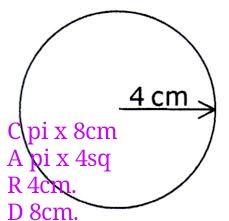
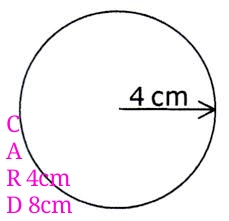
I then come away from the presentation and project some circles onto my board with varying measurements of radius and diameter. I then give the learners the option to go through area first and then circumference. I highlight that in my experience the thing people get wrong in this topic is doing the wrong one in the wrong question. Calculating area when they needed circumference. Or I give the learners the option of my default every time way. They choose my way. Everyone I see a circle I write CARD. We look at this example where we are asked to find the circumference of this circle:


The question gives us 4cm as a radius. We can write into CARD that R is 4cm and D is 8cm. Quickly singing pi r squared sounds like area to me… we can write in that the circumference would be pi x 8 and area would be pi x 4 squared. We then look back to the question and see what it asked us to calculate. In this case it was circumference so we circle that one and work it out. I like this method as it build solid repetition of the skill of recalling and applying the formulae. I also like it as it encourages the learner to reflect and choose is it area or circumference before diving in. 


In my class today the lower level group struggled to start but once CARD had been repeatedly applied they had rapid progression through the tasks. My top end learner decided his way was better and off he went. I always say, I don't care how you get here, just get here if you can. Meaning here is the correct answer! All the learners have access to the answers of all the tasks, they are marking as they go along. Suddenly my top end learner becomes frustrated. He has got most of the work wrong. I take a look and he has done the classic mistake of circumference when it wants area and vice versa. I remind him of CARD he gives it another go and signals to me 5 minutes later that he is being more successful now!


Whilst the learners are working I take 3 of them out one by one for a mini tutorial. They are my 3 at risk learners. I let them know I am putting in interventions for them and say that I believe with hard work they can improve. I am then taken aback realising my peer observers are with me in my final mini tutorial. I am mortified I left my class unattended with peer observers in the room. I apologise and my peers are great and they say, no we think it's brilliant you have taught them well enough to leave them for 5 minutes and these mini tutorials are equally important. I check on the class and they have all done a nice mix of area/circumference including semi circles and compound shapes. I give verbal feedback (should have written more down!) It's almost time for a break but not quite and I am just about to move on when one of the learners makes a safeguarding disclosure to me out of the class so I call a break for 10 minutes while I make notes and report it to my safeguarding lead. I bid farewell to my peers.


I grab 2 minutes to think about what we can do next. I had planned to do angles in parallel lines but I'm concerned that the secure circle knowledge is at risk if I go to angles. My other option is loci or bearings. I decide to go loci. I don't know why I don't teach loci particularly well. Actually it probably ranks as one of my worst lessons. I don't enjoy it and I struggle to visualise the boundaries of areas in the complex questions. Decision has been made now though, I am writing my new learning intentions up on the board before I remember how badly I teach loci!


We do a quick Slido to check our rating now on circles. Everyone has improved. We review the grade 3 and grade 5 learning intentions on loci and constructions and do another Slido, the class has no idea about the language of the topic. No one rates themselves higher than a 1. With a feeling of dread that this has been a poor decision we begin by drawing line and angle bisectors on blank pieces of paper. I demo them in my Slides presentation. (Someone years ago shared a nice demo where the compass moves and the arc appears, I would never have the time to make such a beautiful presentation so I am very grateful to still have it!) Cue difficulties with expanding compass widths in between arcs. Some are unable to keep their pencil in the compass. Some can't use the compass. I get round everyone improving their techniques I see no harm in spinning the paper rather than the compass if the learner struggles. We then take a look at some exam questions. They progress into not explicitly stating it is a line or an angle bisectors but a more worded question. All can do the explicit ones, most can do the more challenging ones. Progress is through skill repetition practise here.


I then put an x on the board (I have been rummaging in my bag for post it notes whilst they were working) and I ask each of them to put a post it note 20cm away from my x. They chat amongst themselves. Some want to do a line, someone twigs it would be a circle, then there's a competition on who can be accurate and exactly 20cm away. I am observing this active learning loving the conversation. I then demo a dog tied to a post would have a circle locus. Then a dog tied to a bar would have a running track shaped locus. (Handily there's a bar outside my window to help visualise) all are keen to get going and for some unknown reason I then decide to demo one of the complex garden planning questions. I draw a rectangle ABCD and ask them where I could put my path that is an equal distance from AB and CD. I start to get clammy I am about to jump in and answer my own question when one of the weaker learners contributes "would it be a line dissector?" We will skip over the incorrect language for now. I check the room and all are thinking the same. Another learner says "yeah this is fine but more than 5m away from the tree for the fountain that isn't any bisect or anything so what do we do there?" I am over joyed. The long phase about the path was because they had twigged that it was a line bisector and were struggling with the next part of the question. I demo an arc 5m from the tree and all are itching to get going. We do a quick Slido and no one rates themselves below a 4!


I circulate the room giving feedback. All have the answers so can tick and flick. I see little merit in me ticking and flicking their work. My role is to shape their learning journey and I do this through feedback not ticks and flicks. I can't believe it, everyone can do it! The lower level ones have some beautiful running track shaped around lines and even a running track around an L shape. The higher level ones are shading the correct regions in the town planning questions. One learner even attempts a create a shipping path question involving 5 elements. I look at the clock and 3.5 hours has gone! I pull them back for a final Slido, it stays the same. I recap our learning intentions and ask them to reflect in their fake iMessage sheets. See my blog post on feedback for these. They all thank me for a brilliant lesson.


I grab a cuppa and sit down to respond to their feedback iMessage sheets. Here are some of the responses:


"Why has no one shown me CARD before? Changed it all now"


"I will forget loci but I won't forget the lesson"


"Thank you it was epic, I learnt more than the last 4 years of studying for my GCSE"


I honestly think this was my best lesson ever. Yes I had pre planned presentations and my photocopying was ready but I made responsive decisions throughout and reflected on learner points. I don't think I did anything special, I certainly would never do anything special for a peer obs, and it all came good in the end. The peer observer emailed me a few weeks later and said she was trying Slido and some other bits she had seen me do, that is why I have an open door policy!


SLED exam technique

I have mentioned before the challenge of answering A03 questions and some strategies I employ. A03 style questions are when our students are required to make connections interpret results and evaluate solutions. The easiest way I remember it and explain to student teachers is it's those questions that are open ended and they could go many different routes to find the answer generally with a full blank page underneath. I am forever looking for current relevant research that can be easily applied to my maths lessons. Last year while studying a course on a MOOC for the Friday Institute about learning differences I came across something that may help. Yes I can't quite see how course on learning differences lead me to this, but it did, and I am grateful! It just goes to show you should read as wide as possible because you never know what it will turn up. One of the things that came out of one of the pieces of reading for this course was SLED. 

sketch 

label 

explain 

discuss

It got me thinking about these complex a03 style questions where we could easily sketch a picture of what the answer might look like, the painting of the floor plan or the number of marbles in a bag whatever the question maybe about. 


We can label underline key parts of the question. Now instead of explain I switch this to estimate. This was to relieve the pressure of the learners to immediately hit upon the right answer. They are allowed to roughly approximate first. Generally they are correct but with the pressure being off it really improved their confidence in giving these types of questions a go. So the learners could estimate how many tubs of paint how many marbles in a bag and then we could discuss our answers with our peers and then choose the correct strategy for solving the question. The power in relieving the pressure in making it an estimate was immediately evident with my groups. Learners openly admitted that previously they would have skipped this type of question but were now willing to give it a go. We now had a strategy where we could pose, pause, pounce and bounce! We could now have those meaningful discussion that deepen understanding that I keep seeing in other subjects lessons! 


This is a rough example of a simple A03 question using SLED:


Being brave I asked my learner's to SLED an A03 question before the lesson. We then discussed on tables and then as a class different approaches to the same problem. Again I believe powerful learning takes place where misconceptions or different approaches to the same problem can be explored. It was an instant hit with my learners. We then began thinking about how they could adopt this in an exam. We changed discuss to DECIDE for exam situations. This is when after you have estimated, you may have created 2 or 3 different options you must decide on the correct working out and clearly state that as your answer. I like to remind students at this point that multiple workings out will attract lowest marks available and remember each question is a new opportunity to leave an impression on an examiner. 


Here is the same ratio SLED problem with the decide element added, the original working has been left in for this examples purpose but would normally be crossed out:


I like this approach as it gives confidence to tackling complex A03 problems. It provides a crutch for learners to hold on to. It promotes discussion in maths lessons, it’s not always right or wrong! It promotes deeper understanding by looking at common errors and misconceptions. One mature learner, I won’t say her age, said that this strategy gave her the confidence at work to plan her response to requests and improved her stress levels, so it worked outside the maths classroom too!


Challenge for all2

As I said in the previous post the 'challenge for all' really changed my teaching from stretching the more able to challenging everyone and not by giving them more activities to do. Dylan Wiliam is just a treasure trove of hints and tips every time he writes or speaks. In one piece I read (the full article is here) he talks about activating students as instructional resources for one another. In its simplest terms he talks about before a piece of work is handed in a peer marks it and signs to say they have done so. If there are any remedial actions needed the peer must let the learner know, as if there’s anything missing when the teacher marks the work it is the peer that is responsible not the original learner. I liked this as I could easily see this in maths working well. You could give some learners a mark sheet to help them and for others you could ask them to do it without. Everyone could be involved. I was then browsing the brilliant trythisteaching and came across this Doctor’s Diagnosis It takes Wiliam’s idea and asks learners to prescribe remedial work to the originator. 


I took some prescriptions from the trythisteaching templates into my lesson. We were looking at sequences. 

Ben has completed the task. Stacey has marked his work and corrected his error. What I like about this is the level of differentiation available. Depending on my instruction Stacey could have just asked Ben to look again at part B, she could indicate the date we looked at the topic, or she could research a resource online that would help Ben and share that with him. I also like that they don’t need to be in the same class. Stacey is from group B and Ben group A, same set just opposite timetable. The possibilities of this are endless. You could do it verbally in class. However, when I tried this all I heard was “good try” “you did this bit great”. I found that when students had to put their comments in writing they became more focussed in their feedback. I find that many great teaching and feedback ideas are tricky to fit with maths as a subject but this one worked for me!


I am known when mentoring to say “if it isn’t in the plan it won’t happen” I am not pushing lesson plans, please don’t mistake me! What I mean is, whatever you use to plan, make sure all your activities and episodes are planned. For example, for progress checks against the learning intentions I encourage student teachers to have a slide in their presentation to ensure that they happen. (It’s not just student teachers that need reminding of this, I am more than aware!) I needed to ensure that I remembered to include a 'challenge for all' element in my lessons. As I have an open door policy for all staff, and especially mentees, I always need to be on point. I like doing one thing once and doing it well so that it is always the same level of planning from me. I found that whilst creating all these 'challenge for all' activities I found that some worked and some didn’t. So I hit upon a choice board. I created a Padlet of my 'challenge for all' activities. If you are unfamiliar with Padlet, it can be used as a virtual noticeboard with ideas pinned to it. If you are out of free usage of Padlet there are alternatives, try Linoit. My padlet looks like this:


I loved Fighting Talk on BBC Radio Five Live when I was younger. It was part of my pre match routine. The game ends with defend the indefensible. Two players were given opposing sides of a statement to defend. The statement was purposely controversial or opposing to the participant views. For example, one participant was asked to defend the statement that his wife’s cooking was terrible. He refused to engage! I have found that this format plays great in maths lessons. 


Imagine we are looking at solving equations x^2 = 36


Ben is asked to defend that x=6

Stacey is asked to defend that x=18


What I like about this is that both need to calculate the correct answer. Stacey needs to identify where the misconception has come from in order to defend it. I am a big fan of learners knowing the common misconceptions in order to avoid them. All to often in maths I see the power of 2 mis-interpreted as multiplying by 2! 


I found that defend the indefensible worked in many lessons and I could generally think of them on the spot! Any time solving or rearranging with algebra was involved I would challenge the whole class with defend the indefensible. We would do it as 2 teams against each other or lots of small pairs debating to the class. I found it a nice way to promote respect and listening along with developing debate and argument forming skills.


Spot my error and tick or trash were brought to my attention via TES. Spot my error came from the fabulous alutwyche https://www.tes.com/teaching-resources/shop/alutwyche  (he is also on Twitter https://twitter.com/andylutwyche) and tick or trash I originally found on the old but brilliant Number Loving from Laura Rees Hughes A lot of the Number loving resources are now to pay for on TES. Tick or trash has a question in the middle and to the left and right are two answers, one is correct, to be ticked, and one is incorrect, to be trashed.


The spot my error tasks from alutwyche are quite comprehensive. I have enjoyed adapting this idea. I will present and incorrectly answered question on the board and ask the learners to spot my error. This also helps with the inevitable board work mistakes I make daily as it gives me a great cover story! The spot my error from alutwyche and my own ones all focus on displaying a common misconception. Again if learners know the common misconception and can realise where it comes from they can avoid it. Both STEM and NCETM have resources and evidence explaining the common misconceptions in maths. You can find them here and here. The NCTEM also has a great paper on inspection worthy mistakes made by students here. It makes a great read. Broadly it suggests that “Conducting appropriate class inspections of mistakes in student work can create pedagogically powerful moments in the classroom.” One of the most powerful types of mistake to investigate, the article says, are those that approach the problem from a different way that the broad solutions from the class, as if the problem had been interpreted differently. This is my aim when I create either defend the indefensible, spot my error or tick or trash activities. How could the problem be interpreted and how different will the answer be?


My final activity in challenge for all is to create cheat sheets. I was shown these by my mentor in my NQT year and they have been with me every since. Do you remember the old, make a poster lesson? I hated them in school as I would rather be at home watching MTV Select than in school making posters! As a teacher I also dislike them as really, what are the learners learning apart from how to use fineliners of contrasting colours to make 3D lettering? A cheat sheet is like a poster but different! Have you ever had this... You ask the learners after a lesson, how much of this are you going to remember? Queue awkward faces and panic! It happens multiple times a day to me! A cheat sheet gives the learners a way out of this. You ask learners to imagine that they have 2 minutes before the exam and their present self wants to tell their future self all about this topic and they need to make a cheat sheet to record it. I normally model one as an example. I follow a thought or spider diagram. I encourage the learners to make it personal to them. A specific error they made in class they may want to clarify or they may want to emphasise a specific stage of the process. 


This rough example (apologies!) is personal to the learner. They are clearly wanting to remember interior means inside the shape angles. They are also keen to remember it’s angles around a point rather than in a circle! With my adult learners, evening class learners specifically, we do this weekly as they worry they won’t be able to remember it. I don’t blame them, maths is hard, many are working and raising families as well as coming to maths. We end up with a bank of 20 or so personalised cheat sheets. The learners then have a revision guide ready to go when exam day comes.


I am now pleased with where I have got to with my 'challenge for all'. There is challenge for all available in every learning episode via my padlet or prepared activities (if I remember!) It has been powerful in helping me develop skills to enable understanding rather than offering more tasks for my learners to complete. My learners were initially sceptical but embrace the challenge now and enjoy unpicking where the incorrect answers have come from.


Why do we count in 4s?

 Why do we count in 4s in England? As a former maths teacher who chose to work in #FEmaths I think we may need to look at assessment at age ...