Showing posts with label multiplication. Show all posts

Padlet and notice boards

One of the things I am often asked for is an online noticeboard. Staff want to use them to inform learners, assess learners and display student work. The natural choice is Padlet. See my previous post on challenge for all. This is an example of my challenge for all Padlet. When we were ready to enter the challenge for all zone I would display my Padlet and learners would choose a challenge to apply their knowledge from the lesson to.


I hit a problem when Padlet became popular at work. We were limited to the free accounts only and this meant I now had MASSIVE messy padlets. No longer was a nice collection of things, it was now a repository for everything shiny. We trialled a few others, Linoit was my personal favourite.
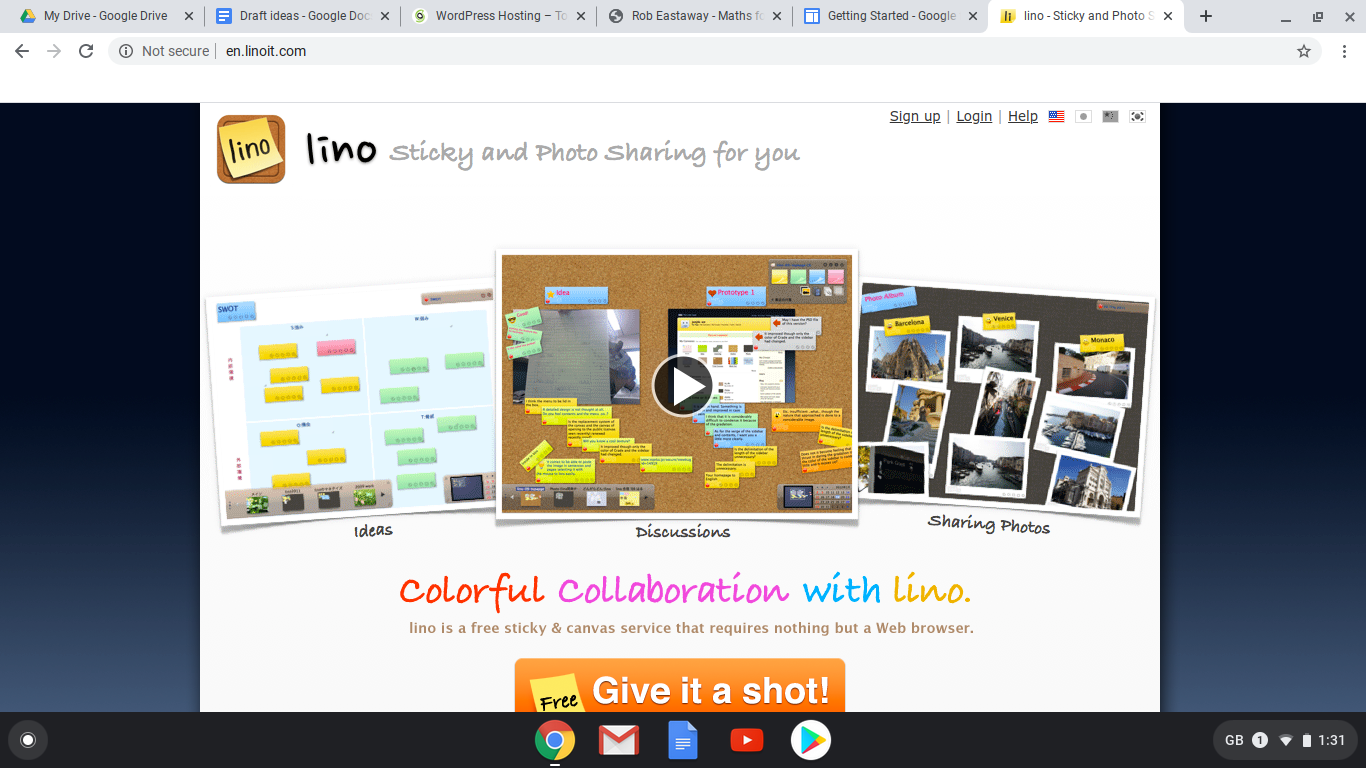

Linoit allows you to get learners to collaborate together on a large noticeboard. I liked the ease of it. I disliked the basic feel of it. We were then introduced to Jamboards. I must always point out I am a Google Certified Trainer and I do use Google a lot! Jamboard replaced Linoit for me as it was very similar. The real power of Jamboard is the app that can be used on any device and everyone can collaborate live. This is seen best with an actual Jamboard in the classroom. I take the point that it is another type of board and it is unaffordable for many. I am not totally convinced on any type of board to be honest. Some of my lessons are in a room that has a projector onto a whiteboard and I annotate around my slide deck in whiteboard pen. I am very happy with this arrangement! Like I said before, I am not a fan of tech just for the sake of it and an interactive board is not always necessary in my lessons.


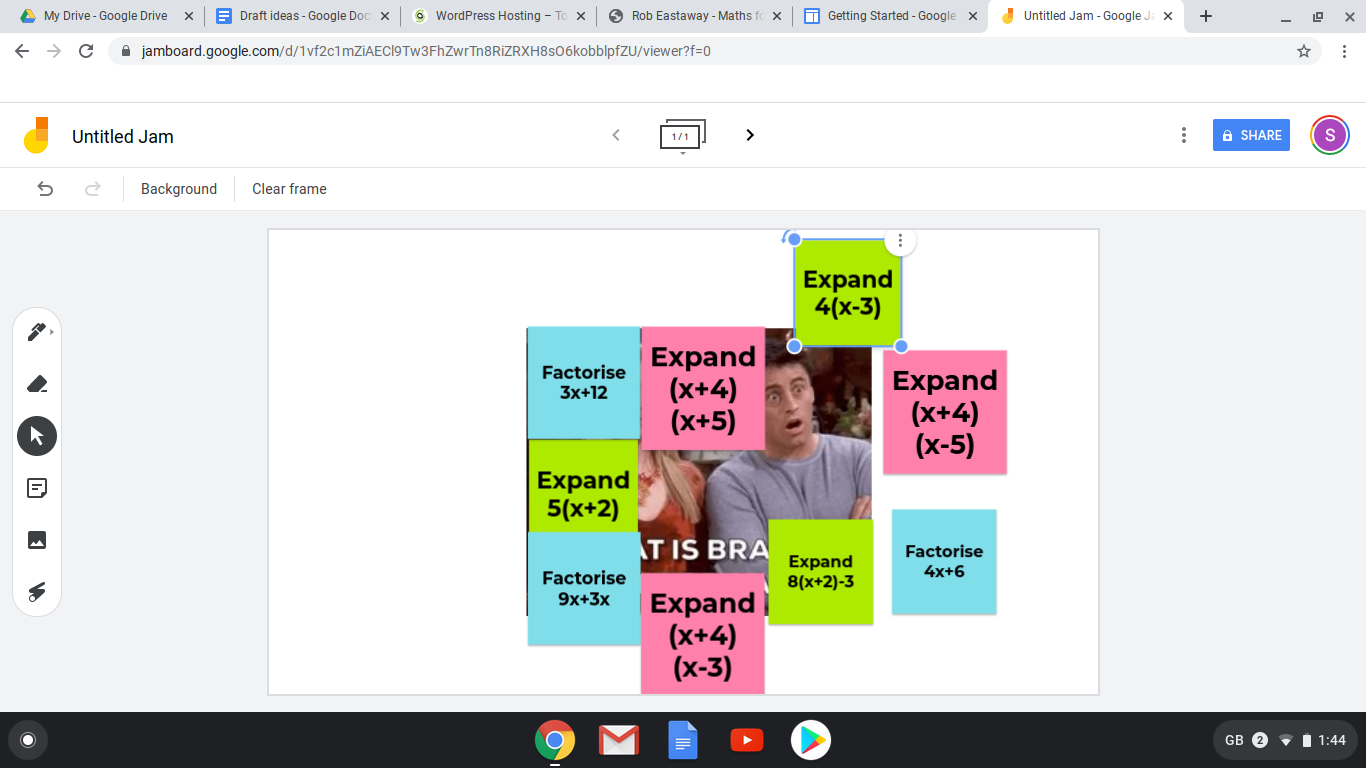
Anyway Jamboard...I like the collaborative nature, I like the name, join a jam, I like the colours and ease of it. I dislike the feature limitations and that it doesn’t recognise maths notation (quite a large problem!)(I m hopeful Equatio will be built in soon!) However I work with teachers of all different subjects and it has transformed some lessons. This is a simple maths jam that I use. It’s a drag and drop to reveal a hidden picture. Very similar idea to the amazing Catchphrase activities that the brilliant Laura Rees Hughes made in the early years of my teaching career that were very handy to have. 


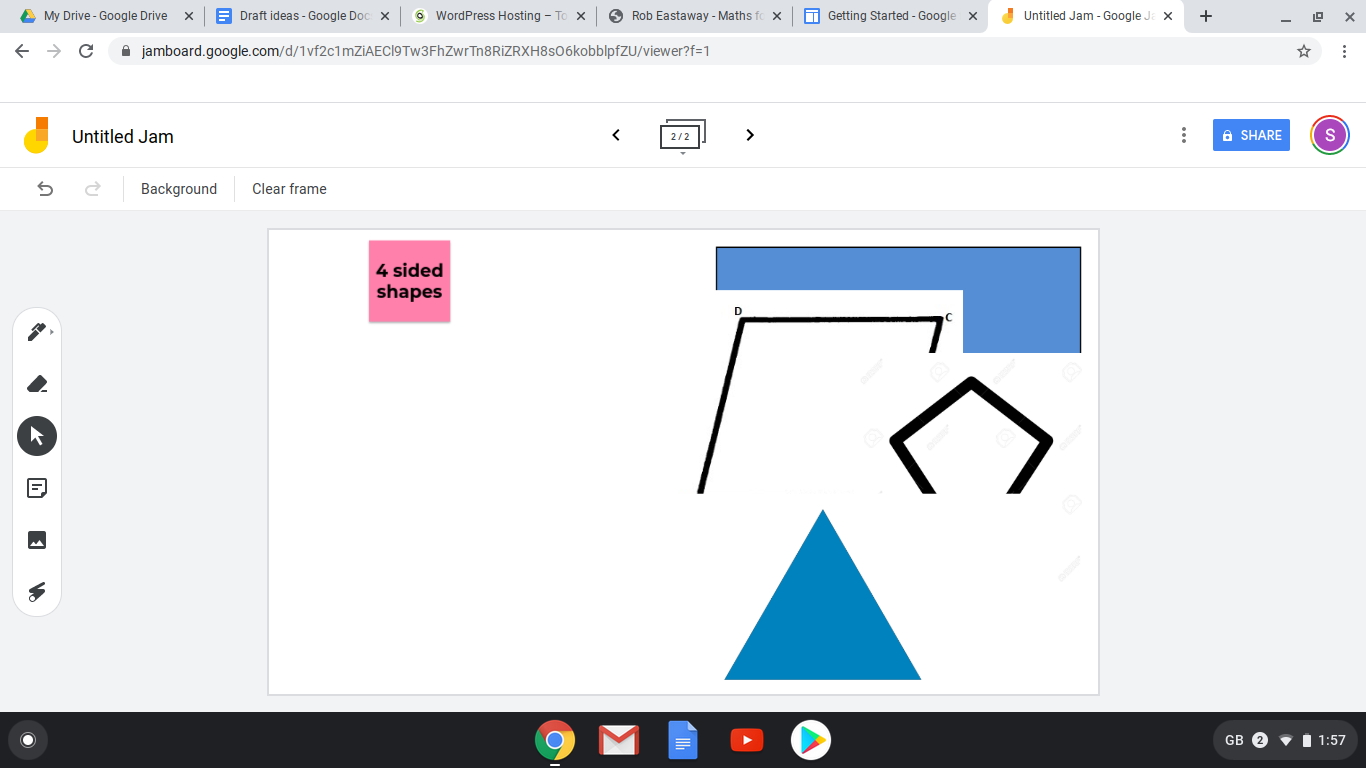
I work with provisions with learners with additional needs and some learners with profound learning needs. I hoped the power of Jamboard would be useful to the teaching staff in these areas. I was right. The learners enjoyed the kinaesthetic nature of dragging and dropping to reveal a picture. I then expanded this to reveal giphs. One learner loved buttons, so I used buttons instead of the sticky notes and it revealed a giph of underwater creatures bubbling away. We then used the Jamboard to practise mark making. I inserted mark making worksheets as backgrounds that learners wrote over. Finally we looked at traditional categorising card sort activities and replacing them with the Jamboard. We used the Jamboard to categorise shapes that had 4 sides on. I simply inserted lots of shapes, using the Google image search feature on Jamboard. It layers them nicely on top so you have a stack of them to move about. I then added a sticky of the category.


We then built on this to parts of the body, we did an activity on vowels and consonants. We also did an ordering activity where I inserted the images of washing your hands and the learners had to put them in the right order. It has been hugely successful with our learners with additional needs. My maths learners like the maths sticky activities too. So from a tool where we collected ideas on Padlet we have now moved to Jamboard for assessing and categorising. This meant I still had a need for a tool for displaying ideas and resources. I was introduced to Wakelet. 


You can add anything to Wakelet, your own material, material from the web, videos, bookmarks the list goes on. The aim of Wakelet is to curate your collection. The very problem I was having with Padlet ending up all messy is resolved with Wakelet as it is about picking your best, and being selective. My learners like Wakelet as a reference board. For example I would make one on multiplication, starting with lattice method. Then multiplying decimals. Supported with some videos and some practise on the methods. I am by no means a Wakelet expert, others I work with are! But I see the benefit and I like to set them up after a staff CPD session just displaying the tools or theory I raised in the session.

Best buys and fractions

These best buy questions were very in vogue when I started teaching every exam paper without fail had a best value question. I can still picture the washing powder boxes with their greyed out images those of you have been around awhile will still see them too. As I may have mentioned before one of my roles was to achieve 100% pass rate in a school that I taught in. As the best buy questions tended to be on the calculator paper we often felt these were easy marks that our lower sets could achieve.


It was my job to come up with a department wide approach for tackling best buy questions for those students lower set or higher set who just didn't get it. I cannot tell you how many times in my experience of working in schools marking mocks papers I have seen the division the wrong way round! 


Picture the morning of the exam. The free snacks or breakfast flowing and the whole of year 11 are looking at me for last minute tips. I was the lead presenter as the rest of the department floated around helping the panickers. I had been looking into all sorts of ways to solve the department wide problem of answering best buy questions so this wasn’t entirely out of the blue but I hadn’t firmed up my plans at this point. By opening my mouth I suddenly did firm up the department wide approach much to the shock of the head of department who was watching on! 

Price

Quantity


Yes there are best value questions where multiplying quantities up would give a more sensible answer but this became the approach for calculator best value questions. This may lead to fractional pence answers but it does give two prices that can be compared and a decision made on which is best value. I tell my learners that if they have their own way then they should use that but this may inspire some to tackle questions that they previously avoided. It also provides a nice opportunity to revisit rounding and significant figures. as I've said before rounding and significant figures is something that needs constant reminding and reinforcing and is always in my retrieval practice grids. 


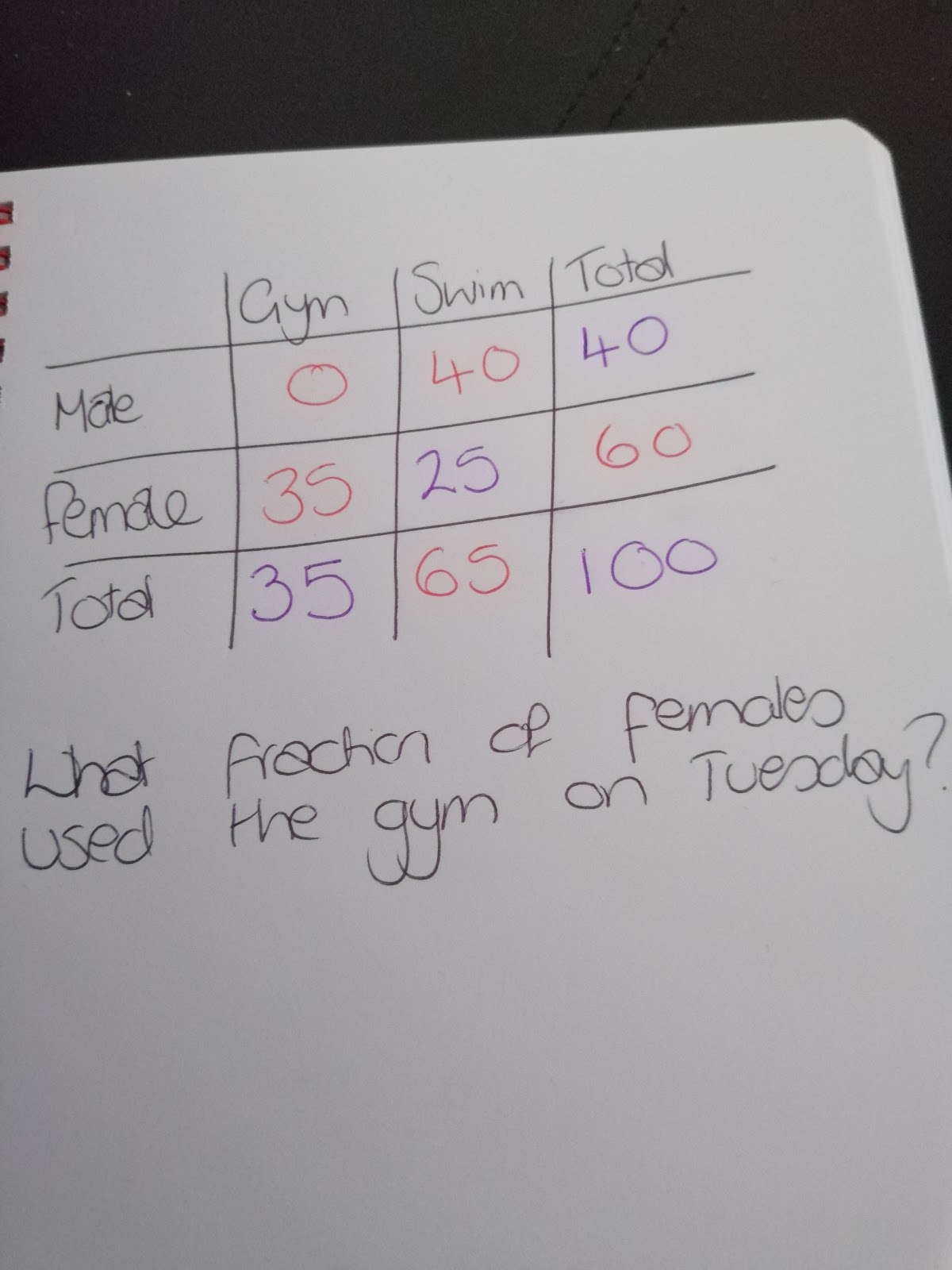
In the department I was in we began to look at other opportunities for marks for our lower sets. We looked at two way tables. We found the learners enjoyed completing the tables but struggled to pull out the final fraction. 


I began by asking my students how they would work it out. The main question I was asked is “how do you know which number you want?” This was evident in their working out. Nearly all of the students had 100 as their denominator with a variety of 35 or 60 as the numerator. Keeping things as simple as possible I used the language of the students. I trialled what you get as a fraction of what you want. So in this example we want females and we get gym females. 


This not only works for two way tables but any time a fraction from probability is required. 

What is the fraction of red marbles in the bag that has 4 green and 6 red? 6/10. You want marbles, you get red. It’s quite simple and really helped us crack the using the wrong denominator in the two way tables. 


prime factor decomposition and fractions

I inherit every possible method for teaching fractions under the sun. My learners come from every school across the city and all have their own way of doing things. Kiss and flick, kris kross, X marks the spot and so on are all ways for multiplying and dividing fractions. Like I always say, if you have a way that works consistently for you then use that way. I never unteach a method unless it is incorrect. Often methods have become incorrect because the learner has become confused with the method shown to them. In my experience students are more likely to become confused if they lack knowledge of the basics. One of the ‘wins’ I enjoy teaching is product of primes, prime numbers, simplifying fractions and divisibility checks. 


I like to start with prime factor decomposition. I like to call it this in my intentions on the board. I like to discuss the anxieties the learners have when they see the title and then experience the joy on their faces when they crack it in the end! There’s no fancy trick in what I am teaching, this one I am afraid requires singing and dancing as it is all about the presentation. I am not above making a fool of myself to help a concept stick in the learners minds. It all starts with some audience participation. I write up 2, 3, 5, 7, 11 on the board. We spend a few minutes shouting it as loud as we can. We play finish my sentence and I will call out 2, 3 and pick a learner to finish it off. Then we move onto questions of what is the third prime number? What is the fifth? We spend quality time recalling the first 5 prime numbers.


I don’t think I am doing anything out of the ordinary at this point for the learners. Everyone I have ever seen teach the topic as well has started by spending quality time on the first 5 primes. I tend to just stick to 2 3 5 7 11 for these early stages. An old favourite from my cover supervisor days on my PGCE was the 10 x 10 grid and playing in pairs to find all the primes up to 100. I will, if we have time, move onto games like this but in the first instance I stick to the first 5 primes. 


Here comes the singing and dancing…


“If you like it then you should have put on a ring on it”


Here is an example of the prime factor decomposition of 420:


We begin with writing our first 5 primes. We then use these as divisibility checks. I am aware that learners can find the highest prime factor and solve this problem quicker. I am not aiming for speed here. I am aiming for a consistently correct method. We always begin by seeing if 2 goes into the number. We keep the primes on the left as well.

I am aware that it may be obvious for some learners to use 5 as the prime when breaking down 105. I have no problem with this, actually in making these images that’s what I did and had to start again! Once we have broken the number down. I will then sing a bit of Beyonce or show an image of her on my board. (Beyonce also sits on my wall as well as Terry Pratchett!) The blue writing is purely for the example here, we verablise this in class but don’t write it.

Once we have really solidly grasped these divisibility checks, we can use them in a variety of ways. We can then look at simplifying fractions.

Yes this is a long way round but it ensures a consistent approach and reinforces the use of 2, 3, 5, 7, 11. It's a nice introduction in a stepping-stone to unpicking that initial knowledge that's needed to tackle a wide range of questions. Like I always say if you have your own with working things out please use your own way, but for those who struggle 2, 3, 5, 7 11 may just help with developing those core divisibility skills.


Multiplication

I'm sure by now you have heard me mention that I teach a lot of resitters where they may be sitting the GCSE for the second, third, fourth or however many time. I've also talked about those quick wins in those early weeks to earn their trust help them gaining confidence and to deepen their mathematical understanding. One of the easiest ways I've found to do this is through teaching students how to multiply correctly. As part of my PGCE training I was asked to teach a year 7 group a series of lessons covering every possible type of multiplication that I could find available. It led me to Egyptian, Chinese and many other types of multiplication. I became familiar with a wide variety of multiplication techniques that I had to fully understand before I could explain them.


My own knowledge needed to be sound and secure before I explained them to the attentive year 7’s hanging off my every word. There are some elements of teaching year 7 that I miss greatly! Chinese multiplication became my new favourite thing. I know only multiply this way, much to my builder and husband’s annoyance when planning our new extension! I'm sure you've seen it before the lattice method the Geloise method or simply Chinese multiplication. 


What I want to discuss here is the importance of being able to multiply correctly including decimals. Like I always say if you have a way that works for you than that's the way you do it what I'm offering you is a way if you can't do it consistently correctly. Many of my learner's come to me unable to multiply correctly they have been taught the grid method in primary school and they don't know what to do when they're lining them up for the final addition.


Take a look at this work this is typical of my students work. The grid is correct but the place value when adding is appalling. Yes, I am aware I will need to re teach place value but will these mistakes arise again after we have done that unit? What would happen if we looked at Chinese multiplication instead? 

Look at the lattice method above. Here we have the correct answer in a much simpler way. Place value is correct. This makes me happy. I like the Chinese/lattice method because it promotes place value. I like the fact that it only uses the times tables up to 9 x 9 and although we teach up to 15 x 15 often up to 9x9 is secure and above that can be a bit sketchy in my experience. 


But the real reason I like the lattice method is because of the power it has to unlock learning for many resitters. I say to all my trainee teachers and staff that I mentor. Teach someone to multiply correctly and they will be set for life. It is true, multiplication is one of those skills people have had negative experiences with and switch off. To be able to show someone how to multiply correctly can sometimes be transforming. A colleague (not a student or a teacher) was trying to multiply the number of tickets and the cost of tickets to budget for the cost of a conference for her team. She was struggling. I showed her lattice multiplication ( I drew the grid) she loved it. She was so overwhelmed she began to tear up. Maths, multiplying decimals in particular, had always been a struggle for her but she felt that it wasn’t anymore. That is the power of being able to multiply correctly. Lattice may not be the best way for everyone but I think it is worth spending the time to teach learners how to multiply correctly, including with decimals, to provide the skills that are needed for life, not just GCSE.


Why do we count in 4s?

 Why do we count in 4s in England? As a former maths teacher who chose to work in #FEmaths I think we may need to look at assessment at age ...