Showing posts with label padlet. Show all posts

Why do we count in 4s?

 Why do we count in 4s in England?


As a former maths teacher who chose to work in #FEmaths I think we may need to look at assessment at age 16.


I give the analogy of a pilot in my book.


A pilot proves knowledge has been acquired and retained on key aspects of flying in an exam. But to fly a plane commercially they accrue hours of competency. They evidence, over time, how they apply this acquired knowledge. They progress in their roles held in a hierarchical structure with flying hours a key part.


When I think about assessment in England, we assess at 16 a whole course approach and those who don't achieve the desired grade 4 are immediately affected for the rest of their lives. 


Imagine a student who achieved a grade 3 in maths but 7s in all other subjects. They gain 4 A levels (not in maths). Go to university and achieve a BA. They do an MA and then decide to get a job.


The first qualification that is often required is a grade 4 in English and maths. The rest of this students brilliant study doesn't get taken into account unless that grade 4 is there.


The 4 is what counts.


Sure the student can re-sit alongside other study but the point is, we place all our emphasis on this assessment designed for students aged 16.


What were you like at 16?


We don't take into account experience, skills, evidence of learning over time. 


We count in 4s.


I say this having taught an adult who worked as a healthcare assistant in a hospital, during covid, who wanted to be a nurse. They re-sat maths 6 times. They earnt a healthcare assistant wage for the 6 years of re-sits they took. They gained vast care and medical experience in that time. The year of covid they passed maths and immediately began a nursing qualification. Upon completion all the years experience were recognised and they entered nursing at a higher band salary than would be usual.


The experience counted but only after we counted in 4s.


So I come back to the pilot example, yes a skills test of the basics. Then a process of evidencing learning over time, applying the subject to real life, showing what you know in a variety of non exam ways. Sounds like a good maths course for 16-19 years olds, no?


These are not our decisions to make but we can raise our voices and show how we think change would deliver better for our students.


We need to stop counting in 4s.


This analogy and other arguments for disruption are in my book which is raising funds for charity. It is also available as an audio listen along version as well. Info at www.whatthetrig.co.uk 

Padlet and notice boards

One of the things I am often asked for is an online noticeboard. Staff want to use them to inform learners, assess learners and display student work. The natural choice is Padlet. See my previous post on challenge for all. This is an example of my challenge for all Padlet. When we were ready to enter the challenge for all zone I would display my Padlet and learners would choose a challenge to apply their knowledge from the lesson to.


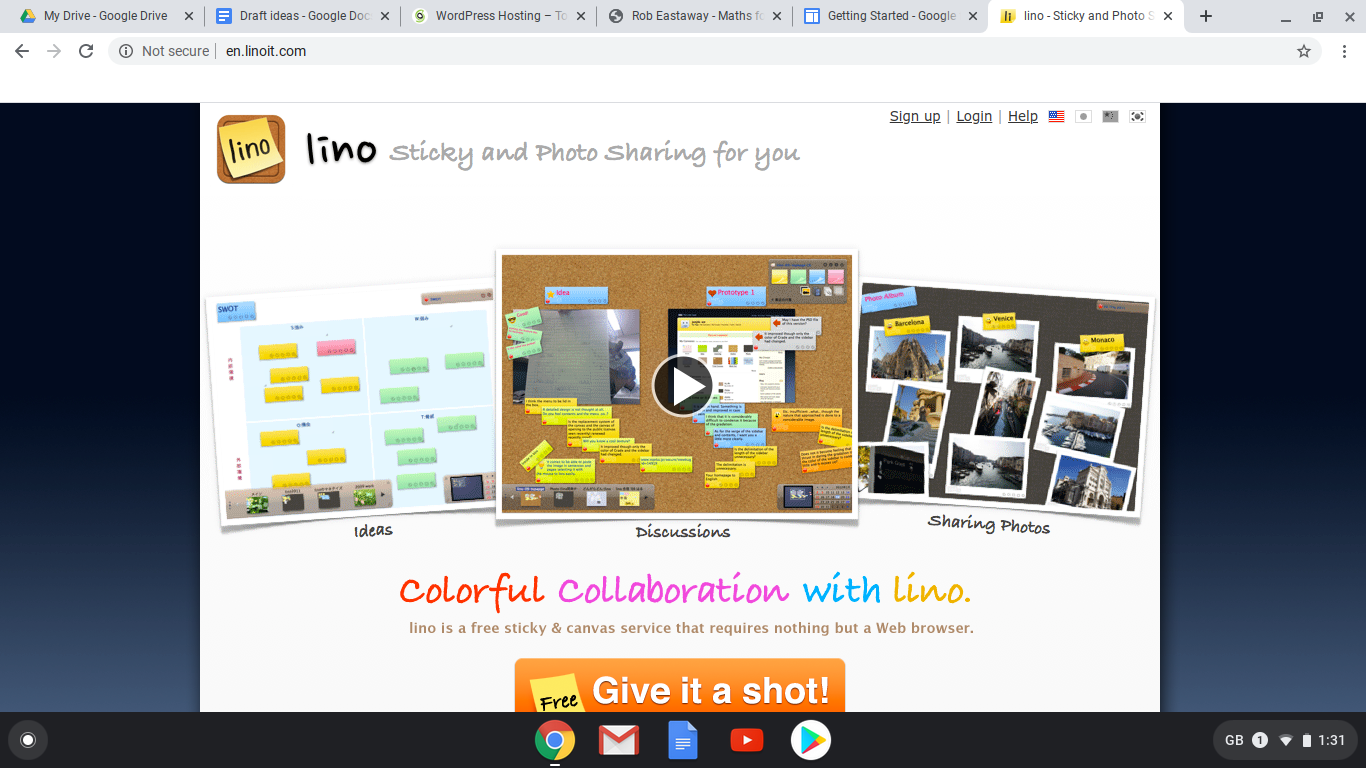
I hit a problem when Padlet became popular at work. We were limited to the free accounts only and this meant I now had MASSIVE messy padlets. No longer was a nice collection of things, it was now a repository for everything shiny. We trialled a few others, Linoit was my personal favourite.


Linoit allows you to get learners to collaborate together on a large noticeboard. I liked the ease of it. I disliked the basic feel of it. We were then introduced to Jamboards. I must always point out I am a Google Certified Trainer and I do use Google a lot! Jamboard replaced Linoit for me as it was very similar. The real power of Jamboard is the app that can be used on any device and everyone can collaborate live. This is seen best with an actual Jamboard in the classroom. I take the point that it is another type of board and it is unaffordable for many. I am not totally convinced on any type of board to be honest. Some of my lessons are in a room that has a projector onto a whiteboard and I annotate around my slide deck in whiteboard pen. I am very happy with this arrangement! Like I said before, I am not a fan of tech just for the sake of it and an interactive board is not always necessary in my lessons.


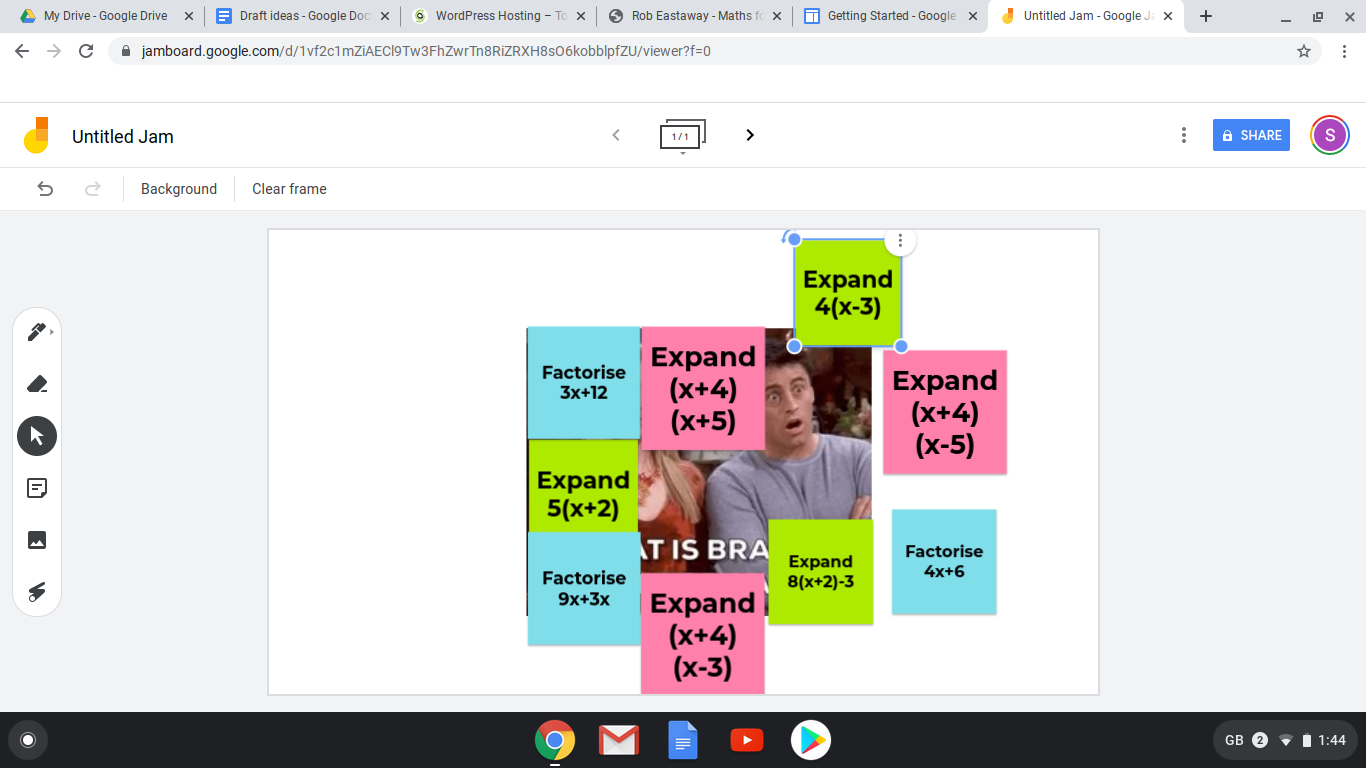
Anyway Jamboard...I like the collaborative nature, I like the name, join a jam, I like the colours and ease of it. I dislike the feature limitations and that it doesn’t recognise maths notation (quite a large problem!)(I m hopeful Equatio will be built in soon!) However I work with teachers of all different subjects and it has transformed some lessons. This is a simple maths jam that I use. It’s a drag and drop to reveal a hidden picture. Very similar idea to the amazing Catchphrase activities that the brilliant Laura Rees Hughes made in the early years of my teaching career that were very handy to have. 


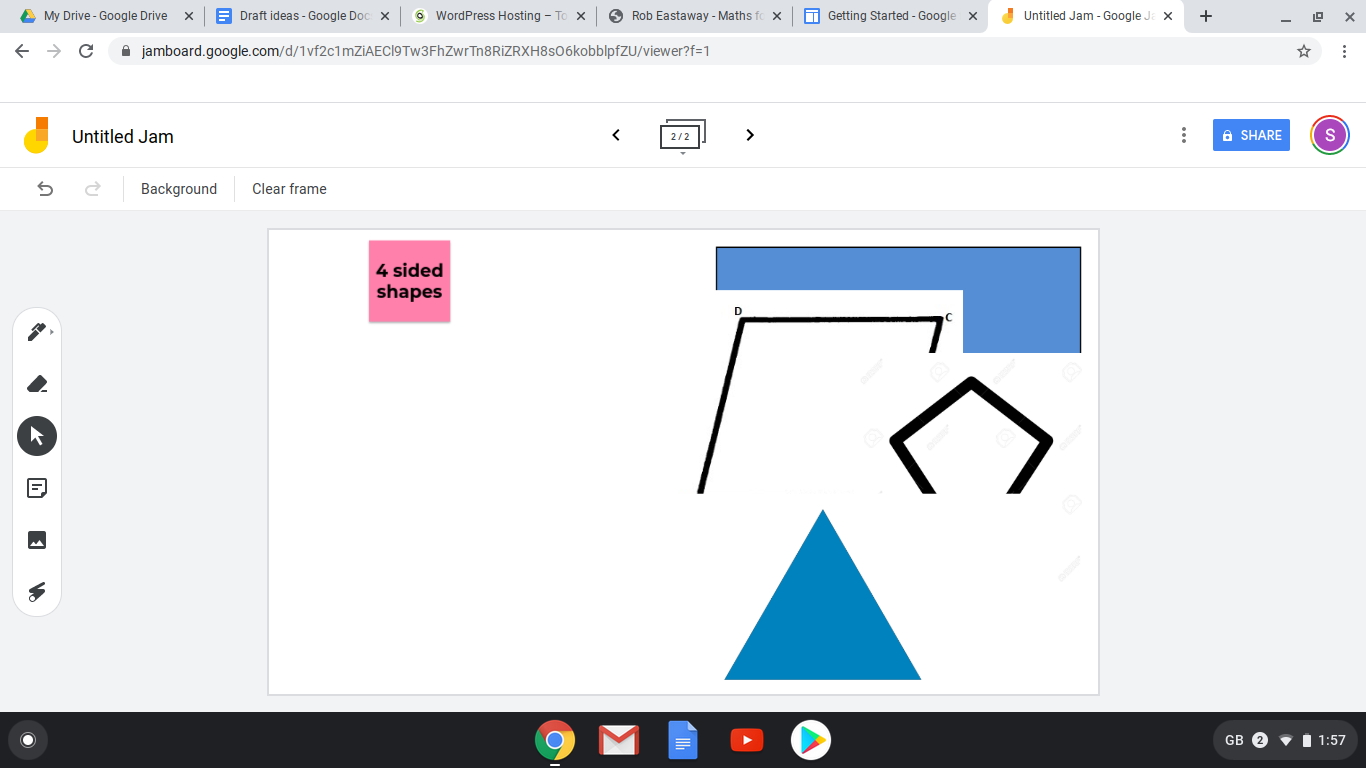
I work with provisions with learners with additional needs and some learners with profound learning needs. I hoped the power of Jamboard would be useful to the teaching staff in these areas. I was right. The learners enjoyed the kinaesthetic nature of dragging and dropping to reveal a picture. I then expanded this to reveal giphs. One learner loved buttons, so I used buttons instead of the sticky notes and it revealed a giph of underwater creatures bubbling away. We then used the Jamboard to practise mark making. I inserted mark making worksheets as backgrounds that learners wrote over. Finally we looked at traditional categorising card sort activities and replacing them with the Jamboard. We used the Jamboard to categorise shapes that had 4 sides on. I simply inserted lots of shapes, using the Google image search feature on Jamboard. It layers them nicely on top so you have a stack of them to move about. I then added a sticky of the category.


We then built on this to parts of the body, we did an activity on vowels and consonants. We also did an ordering activity where I inserted the images of washing your hands and the learners had to put them in the right order. It has been hugely successful with our learners with additional needs. My maths learners like the maths sticky activities too. So from a tool where we collected ideas on Padlet we have now moved to Jamboard for assessing and categorising. This meant I still had a need for a tool for displaying ideas and resources. I was introduced to Wakelet. 


You can add anything to Wakelet, your own material, material from the web, videos, bookmarks the list goes on. The aim of Wakelet is to curate your collection. The very problem I was having with Padlet ending up all messy is resolved with Wakelet as it is about picking your best, and being selective. My learners like Wakelet as a reference board. For example I would make one on multiplication, starting with lattice method. Then multiplying decimals. Supported with some videos and some practise on the methods. I am by no means a Wakelet expert, others I work with are! But I see the benefit and I like to set them up after a staff CPD session just displaying the tools or theory I raised in the session.


Why do we count in 4s?

 Why do we count in 4s in England? As a former maths teacher who chose to work in #FEmaths I think we may need to look at assessment at age ...