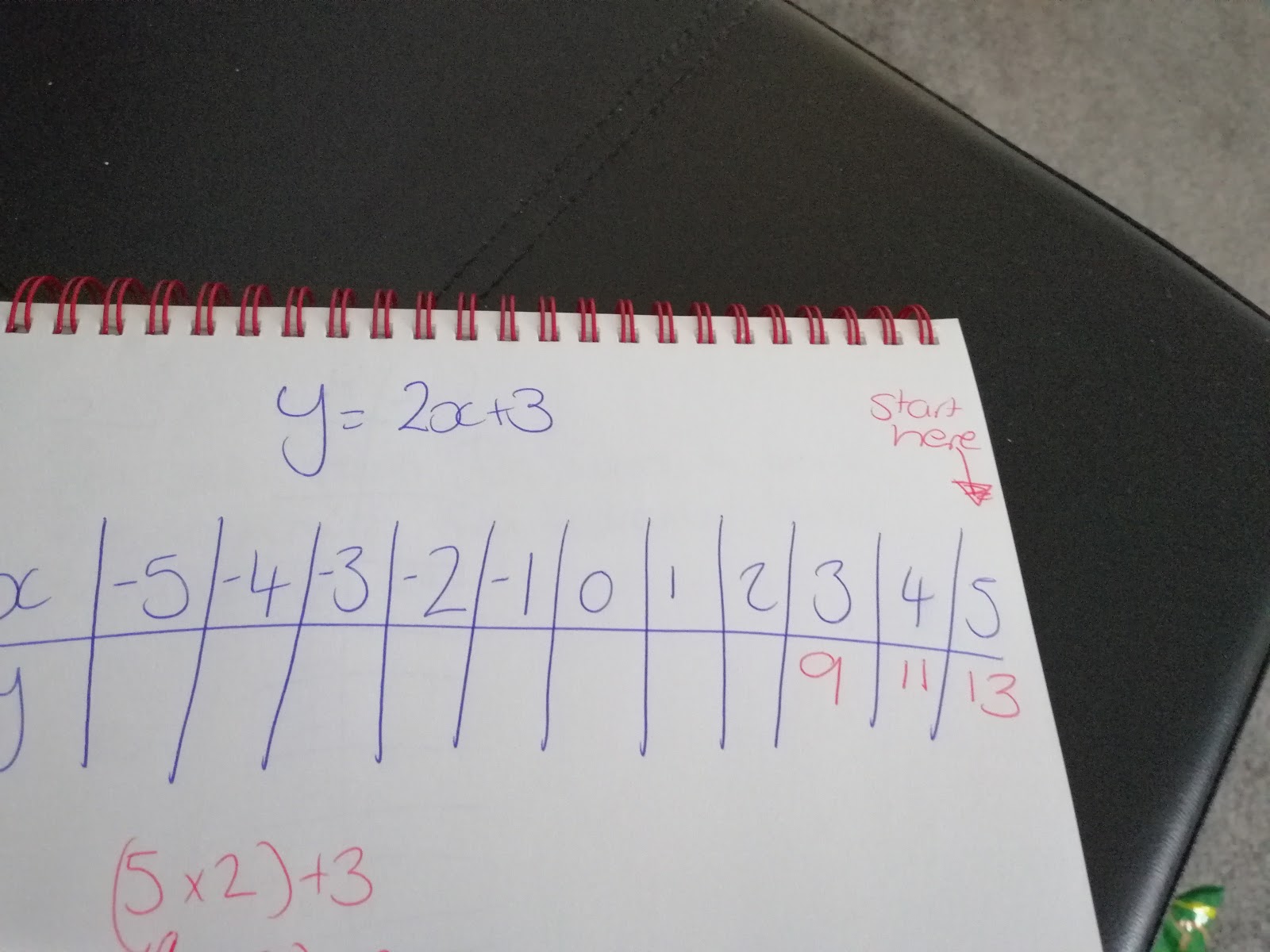
Collecting like terms, simplifying expressions, introduction to algebra, whatever you call it, it’s one of the most important but underestimated lessons in my opinion. It’s an opportunity to introduce the key concept of letters for numbers and the unknown. The old avoid x and y playing in my mind, integrating equality and diversity as well as employability and enhancing digital IT skills ringing in my mind ...my lesson needed a revamp, or so I thought! My original lesson began with describing the shopping in the basket.
I always say to the learners, you wouldn’t say that you had 9applebananas so why would you write it in algebra? The point being that each term is a different unknown. 5a + 4b. Did this need a revamp? Maybe? So it became a bingo game! Each image had a mixture on the page and learners had to form an expression to represent it! I had great fun!
On the bingo card was 6n+6t in one of the squares!
You get the idea, it just freshened up the apple and banana image. We then did some work based ones, for catering students we had this one for 7c+5w:
The idea was to engage the learners. By changing the image and creating a game rather than chalk and talk and questioning through we had a much nicer time! I felt that the concept was more secured than my usual discussion. I was impressed with the power of changing the images and activity, not everything needs to be all singing all dancing!
We got to forming equations and then solving equations much quicker as well. I was rapidly searching my Google Drive for anything that I could go with mid lesson as we were about to finish the forming expressions tasks. I came across this
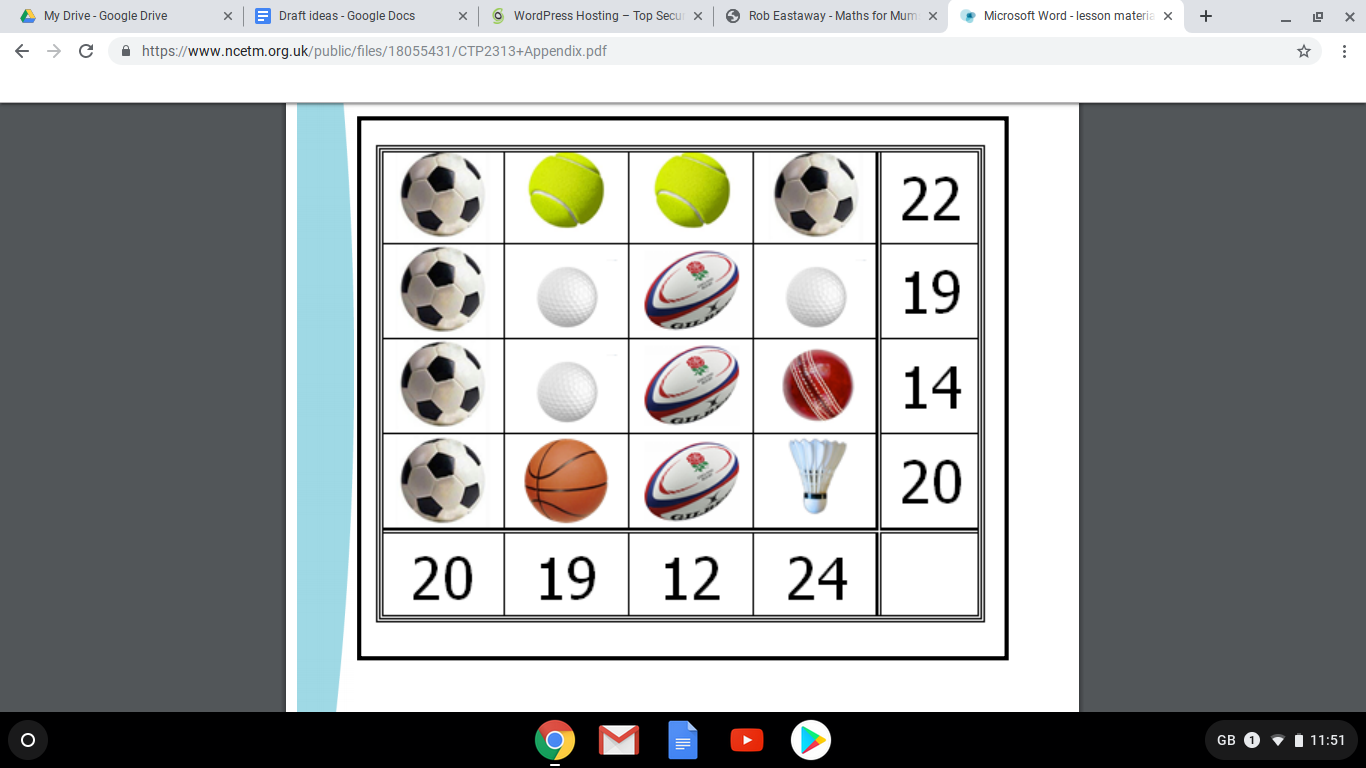
I wouldn’t like to guess how old this resource is, I have certainly had it for 10 years or so! The learners quickly formed equations for the image and got straight on with solving the equations. That weekend we went for a family nightmare, sorry I mean meal, at a chain restaurant, and on the kids pack was a similar one of peppers and cucumbers. Even my 4 year old worked out that a pepper was worth 2 and they started to look at the value of the cucumber.
Reflecting on my lesson where I had gone to the NCETM resource off the hoof and the ease my 4 year was engaged and able to solve I thought there must be something in this approach. Why do I teach solving equations with unknowns represented as letters and not as images? Because that’s how it is in the final exam? Is there a way I can start with images then move onto letters? Fast forward to my night class of adult resitters. Algebra was not their thing, the very word made them panic. In my way of no lesson being a surprise some of them had started to panic about the lesson coming up in 3 weeks time called solving equations, such are the barriers to learning when we are resitting and have had a previous negative experience with algebra. Realising the anxiety of the learners I carefully planned a sequence that skipped through algebra only using images.
I'd like you to picture a learner who is in her 40s who is working full-time as well as running her house, caring for her children and her grandchild. She's coming to a night class once a week, she needs to pass her maths otherwise she cannot receive a pay rise at work. Her homework is always completed on time but it takes 5 to 10 attempts to get it correct. The pride she takes in her work is out of this world and I stand at the front and say we're going to do algebra. Instantly her face changes, her brain shuts down and she does not want to be there. But in sharing algebra in pictures it transformed her face, and her learning experience. She managed to move onto solving unknowns on both sides using images and taught her peers this the following week!
We were able as a group to really power through solving equations. After we had finished with solving with images, we moved onto traditional 2 or 3 step solving equations. The balance method is something my learners can often recall as a name but not recall as a process. I have never got to the bottom of why the concept alludes so many of them. Like I always say, if you have a method that works for you and you can apply it consistently then use that method. If you don’t you may want to consider my alternative. Solving equations is no different. You may know this as the function machine method, or the flow chart method and I find it a very powerful tool. I also enjoy the story telling I put into it as well!
The story goes like this, g gets on the bus, 5 people get off at the next stop. 4 of his family get on at the stop after and they get off at bus stop number 24 in town. They go shopping, have a vegan sausage roll and to get home, what bus stop do they need to get the bus from? 24, then who will get off the bus first? The 4 family. Then 5 get back on and g gets off at home and they live at house number 11.
The learners don’t draw in the buses etc, they use the arrows but I find the storytelling helps secure the knowledge. My 40 year old who ended up teaching her peers really took to this method, as do all my learners. If I am mentoring teachers and they observe me teaching solving equations like this, it soon becomes their norm of teaching solving equations too. I have been challenged as to what level of understanding the method gives learners in terms of algebra. I argue, they are comfortable calculating with unknowns which is a great place to be at is it not?