Hyperdocs

I love technology, I love technology in teaching, I love trying new things. Even with this passion and love I find it a challenge to seamlessly integrate opportunities to develop learners digital skills in my maths lessons, sorry! I was once observed teaching plotting linear functions. I was exceeding teaching standards in all areas apart from developing digital IT skills. I asked the observer for how they would have done it in the lesson and they said to get the learners to plot the functions using Geogebra. Now I took an issue with this. Mainly because I felt it would have been impractical to fire up the aging PCs and get the learners logged on just to complete this activity and the time it would take to do all of this when we could be learning or developing skills. The observer said but this would be developing their digital skills. I challenged this and said, no it isn’t it is ticking a box for my observation. You can feel the eerie silence even now! My point was that as GCSE is a paper based linear subject the learners are not assessed on being able to plot linear functions online. They are assessed on being able to do it on the exam paper at the end of the course. Also what development of digital skills am I doing by asking learners to insert numbers and the application draws the linear function? I argue very little. Most learners are capable of plugging in values to an application to generate an output. I also argue that their time would be better served accurately plotting coordinates and linear functions than doing this online. You can imagine the observer was relieved when I signed my feedback sheet and the feedback session was over! I am not a fan of doing something for the sake of doing things. We have a lot of boxes to tick as teachers and educators and it is too easy to take a linear approach to this when planning lessons and include activities for the sake of them. I am a fan of integrating things into lessons that have meaningful impact and develop value in the learning that it taking place. I am so passionate about this as once I was in a Head’s debrief of a day one of an OFSTED when she said that anyone who hasn’t been seen needs  to include some ICT (it was a while ago!) as the inspectors haven’t seen any yet. I immediately re-did my beautifully planned lesson to an ICT maths lesson and instantly regretted it when the inspector turned up as I was uncomfortable with the activity and it showed! 


Knowing my inadequacies in integrating meaningful Digital IT skills into my lessons I am an avid reader of all things technology and all blogs, American or from anywhere around the world. Like a YouTube spiral, reading blogs can lead me to another blog to another blog and so on. One day I landed on a blog talking about teaching maths with Hyperdocs. 


Here is a great Padlet made by Kristine Vester @kavester  https://padlet.com/kvester/mathhyperdocs

There are also templates and examples on https://hyperdocs.co/index.php/templates


A hyperdoc is a Google Doc that asks learners to explore, digitally, concepts and evaluate approaches, thinking critically and developing their skills. It isn’t an interactive worksheet. Most Hyperdocs ask learners to  engage, explore, explain, apply, share, reflect, extend the learning. One example that I found on the Padlet was this one for solving equations.


I like Hyperdocs for a few reasons. They allow learners to participate in a meaningful learning experience without my input. Not that I am doing myself out of a job but, taking from Alice Keeler, this allows me more quality time focussing on the learning that that individual needs. Likewise this learning experience can happen outside of the classroom. I use them as prior learning, so that we can tackle the harder stuff in class. I am a firm believer that a lesson will be more productive if a learner arrives prepared and engaged, I’m not a fan of keeping lesson topics as a surprise, I like them to take an interest and try to get ahead! I am under no illusion that not every learner will arrive prepared and there comes a challenge of how to catch those up who haven’t prepared and develop those that have, but the Hyperdoc allows those that haven’t prepared the opportunity to do it independently in the lesson whilst the rest move on. Hyper docs help me with my long term absentees. Those who realise that the next stage in life is locked away to them (around Easter time) because they haven’t attended and are unlikely to achieve their GCSE maths. That panic of how to catch them up and reintegrate them in lesson is overcome with Hyperdocs. Teaching performing arts students around Christmas time when it is panto rehearsal can be a challenge but giving them access to the Hyperdoc and creating a bespoke 1to1 session in the lesson had a deeper meaning and was more powerful for my learners than me chasing them for attendance. No I am not an expert on Hyperdocs and nor have I had the time to create my own without a template, but if there’s such good resources out there, I don’t see the need. Hyperdocs have enhanced my learners experience and reduced my chalk and talk time, they’re a winner for me! 

Plotting functions

We call it plotting linear functions,  we may call it plotting line graphs, we may also call it drawing graphs. You may also call it y = mx + c. There are many different ways that we can call plotting linear functions. However not many of these ways mean anything to our learners. Yes we could loosely and tentatively link in English and explore the language of plotting linear and define the term functions. After we define the words, use a thesaurus, come up with synonyms and then devise our own definition and then create our own lesson objectives we have probably used a full hour?!


This might be a nice activity but actually it's not going to help with the knowledge that we need in the first instance because when we start teaching this topic what were actually teaching them to do is complete tables of values. I appreciate you may not teach it this way but this seems to be the way I have seen it or across many different schools. And when were completing a table of values again we're calling it something that means nothing to our learner's. This whole idea came from the excellent Will Emery http://www.greatmathsteachingideas.com/ . It was Will who said why do we call it table of values when actually it's a table of coordinates? And it was that simple changing language that cracked it for me with the bottom set year 8 in a school I was in that all of a sudden could plot linear functions. Which is why I'm a great advocate of finding a different way to say something to remove are complicated mathematical language where appropriate. Yes I still call it prime factor decomposition and yes I will still refer to this as plotting linear functions and completing the table of values but my lesson objectives will refer to completing tables of coordinates. Because as in the blog post that I read from Will Emery that is essentially what they're creating a table of coordinates. Just such a simple language change makes all the difference. 


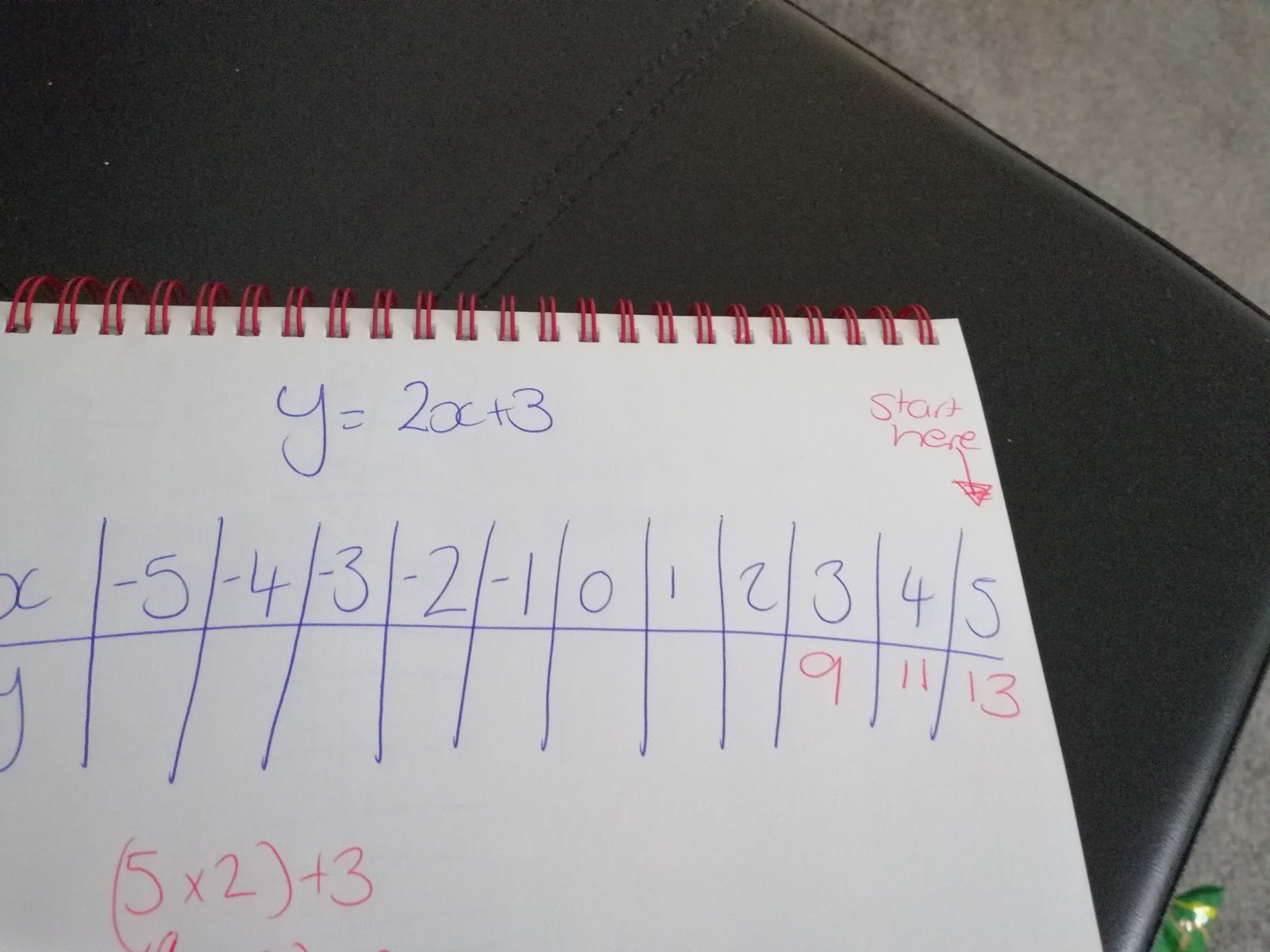
Once we have called it a table of coordinates we may not be good to go, as I learned! Think of the typical question, something like “plot the table of values for the function y=2x+3 for the values of x -5 to 5.”  Channelling Will Emery’s post it it struck me that actually if you start with the positive end of the table of coordinates (values) you can spot the linear pattern and then complete the negative values. In the function y = 2x + 3 for the values of x -5 to 5 , 

I would substitute in 5 first 5 x 2 is 10 + 3 13.  

Then I would substitute in for 4 x 2 is 8 + 3 is 11 

Then I was substituting 3 so 3 x 2 is 6 plus 3 is 9.

I can now see a pattern in that is going down by two. I can now complete the rest of the table of values without having to actually multiply negative numbers by continuing the pattern. Yes multiplying with negative numbers is important. I would always encourage students to check that they are correct my substituting in negative numbers. But if you think about what we are trying to achieve in this lesson, it is to plot functions, not multiply negative numbers. I am aware that these skills should be secure and should time allow I would love to recover and remain on negative numbers until the were secured. However, I prefer to look at and explore why a linear function generates a linear sequence rather than focus on the practical application of multiplying negative numbers which may not be secure knowledge for learners. Once they have discovered the pattern, we can then ask why is there a pattern and explore algebra through the interest that plotting linear functions has generated.


Best buys and fractions

These best buy questions were very in vogue when I started teaching every exam paper without fail had a best value question. I can still picture the washing powder boxes with their greyed out images those of you have been around awhile will still see them too. As I may have mentioned before one of my roles was to achieve 100% pass rate in a school that I taught in. As the best buy questions tended to be on the calculator paper we often felt these were easy marks that our lower sets could achieve.


It was my job to come up with a department wide approach for tackling best buy questions for those students lower set or higher set who just didn't get it. I cannot tell you how many times in my experience of working in schools marking mocks papers I have seen the division the wrong way round! 


Picture the morning of the exam. The free snacks or breakfast flowing and the whole of year 11 are looking at me for last minute tips. I was the lead presenter as the rest of the department floated around helping the panickers. I had been looking into all sorts of ways to solve the department wide problem of answering best buy questions so this wasn’t entirely out of the blue but I hadn’t firmed up my plans at this point. By opening my mouth I suddenly did firm up the department wide approach much to the shock of the head of department who was watching on! 

Price

Quantity


Yes there are best value questions where multiplying quantities up would give a more sensible answer but this became the approach for calculator best value questions. This may lead to fractional pence answers but it does give two prices that can be compared and a decision made on which is best value. I tell my learners that if they have their own way then they should use that but this may inspire some to tackle questions that they previously avoided. It also provides a nice opportunity to revisit rounding and significant figures. as I've said before rounding and significant figures is something that needs constant reminding and reinforcing and is always in my retrieval practice grids. 


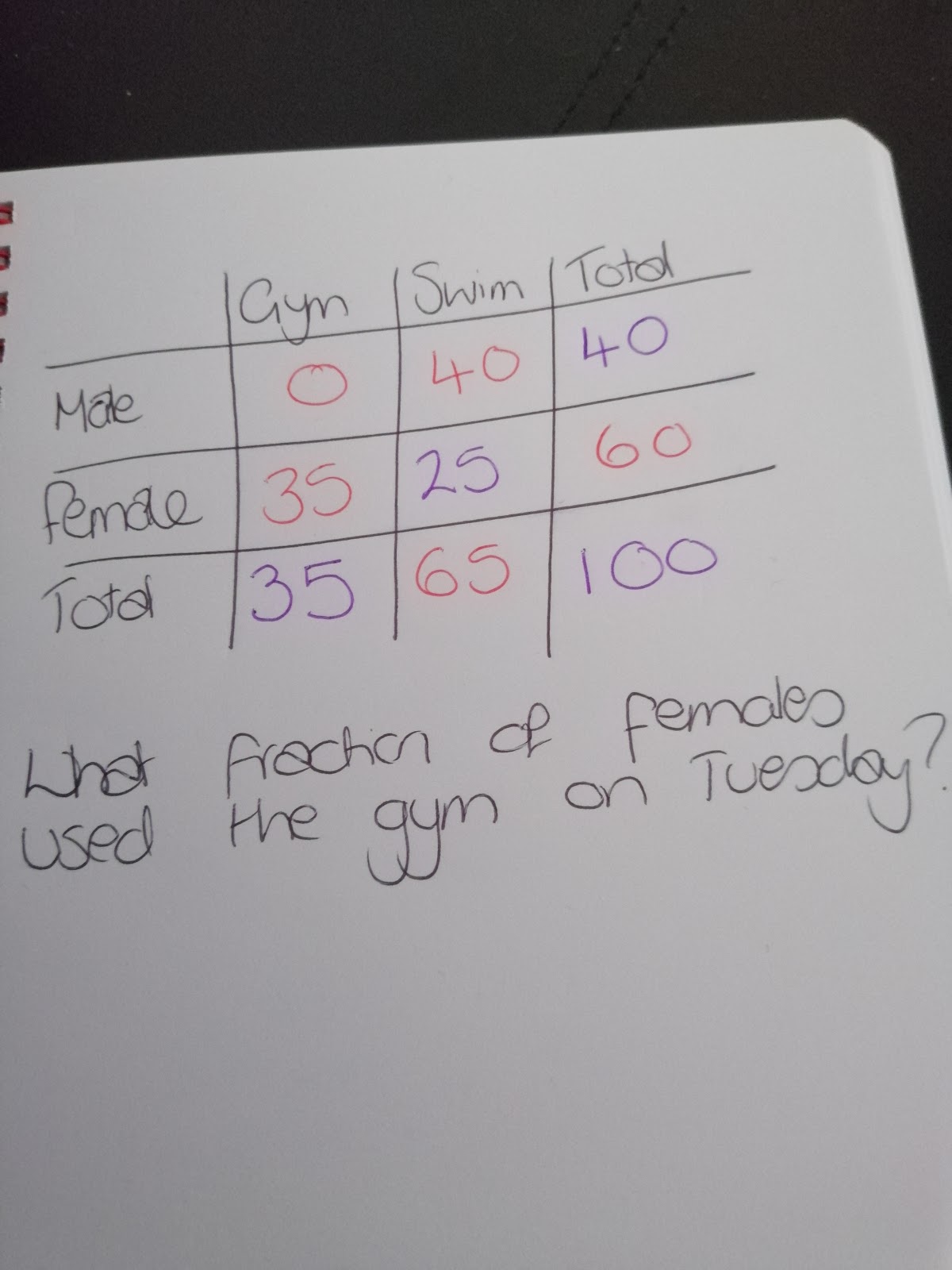
In the department I was in we began to look at other opportunities for marks for our lower sets. We looked at two way tables. We found the learners enjoyed completing the tables but struggled to pull out the final fraction. 


I began by asking my students how they would work it out. The main question I was asked is “how do you know which number you want?” This was evident in their working out. Nearly all of the students had 100 as their denominator with a variety of 35 or 60 as the numerator. Keeping things as simple as possible I used the language of the students. I trialled what you get as a fraction of what you want. So in this example we want females and we get gym females. 


This not only works for two way tables but any time a fraction from probability is required. 

What is the fraction of red marbles in the bag that has 4 green and 6 red? 6/10. You want marbles, you get red. It’s quite simple and really helped us crack the using the wrong denominator in the two way tables. 


prime factor decomposition and fractions

I inherit every possible method for teaching fractions under the sun. My learners come from every school across the city and all have their own way of doing things. Kiss and flick, kris kross, X marks the spot and so on are all ways for multiplying and dividing fractions. Like I always say, if you have a way that works consistently for you then use that way. I never unteach a method unless it is incorrect. Often methods have become incorrect because the learner has become confused with the method shown to them. In my experience students are more likely to become confused if they lack knowledge of the basics. One of the ‘wins’ I enjoy teaching is product of primes, prime numbers, simplifying fractions and divisibility checks. 


I like to start with prime factor decomposition. I like to call it this in my intentions on the board. I like to discuss the anxieties the learners have when they see the title and then experience the joy on their faces when they crack it in the end! There’s no fancy trick in what I am teaching, this one I am afraid requires singing and dancing as it is all about the presentation. I am not above making a fool of myself to help a concept stick in the learners minds. It all starts with some audience participation. I write up 2, 3, 5, 7, 11 on the board. We spend a few minutes shouting it as loud as we can. We play finish my sentence and I will call out 2, 3 and pick a learner to finish it off. Then we move onto questions of what is the third prime number? What is the fifth? We spend quality time recalling the first 5 prime numbers.


I don’t think I am doing anything out of the ordinary at this point for the learners. Everyone I have ever seen teach the topic as well has started by spending quality time on the first 5 primes. I tend to just stick to 2 3 5 7 11 for these early stages. An old favourite from my cover supervisor days on my PGCE was the 10 x 10 grid and playing in pairs to find all the primes up to 100. I will, if we have time, move onto games like this but in the first instance I stick to the first 5 primes. 


Here comes the singing and dancing…


“If you like it then you should have put on a ring on it”


Here is an example of the prime factor decomposition of 420:


We begin with writing our first 5 primes. We then use these as divisibility checks. I am aware that learners can find the highest prime factor and solve this problem quicker. I am not aiming for speed here. I am aiming for a consistently correct method. We always begin by seeing if 2 goes into the number. We keep the primes on the left as well.

I am aware that it may be obvious for some learners to use 5 as the prime when breaking down 105. I have no problem with this, actually in making these images that’s what I did and had to start again! Once we have broken the number down. I will then sing a bit of Beyonce or show an image of her on my board. (Beyonce also sits on my wall as well as Terry Pratchett!) The blue writing is purely for the example here, we verablise this in class but don’t write it.

Once we have really solidly grasped these divisibility checks, we can use them in a variety of ways. We can then look at simplifying fractions.

Yes this is a long way round but it ensures a consistent approach and reinforces the use of 2, 3, 5, 7, 11. It's a nice introduction in a stepping-stone to unpicking that initial knowledge that's needed to tackle a wide range of questions. Like I always say if you have your own with working things out please use your own way, but for those who struggle 2, 3, 5, 7 11 may just help with developing those core divisibility skills.


Multiplication

I'm sure by now you have heard me mention that I teach a lot of resitters where they may be sitting the GCSE for the second, third, fourth or however many time. I've also talked about those quick wins in those early weeks to earn their trust help them gaining confidence and to deepen their mathematical understanding. One of the easiest ways I've found to do this is through teaching students how to multiply correctly. As part of my PGCE training I was asked to teach a year 7 group a series of lessons covering every possible type of multiplication that I could find available. It led me to Egyptian, Chinese and many other types of multiplication. I became familiar with a wide variety of multiplication techniques that I had to fully understand before I could explain them.


My own knowledge needed to be sound and secure before I explained them to the attentive year 7’s hanging off my every word. There are some elements of teaching year 7 that I miss greatly! Chinese multiplication became my new favourite thing. I know only multiply this way, much to my builder and husband’s annoyance when planning our new extension! I'm sure you've seen it before the lattice method the Geloise method or simply Chinese multiplication. 


What I want to discuss here is the importance of being able to multiply correctly including decimals. Like I always say if you have a way that works for you than that's the way you do it what I'm offering you is a way if you can't do it consistently correctly. Many of my learner's come to me unable to multiply correctly they have been taught the grid method in primary school and they don't know what to do when they're lining them up for the final addition.


Take a look at this work this is typical of my students work. The grid is correct but the place value when adding is appalling. Yes, I am aware I will need to re teach place value but will these mistakes arise again after we have done that unit? What would happen if we looked at Chinese multiplication instead? 

Look at the lattice method above. Here we have the correct answer in a much simpler way. Place value is correct. This makes me happy. I like the Chinese/lattice method because it promotes place value. I like the fact that it only uses the times tables up to 9 x 9 and although we teach up to 15 x 15 often up to 9x9 is secure and above that can be a bit sketchy in my experience. 


But the real reason I like the lattice method is because of the power it has to unlock learning for many resitters. I say to all my trainee teachers and staff that I mentor. Teach someone to multiply correctly and they will be set for life. It is true, multiplication is one of those skills people have had negative experiences with and switch off. To be able to show someone how to multiply correctly can sometimes be transforming. A colleague (not a student or a teacher) was trying to multiply the number of tickets and the cost of tickets to budget for the cost of a conference for her team. She was struggling. I showed her lattice multiplication ( I drew the grid) she loved it. She was so overwhelmed she began to tear up. Maths, multiplying decimals in particular, had always been a struggle for her but she felt that it wasn’t anymore. That is the power of being able to multiply correctly. Lattice may not be the best way for everyone but I think it is worth spending the time to teach learners how to multiply correctly, including with decimals, to provide the skills that are needed for life, not just GCSE.


SLED exam technique

I have mentioned before the challenge of answering A03 questions and some strategies I employ. A03 style questions are when our students are required to make connections interpret results and evaluate solutions. The easiest way I remember it and explain to student teachers is it's those questions that are open ended and they could go many different routes to find the answer generally with a full blank page underneath. I am forever looking for current relevant research that can be easily applied to my maths lessons. Last year while studying a course on a MOOC for the Friday Institute about learning differences I came across something that may help. Yes I can't quite see how course on learning differences lead me to this, but it did, and I am grateful! It just goes to show you should read as wide as possible because you never know what it will turn up. One of the things that came out of one of the pieces of reading for this course was SLED. 

sketch 

label 

explain 

discuss

It got me thinking about these complex a03 style questions where we could easily sketch a picture of what the answer might look like, the painting of the floor plan or the number of marbles in a bag whatever the question maybe about. 


We can label underline key parts of the question. Now instead of explain I switch this to estimate. This was to relieve the pressure of the learners to immediately hit upon the right answer. They are allowed to roughly approximate first. Generally they are correct but with the pressure being off it really improved their confidence in giving these types of questions a go. So the learners could estimate how many tubs of paint how many marbles in a bag and then we could discuss our answers with our peers and then choose the correct strategy for solving the question. The power in relieving the pressure in making it an estimate was immediately evident with my groups. Learners openly admitted that previously they would have skipped this type of question but were now willing to give it a go. We now had a strategy where we could pose, pause, pounce and bounce! We could now have those meaningful discussion that deepen understanding that I keep seeing in other subjects lessons! 


This is a rough example of a simple A03 question using SLED:


Being brave I asked my learner's to SLED an A03 question before the lesson. We then discussed on tables and then as a class different approaches to the same problem. Again I believe powerful learning takes place where misconceptions or different approaches to the same problem can be explored. It was an instant hit with my learners. We then began thinking about how they could adopt this in an exam. We changed discuss to DECIDE for exam situations. This is when after you have estimated, you may have created 2 or 3 different options you must decide on the correct working out and clearly state that as your answer. I like to remind students at this point that multiple workings out will attract lowest marks available and remember each question is a new opportunity to leave an impression on an examiner. 


Here is the same ratio SLED problem with the decide element added, the original working has been left in for this examples purpose but would normally be crossed out:


I like this approach as it gives confidence to tackling complex A03 problems. It provides a crutch for learners to hold on to. It promotes discussion in maths lessons, it’s not always right or wrong! It promotes deeper understanding by looking at common errors and misconceptions. One mature learner, I won’t say her age, said that this strategy gave her the confidence at work to plan her response to requests and improved her stress levels, so it worked outside the maths classroom too!


Challenge for all2

As I said in the previous post the 'challenge for all' really changed my teaching from stretching the more able to challenging everyone and not by giving them more activities to do. Dylan Wiliam is just a treasure trove of hints and tips every time he writes or speaks. In one piece I read (the full article is here) he talks about activating students as instructional resources for one another. In its simplest terms he talks about before a piece of work is handed in a peer marks it and signs to say they have done so. If there are any remedial actions needed the peer must let the learner know, as if there’s anything missing when the teacher marks the work it is the peer that is responsible not the original learner. I liked this as I could easily see this in maths working well. You could give some learners a mark sheet to help them and for others you could ask them to do it without. Everyone could be involved. I was then browsing the brilliant trythisteaching and came across this Doctor’s Diagnosis It takes Wiliam’s idea and asks learners to prescribe remedial work to the originator. 


I took some prescriptions from the trythisteaching templates into my lesson. We were looking at sequences. 

Ben has completed the task. Stacey has marked his work and corrected his error. What I like about this is the level of differentiation available. Depending on my instruction Stacey could have just asked Ben to look again at part B, she could indicate the date we looked at the topic, or she could research a resource online that would help Ben and share that with him. I also like that they don’t need to be in the same class. Stacey is from group B and Ben group A, same set just opposite timetable. The possibilities of this are endless. You could do it verbally in class. However, when I tried this all I heard was “good try” “you did this bit great”. I found that when students had to put their comments in writing they became more focussed in their feedback. I find that many great teaching and feedback ideas are tricky to fit with maths as a subject but this one worked for me!


I am known when mentoring to say “if it isn’t in the plan it won’t happen” I am not pushing lesson plans, please don’t mistake me! What I mean is, whatever you use to plan, make sure all your activities and episodes are planned. For example, for progress checks against the learning intentions I encourage student teachers to have a slide in their presentation to ensure that they happen. (It’s not just student teachers that need reminding of this, I am more than aware!) I needed to ensure that I remembered to include a 'challenge for all' element in my lessons. As I have an open door policy for all staff, and especially mentees, I always need to be on point. I like doing one thing once and doing it well so that it is always the same level of planning from me. I found that whilst creating all these 'challenge for all' activities I found that some worked and some didn’t. So I hit upon a choice board. I created a Padlet of my 'challenge for all' activities. If you are unfamiliar with Padlet, it can be used as a virtual noticeboard with ideas pinned to it. If you are out of free usage of Padlet there are alternatives, try Linoit. My padlet looks like this:


I loved Fighting Talk on BBC Radio Five Live when I was younger. It was part of my pre match routine. The game ends with defend the indefensible. Two players were given opposing sides of a statement to defend. The statement was purposely controversial or opposing to the participant views. For example, one participant was asked to defend the statement that his wife’s cooking was terrible. He refused to engage! I have found that this format plays great in maths lessons. 


Imagine we are looking at solving equations x^2 = 36


Ben is asked to defend that x=6

Stacey is asked to defend that x=18


What I like about this is that both need to calculate the correct answer. Stacey needs to identify where the misconception has come from in order to defend it. I am a big fan of learners knowing the common misconceptions in order to avoid them. All to often in maths I see the power of 2 mis-interpreted as multiplying by 2! 


I found that defend the indefensible worked in many lessons and I could generally think of them on the spot! Any time solving or rearranging with algebra was involved I would challenge the whole class with defend the indefensible. We would do it as 2 teams against each other or lots of small pairs debating to the class. I found it a nice way to promote respect and listening along with developing debate and argument forming skills.


Spot my error and tick or trash were brought to my attention via TES. Spot my error came from the fabulous alutwyche https://www.tes.com/teaching-resources/shop/alutwyche  (he is also on Twitter https://twitter.com/andylutwyche) and tick or trash I originally found on the old but brilliant Number Loving from Laura Rees Hughes A lot of the Number loving resources are now to pay for on TES. Tick or trash has a question in the middle and to the left and right are two answers, one is correct, to be ticked, and one is incorrect, to be trashed.


The spot my error tasks from alutwyche are quite comprehensive. I have enjoyed adapting this idea. I will present and incorrectly answered question on the board and ask the learners to spot my error. This also helps with the inevitable board work mistakes I make daily as it gives me a great cover story! The spot my error from alutwyche and my own ones all focus on displaying a common misconception. Again if learners know the common misconception and can realise where it comes from they can avoid it. Both STEM and NCETM have resources and evidence explaining the common misconceptions in maths. You can find them here and here. The NCTEM also has a great paper on inspection worthy mistakes made by students here. It makes a great read. Broadly it suggests that “Conducting appropriate class inspections of mistakes in student work can create pedagogically powerful moments in the classroom.” One of the most powerful types of mistake to investigate, the article says, are those that approach the problem from a different way that the broad solutions from the class, as if the problem had been interpreted differently. This is my aim when I create either defend the indefensible, spot my error or tick or trash activities. How could the problem be interpreted and how different will the answer be?


My final activity in challenge for all is to create cheat sheets. I was shown these by my mentor in my NQT year and they have been with me every since. Do you remember the old, make a poster lesson? I hated them in school as I would rather be at home watching MTV Select than in school making posters! As a teacher I also dislike them as really, what are the learners learning apart from how to use fineliners of contrasting colours to make 3D lettering? A cheat sheet is like a poster but different! Have you ever had this... You ask the learners after a lesson, how much of this are you going to remember? Queue awkward faces and panic! It happens multiple times a day to me! A cheat sheet gives the learners a way out of this. You ask learners to imagine that they have 2 minutes before the exam and their present self wants to tell their future self all about this topic and they need to make a cheat sheet to record it. I normally model one as an example. I follow a thought or spider diagram. I encourage the learners to make it personal to them. A specific error they made in class they may want to clarify or they may want to emphasise a specific stage of the process. 


This rough example (apologies!) is personal to the learner. They are clearly wanting to remember interior means inside the shape angles. They are also keen to remember it’s angles around a point rather than in a circle! With my adult learners, evening class learners specifically, we do this weekly as they worry they won’t be able to remember it. I don’t blame them, maths is hard, many are working and raising families as well as coming to maths. We end up with a bank of 20 or so personalised cheat sheets. The learners then have a revision guide ready to go when exam day comes.


I am now pleased with where I have got to with my 'challenge for all'. There is challenge for all available in every learning episode via my padlet or prepared activities (if I remember!) It has been powerful in helping me develop skills to enable understanding rather than offering more tasks for my learners to complete. My learners were initially sceptical but embrace the challenge now and enjoy unpicking where the incorrect answers have come from.


Challenge for all

You know the feeling when you return in September, feeling prepared, lessons ready, imagining your groups, beautiful 5 minute lesson plans for the first 12 weeks that took an hour each all ready….smug! Then day 1 you are hit with...right so today we thought we could spend some time planning the first few weeks of term given our new lesson plan and scheme of work structure….Argh!!!! It’s all changed! Into the bin goes your summer work and rapidly you pray to get through at least the first 4 weeks worth of work in a day. No idea what I am on about, then you are very fortunate as this happens to me every year! Thankfully every year’s change or tweak to the lesson plans or schemes of work are positive and eventually I am pleased they have changed but those first few weeks are gruelling!


A few years ago I was introduced to the 'challenge for all'. (Cue images of Tower of Terror ride at Disneyland and the Twilight zone music!) As part of the team responsible for coaching and mentoring staff to meet standards it was quite complex to get across to staff what the 'challenge for all' is. I can take no credit it was all the work of my amazing teaching and learning colleagues but I am more than happy to share it!


To be clear, this is not stretch and challenge in the sense that you plan for the HATs (oldie but a goodie term!) top end of the group some extension activities. There is an element of that but it is actually about challenging all learners no matter where they sit in your group. What often comes up as good ideas for challenging all are, design a tweet, create a mnemonic, promote a discussion with deeper probing questions. Some of these techniques are useful and appropriate to maths lessons but often they are not. Discussions and opinions about who is right and wrong are very limited in their applicability in maths in my opinion. 


Imagine we are teaching expanding brackets, something like 2(x+5). 

Traditionally to stretch and challenge the high attainers we might ask them to move onto expanding double brackets, for example (x+5) (x+3). This stretches their skills to a new level. However it can be argued that they are actually learning a new skill in moving on to double brackets. In my experience of doing this, more teacher input is required meaning that the learner isn’t being stretched but that the teacher is guiding them to the next activity. Yes you can set them off with scaffolded worksheets to relieve this but I always have Dylan Wiliam ringing in my ears at this point. Wiliam (on the amazing Mr Barton Maths Blog) talks about a hysteria of a few years ago which came from observations where teachers, observers and OFSTED all wanted to see more activities to evidence the learning. Thankfully this is less so now, we recognise it’s not the busyness of the learner it’s the engagement that tells us if learning is taking place. This is why I like the 'challenge for all' element. It’s not about keeping them busy with the next thing, it’s not about more teacher input, it’s about deepening the learners understanding of the topic covered in that lesson.


So let’s return to our expanding brackets of 2(x+5). We could ask learners to create a tweet, a diagram of the stages or a cheat sheet (see next blog). However, if we could apply their knowledge to new concept we could evidence a deeper understanding. Asking them to move onto double brackets wouldn’t necessarily achieve this. We could take expanding brackets to solving a worded problem, an AO3 style question.  We could ask the learners how old Millie is if Billie is 5 years older than Ellie and Millie is twice as old as Billie.  For the lower attainers we could form the expressions as Billie is (x+5) and Millie then is 2(x+5). For the middle attainers we could give them the problem without the expressions. For the high attainers we could ask them how old Millie is if Billie is 12 and they could solve the expressions. We could ask all of them the age difference between the oldest and youngest and see if they can work this out algebraically rather than by solving. This got me thinking, would this work with any AO3 style question? Could we give a 'challenge for all' opportunity for all just by looking at the AO3 style problems. 


I am a big fan of doing something well once and it will save you time in the long run. I created a lucky dip box and cut up AO3 questions and put them in the box. The 'challenge for all' then became about learners applying their knowledge to an AO3 style question. It started off as random and they could pick a number AO3 question out and we had been learning data but it worked as a nice retrieval element as well. Reflecting on this,  I created an algebra AO3 lucky dip, a shape AO3, a number one, data and finally the really tricky crossover problems box lucky dip. Depending on the topic would depend on which lucky dip box we used. The beauty of this was high attainers could pull their own AO3 out. Mid and low attainers we could work on as groups and collaboratively solve. 


As with anything once it becomes routine it is expected. Learners would race through activities to get to the lucky dip. There was a leader board of who answered which question quickest. We would discuss if one question was harder than the other, and if so why. Given that we think one is harder than the other, should they be worth the same amount of points for the leaderboard. This then got learners thinking about the design on the question. One healthcare student said “the maths isn’t any harder in that one it’s just spotting what it’s asking” I think if we are aiming for learners to deepen their knowledge that quote sums it up beautifully. If learners know why they are doing something and can explain what the aim of the task is they have begun to understand the topic. We will cover understanding another time….


Retrieval Practice

I love to read, and I read widely around education, teaching. Maths, anything that interests me. However, no matter how much I love to read the amount of time I am able to spend reading is significantly less than I would like it to be. Prior to my current position, unfortunately the only real time I devoted to reading was when there was an urgent need. I was preparing for interview for my previous position I was trying to find some research that was relevant to what I was discussing in my presentation. 


I know this is the wrong way round to do things the research should have informed what I was doing beforehand but we were where we were and the interview was in 2 days. I am pleased that I now allocate myself coffee and reading time once a week to keep up with the latest blogs and developments. I love my coffee and reading time and it is sacred, I need it to be so. That doesn’t mean that if work is busy and I don’t get time to read at work I will make time to sit at home with a coffee and read, point is I read weekly! Whilst preparing for my  interview I came across retrieval practice. Retrieval practice had nothing to do with what I was presenting in interview but it instantly sparked my interest. 


I ended up spending all my interview talking about retrieval practice and openly admitted that I haven't used it yet because I just found it but since I got the job and have begun using retrieval practice. I am not an expert but am happy to signpost you to the experts here: https://www.retrievalpractice.org/

Retrieval practice works on the basis that if you regularly retrieve small bits of information you will deepen your understanding. It was really nice to finally find something that was current, relevant to my teaching and unusually appropriate to a maths lesson. Too many times as a maths teacher I have felt left behind. Whilst other subjects make huge strides in questioning and feedback I find myself trying my hardest to make it work in maths but most of the time answers are right or wrong. The guys at https://www.retrievalpractice.org/ shared a retrieval practice grid where the topics that have been covered previously were colour-coded by how far in the past they had been. This was easily replicated into my lessons and it looks a little bit like this. 


Share £60 in the ratio 7:5

Find the nth term of this sequence:

32, 26, 20, 14, 8

Simplify:

f + f -f +2f -2f + e

Multiply:


5.4 x 3.2

What is the 100th term of the sequence 5n-6?

Tickets cost £3.50, we need 18 tickets in total. 

Calculate the total cost.

Share £125 in the ratio 18:7

Simplify:

d x d x d

Simplify:

2k - 3g + 5g + 4k

The next term in a sequence is 15. The start number is 9. What is the nth term rule?

Multiply: 

2.5 x 1.2

Aliaa and Steve share £45 in the ratio 5:4. How much do they each get?

Multiply:

4.4 x 3.2

Gray and Teag share some money in the ratio 2:3. Teag gets £45. How much was the total amount shared?

Simplify:

e x j x j x e x e

Is the term 54 in the sequence 6n-6?


Red is 4 lessons ago, orange is 3 lessons ago, green is 2 lessons ago and blue is last lesson. This replaced my bellwork. Students arrive and these are on their desks already they sit down and begin working through the grid. Every lesson I would change the questions and colours. It really wasn’t an onerous task. The aim of it being a little reminder a little refresher and in total would take less than 5 minutes to go through the board. So I would give the learner's 5 minutes to come in and do it and then 5 minutes to run through at the board I felt that it was worth the sacrifice in my lesson time but I appreciate not everyone has 90 minute lessons like we have. (We only have 1 90 minute lesson a week though!)


My adult resit learners would sit and discuss the questions. You would overhear questions about when to use ADAM or DINO. I would spend the 5 minutes catching up with any absentees from the previous week or any messages that I needed to pass on to my learners. The next time when I would look up the powerful maths discussions that were taking place were jaw dropping. The collaboration and cooperation of learners in reminding and refreshing each other with how to answer the questions was lovely to see. Age gaps disappeared and mature adult learners were working at the same pace and stage collaboratively with teenage adult learners. Over time our little routine expanded into each table being responsible for sharing the answers rather than me standing at the board. My application of the grids also evolved in that the red section became a place for poorly answered topics to be repeated and recovered. For example nth term would be in the red section for one class for a few weeks whereas for another class it was factorising. Using these grids I was able to personalise the retrieval practice that each group needed.


Having taught resit groups for a number of years the impact in my results was significant. The topics that have been regularly and consistently answered correctly on my retrieval practice grids were regularly and consistently answered correctly in my mock exam papers. It was evident that those 5 minutes made all the difference in keeping topics ticking over. When we came to the actual exam one learner asked me for a copy of all the previous retrieval practice grids to revise from. This was a Eureka moment. Thanks to Google Docs I had a bank of sheets that I could print off and issue meaning we had instant revision packs ready to go! Google docs is brilliant for this because it has version history allowing you to revert to previous versions. If you would like to know more about Google docs I will talk about this at a later date. 


Not only did retrieval practice improve my in class testing, it helped create an empowering collaborative working environment which was an outcome I wasn’t expecting. It also enabled me to have a class specific time relevant revision pack for learners appropriate to their stage and ability. I am a big fan of curating revision collections for my learners based on the topics and how well they have done in them. Retrieval practice did this for me! 


Why do we count in 4s?

 Why do we count in 4s in England? As a former maths teacher who chose to work in #FEmaths I think we may need to look at assessment at age ...